
260 Dead Dolphins Scattered on Shoreline of Peru, Just Days After Mysterious U.S. Incident [video included]
By Heather Callaghan
Activist Post
February 13, 2012
Just days after news surfaced about the dead dolphins washing up on the Cape Cod shore, over 260 dolphins were found dead off the Chiclayo shore of Peru. Dolphins were scattered on 66-miles of shoreline north of Lima.
Unlike the Cape Cod incident, where dolphins continue to beach themselves requiring rescue, the Peru dolphins appeared to be already dead. The cause is a complete mystery.
Some officials are speculating that the dolphins are being hunted; the dolphins are not even known to be in the surrounding seas of that area. According to local fisherman, it is extremely rare to see a dolphin near the shallow waters or washed up on shore.
The only markings on the dolphins are from the locals unwisely carving them up for meat. If the dolphins were whole aside from the locals, then for what reason would they be hunted? If they had been hunted far, far out into the ocean, would that explain how over 260 landed ashore?
The only other speculation is poisoning from possibly eating contaminated anchovies that also appeared dead upon the shore. The anchovies were thought to have consumed bad plankton. This still does not explain why dolphins were in the area. It is unclear whether they died first and washed up, or swam too close and beached themselves.
In the last article about the Cape Cod incident, I posted a couple of maps for curiosity’s sake. The first was a map of possible HAARP locations, and the second was Google’s pinpoints of mass animal deaths as of January, 2011. The first map lists a HAARP location right in Peru.
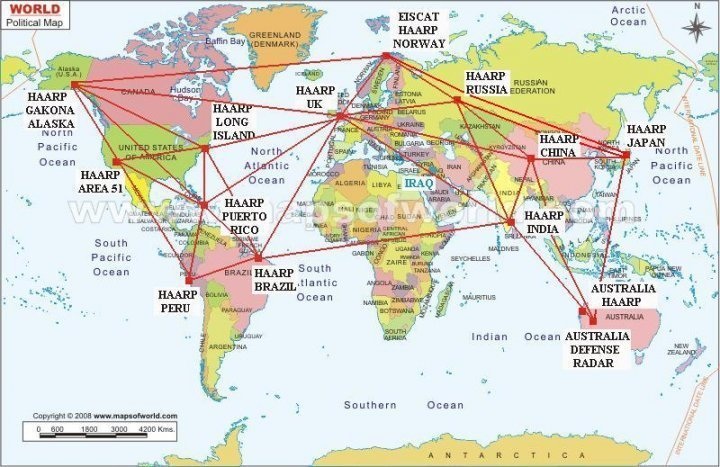
Possible HAARP locations around the world, Jan 8, 2011

Google’s recorded mass animal deaths as of Jan 5, 2011
The Peruvian Sea Institute is currently studying samples to research the mysterious deaths.
Sources:
http://www.theblaze.com/stories/why-are-hundreds-of-dolphins-dead-on-peruvian-beaches/
http://www.guardian.co.uk/world/video/2012/feb/10/dolphin-deaths-peru-video?newsfeed=true
http://www.care2.com/causes/over-260-dead-dolphins-wash-up-in-peru.html
Read other articles by Heather Callaghan here.
—————————-
[hat tip: Pakalert Press]
DARPA Set to Drop Computer “F-Bombs” to Spy on Public
 By Nicholas West
It’s bad enough that drones have been welcomed by Congress into American skies, as well as already being used around the planet to conduct surveillance and bomb select countries from remote locations.
The latest proposed addition to the drone spy program is even creepier: disposable computers with software programs funded by DARPA to be dropped as self-destructing “bombs.”
Now, not only will drones surveil and hack from above, but they will drop a payload to interface with hidden computers on the ground, completely integrating a full-spectrum data transmission and control grid.
The name of the project, as well as its announcement at a hacker convention called ShmooCon, had this non-techie convinced that it had to be satire or a hoax, but the project has also been noted by Forbes and Wired, which only serves to illustrate how far off into our dystopian technocratic police state we have wandered. It seems that we are being acclimated to how funny and cool our futuristic spy toys have become. This fun has culminated in the planned dropping of F-BOMBS (Falling or Ballistically-launched Object that Makes Backdoors) to combat “Bad Men With Guns.”
The F-BOMB introduces the idea of disposable surveillance as a guard against forensic evaluation and the ability to track the source of the drop. Creator, Brendan O’Connor, has received DARPA funding to implement a software package into his nearly non-traceable surveillance hardware as cheaply as possible with easy-to-obtain components.
Back in August, another DIY project was introduced as the Wireless Aerial Surveillance Platform (since renamed Project Vespid). This modified military drone was put together from parts legally obtained on the Internet by two hackers (intelligence agency consultants, actually) Rich Perkins and Mike Tassey, who presented their work at a Black Hat conference. The release was supported by a breathless Wolf Blitzer who seized upon the announcement to illustrate the new threat of being hacked from above. Brendan O’Connor has reduced the DIY cost of similar capabilities to no more than a few hundred dollars with his F-BOMB project.
O’Connor summarizes the value and capabilities of his new Sacrificial Computing for Land and Sky concept in the video that follows, highlighting that his surveillance tool can be planted manually, or dropped from specialized drone aircraft:
Similar to the creators of the home-made WASP hacking drone, O’Connor states that he is merely exposing the vulnerabilities of networks and their users.
Despite its name, O’Connor says the F-BOMB is designed to be a platform for all sorts of applications on its Linux operating system. Outfit it with temperature or humidity sensors, for instance, and it can be used for meteorological research or other innocent data-collecting. But install some Wifi-cracking software or add a $15 GPS module, and it can snoop on data networks or track a target’s location, O’Connor adds. As is often the case with these kinds of hacker projects, he says the devices are only intended for penetration testing–finding security flaws in clients’ networks in order to fix them–and wouldn’t comment on what DARPA might do with the technology (Source)
However, this rings false (or profoundly naive), as O’Connor also has received his funding from the very organization that is at the forefront of using taxpayer money to eradicate privacy around the world, including that of American citizens. As a result, the government already can:
- Hack your personal information (source)
- Monitor your private phone calls (source)
- Read your private e-mails (source)
- Spoof cell phone towers (source)
- Break down firewalls (source)
- Jam cellular frequencies causing denial of service (source)
- Disrupt and manipulate Wi-Fi signals (source)
- Track your every move (source)
Although O’Connor said that he wouldn’t comment on what DARPA might do with the technology, his own business website Malice Afterthought indicates a solid working relationship with military intelligence:
Our principal, Brendan O’Connor, has taught at the US military’s cybersecurity school as well as working for both VeriSign and Sun Microsystems in their security divisions; he has also worked for DARPA and startups as a combination engineer, dreamer, and mad scientist capable of making even the most challenging tasks into reality.
We should all know by now that we don’t have to be technology experts to envision some rather dark applications that are no longer security challenges, but are part of an agenda to fundamentally alter our reality and perceived social contract within a supposedly free society. That reality has little to do with protecting citizens’ data and privacy, and everything to do with covering the tracks of government’s ubiquitous intrusion into our private lives, as well as ramping-up their violation of the Constitution by presuming guilt over innocence, and subjecting citizens to their mad science and mad dreams.
Additional sources:
http://singularityhub.com/2012/02/03/hold-dropping-the-f-bomb-a-disposable-spy-computer…
http://www.wired.com/geekdad/2012/01/f-bomb-shmoocon/
RELATED ACTIVIST POST ARTICLE:
How Close Are We to a Nano-based Surveillance State?
Please help us combat censorship: vote for this story on Reddit: http://www.reddit.com/r/conspiracy/comments/pn3wb/darpa_set_to_drop_computer_fbombs_to_spy_on_public/
Read other articles by Nicholas West here.
Pissed off!!! [geo-engineering video from Phoenix]
YouTube – dvmcgovern
February 1, 2012
Ok people, I had to post this because I am so mad and disgusted at what is being done to us. I cannot fathom the level of malevolence that it takes to perpetrate this upon the people of the Earth. The is Satan’s work pure and simple. The Father said that unless He shortened the time of evil that all life would perish. I can tell you a lot of people are perishing because of this evil. It will only get worse. Trust me.
[hat tip: Michael Edwards from Activist Post]
How Close Are We to a Nano-based Surveillance State? [video included]

click on image for source
By Michael Edwards
Activist Post
February 11, 2011
In the span of just three years, we have seen drone surveillance become openly operational on American soil.
In 2007, Texas reporters first filmed a predator drone test being conducted by the local police department in tandem with Homeland Security. And in 2009, it was revealed that an operation was underway to use predator drones inland over major cities, far from “border control” functions. This year it has been announced that not only will drone operations fly over the Mexican border, but the United States and Canada are partnering to cover 900 miles of the northern border as well.
Now that the precedent has been set to employ drones over non-combat areas, the military is further revealing the technology of miniaturization that they currently have at their disposal. As drone expert, P.W. Singer said, “At this point, it doesn’t really matter if you are against the technology, because it’s coming.” According to Singer, “The miniaturization of drones is where it really gets interesting. You can use these things anywhere, put them anyplace, and the target will never even know they’re being watched.”
So what exactly is on the horizon?
The Defense Advanced Research Projects Agency (DARPA) funds military tech development through the private sector with defense contractors such as Lockheed Martin, Boeing, and Honeywell. It was Honeywell that introduced the T-Hawk micro drone — now purchased by Miami-Dade county for use in the metro area — which weighs all of 16 pounds and can fly in any direction. However, this is not so “micro” compared to the latest spy drone to be revealed: the Nano Hummingbird, produced by AeroVironment. The video below illustrates the capabilities of this 19g vehicle:
This mimicking of nature heralds a range of science fiction nightmare scenarios, but the name of this vehicle, “nano”, is what should spark a red alert. Because, in fact, DARPA and their contractors are working on true nano surveillance that will have biological components . . . and applications.
Here are some surveillance and detection concepts already in operation, or under development (keeping in mind that what is revealed in the public domain is often quite far behind the reality):
- A group of smaller surveillance drones called NAV (nano air vehicles) or MAV (micro air vehicles) already have been commissioned: mapleseed drones; sparrow drones by 2015, dragonfly drones to fly in swarms by 2030, and eventually a housefly drone. And if the reconstruction of nature doesn’t pan out, nature itself can be hijacked using electrical impulses to create cyborg surveillance insects being studied at major universities.
- Nano sensors for use in agriculture that measure crops and environmental conditions.
- Bomb-sniffing plants using rewired DNA to detect explosives and biological agents.
- “Smart Dust” motes that wirelessly transmit data on temperature, light, and movement (this can also be used in currency to track cash).
- Nano-based RFID barcodes that can be embedded into any material for tracking of all products . . . and people.
- Devices to detect molecules, enzymes, proteins and genetic markers — opening up the door for race-specific bioweapons, as mentioned in the Project For a New American Century’s policy paper Rebuilding America’s Defenses.
There are countless ways that we are already tracked in our daily lives, which has acclimatized us to the next steps underway. We know that the military has a desire to track large groups of people in real time. The Gorgon Stare program is currently undergoing some operational difficulties, but the political will is there to continuously expand surveillance of large populations abroad in order to keep us safe at home in the never-ending War on Terror. Combine miniaturized surveillance capabilities with DARPA’s Mind’s Eye program of “smart camera” artificial intelligence that can “think” and make visual reporting decisions independently, and things become exponentially creepier.
The Speed of Nanotech Development
Nanotech has been receiving official federal funding for only the past 10 years when it was raised to the status of a federal initiative in 2001, which sparked massive investment in the private sector. By 2003, the newly opened Department of Homeland Security showed immediate interest in SensorNet, a program spearheaded by Oak Ridge National Laboratory and their strategic partners to research ways to fully integrate nano and micro sensors into one overall Internet-like matrix of real-time detection and surveillance. The Department of Defense allocated $3 million to the initiative for the first year, with a projected budget into the billions being allocated over the long term for “detection systems.”

Strategically mounted sensors and a communications network are the heart of SensorNet. (click on image for source)
By 2006, Oak Ridge announced that they planned to turn Fort Bragg military base into a prototype for America’s future cities. According to Department of Energy researcher, Bryan Gorman, “Any sensor can talk to any application. Just like with the Internet or with telephone systems, it doesn’t matter what kind of computer or telephone you have, where you are or what application you’re running. The system just works.” There is even a proprietary social network that has been designed to provide online access and collaboration.
SensorNet has since morphed into an even more comprehensive system “to integrate safety and security measures . . . into the transportation system,” which includes concerns surrounding transportation and commerce in the “political, economic, or environmental” arenas. It is here that the full scope of surveillance integration can be seen as a management strategy that merges legislation, federal inspection systems, international standards, security threat assessments, and the latest in nanotechnology. Just one example is their discussion of “highway sorting” systems and screening, which begins on page 15 in the previous link; it must be read to be believed. As an aside: the Senior Research Scientist and Senior Program Manager who co-authored the paper linked above is Robert K. Abercrombie, Ph.D. who has a decided interest in cybersecurity. To see where the transportation component of the surveillance grid is heading over the near term, the ITS Strategic Research Plan 2010-2014 is a good indication.
The Promise of Total Integration
February 4, 2011 brought the release of the National Nanotechnology Initiative 2011 Strategic Plan. This 60-page must-read document lays out a projected future “to understand and control matter” for the management of every facet of human life within the surveillance matrix of environment, health and safety. Here is the short-list of the 25 participating Federal agencies and samples of their stated applications:
- Department of Defense (persistent surveillance)
- Intelligence Community (unmanned aircraft)
- Department of Energy (solving energy and climate change challenges)
- Department of Homeland Security (low-cost sensor platforms)
- Department of Justice (applicable to criminal justice needs)
- Department of Transportation (modifying or coordinating travel behavior)
- Environmental Protection Agency (environmental sensing, transformational capabilities)
- Food and Drug Administration (biological systems and effects on human health)
- National Institute of Food and Agriculture (global food security)
- National Institutes of Health (precise control to achieve predictable outcomes)
- Department of the Treasury (improved governance, implementing economic sanctions)
- National Science Foundation (education and societal dimensions)
The promise of integrating technology in a way that will benefit human knowledge and society already has been re-directed toward military applications for decades. It has manifested in the out-of-control military-industrial complex that has engaged America abroad in costly wars and destabilization campaigns. However, the fallout from this misappropriation of technology is beginning to take its toll on America in the form of militarized police and the monitoring of everyday Americans.
How much longer before the full spectrum of military sci-tech, including what we cannot even see, is unleashed upon an American people willing to accept total control to be safe? Has it happened already? Or, more importantly, how long before Americans come to the realization that when the construction of this surveillance prison has been completed — when the door is locked, and the key thrown away — it ultimately will have been our own money that was used to build it.
Additional sources for this article:
Little Brother is Watching You: The future of surveillance is small, very small
On Race-Targetable Biological Weaponry
It’s a Bird, It’s a Spy, It’s Both
The plan for smaller, faster, deadlier UAVs
RELATED ARTICLES:
DNA “Genetic Patdown” Introduced to Airports by DHS
Is Military Spending Saving or Enslaving?
Police and Military Working Together to Oppress Americans
CrossTalk: Syrian Series [video]
Russia Today
February 10, 2012
Why is the Arab League so concerned about the protests in Syria? How far will the Turks go? Should the international community help the rebels, and what options does it have? Is there any way to stop violence in the country without turning it into a new Libya or Iraq? CrossTalking with James Carafano, Nick Ottens and James Morris.
CT on FB: http://www.facebook.com/crosstalkrulez
Good Guns, Bad Guns? US Arms in Reach of Syria Rebels [video]
Russia Today
February 10, 2012
The US is setting up an international coalition aimed at supporting rebels in their struggle. The so-called “Friends of Democratic Syria” will involve countries willing to prop up the opposition, and pile more pressure on the regime. Direct military action is ruled out, but reports suggest British and Qatari special forces are already in the conflict zone. And while the US and its allies criticize Russia for supplying military hardware to Damascus, there are now calls from American lawmakers to arm the opposition. As RT’s Marina Portnaya reports, the region’s already been flooded with firepower made in the USA.
RT on Twitter http://twitter.com/RT_com
RT on Facebook http://www.facebook.com/RTnews
[hat tip: Activist Post]
Death and Diplomacy: Homs on the brink [video]
Russia Today
February 8, 2012
The Syrian opposition say the city of Homs has come under the heaviest attack yet in days of intensive fighting between armed goups and government forces. Activists say hundreds of people have been killed by army shelling since Friday, the government denies the assault. Local journalist, Diana Nemeh, says reports from Homs are difficult to verify.
RT on Twitter http://twitter.com/RT_com
RT on Facebook http://www.facebook.com/RTnews


