The United States has sent F-22 stealth fighter jets, to participate in ongoing military drills with South Korea. Pyongyang earlier said it was in a ‘state of war’ with the South following the latest round of sanctions over its nuclear test two months ago. In turn Seoul warned that its ready to carry out a pre-emptive strike on its neighbour, in case of imminent attack. James Corbett, host of the Corbett Report – believes that the U.S. is playing a dangerous game by trying to benefit financially from the tension which could spill over at any moment.
RT (Russia Today) is a global news network broadcasting from Moscow and Washington studios. RT is the first news channel to break the 500 million YouTube views benchmark.
Ex- CNN Reporter: I Received Orders to Manipulate News to Demonize Syria and Iran
PRAGUE, (SANA)- Ex-CNN reporter Amber Lyon revealed that during her work for the channel she received orders to send false news and exclude some others which the US administration did not favor with the aim to create a public opinion in favor of launching an aggression on Iran and Syria.
Longtime independent researcher of Aerosol Spray Operations aka Chemtrails, and Founder of the Carnicom Institute, Clifford Carnicom offers his research and gives basic information on an underlying organism or pathogen of the so-called “Morgellons Condition” that may be present in almost everyone’s blood. A sub-micron bacteria-archaea-like organism appears to underlie the existence of the so-called “Morgellons” condition. There are five segments, as indicated and dated 07/07/11.
The focus of Clifford’s study remains on the influence of the organism internal to the body vs. external manifestations. The Carnicom Institute (CI) is a not for profit corporation educational and research organization, that was further introduced and discussed about for our Transitions Radio Magazine (TRM) audience in January 2013, featuring CI founder, Clifford Carnicom, and Research Associate, Doctor Jim McClure, with a relevant update on Morgellons and the CI mission. There are also four more recent segments, dated 01/14/13 now available
NICOSIA – In approximately three weeks time, the island of Cyprus will begin receiving its annual cash injection – from holiday tourism. That’s what’s known as a ‘good injection’.
After only a day here, it’s become very clear that the people of Cyprus are concerned, some even scared – about a financial contagion and shock treatment which threatens their future prosperity.
Soon, they will get another ‘bad’ injection, which we are told will be deadly. So we are treating this like a crime scene. The next injection will be administered by ‘Dr Troika’. Just utter his name in public here and you will see wrinkles in people’s faces.
Dr Troika’s injection is the equivalent, in economic terms, to an experimental vaccine – designed to treat a financial contagion which originated in Greece, and Wall Street before that. It is certain to provoke an auto-immune reaction.
The people of Cyprus did not ask for this, yet, they are being forced to take it by the mad economic doctors in Brussels, Berlin and the IMF. It’s the sort of bad medicine that the banking syndicates and corrupt officials have been administering for a while now, in order to take down governments and economies all over the globe with devastating effect.
I arrived in Cyprus on Wed night, and was joined by UK-based writer and talk show host Jason Liosatos from Global Peace Radio at 5am Thursday morning, as we headed in to the capital city of Nicosia to document what many were expecting to be a run on the island’s banks at 12pm after 15 days of closed doors to hundreds of thousands of residents whose savings has been locked inside the banks during the extended “bank holiday”. This particular ‘holiday’ will go down in history as one of the worse on record.
The lines began forming around 11am, but to everyone’s surprise – except the Cypriots’ of course, the lines were not as long as many expected, and not as long as the corporate mainstream media expected either, most of whom were hoping for a fight in front of both the old town’s Bank of Cyprus (good bank) and Laiki Banks (bad bank) branches.
The majority of those queuing were older people, but these included many of the top depositors whose life saving have been clipped by the Troika.
We asked around and quickly learned why the Cypriots did not all rush the bank on Thurs at high noon. Many residents told us that there was a community feeling that islanders did not want to stress the Bank of Cyprus by storming its branches. Strict capital controls have been put into place to slow the cash hemorrhaging this week, with most residents restricted to 300 euros per day, for four days, followed by an official assessment of the situation.
There’s a lot of talk of Cyprus’s potential riches from untapped gas and oil, and many residents believe the bankers have taken down the economy here in order to exchange the island’s future riches for a series of expensive (if not utterly debilitating) ECB and IMF loans. But that’s still a ways off, and more pressing matters are salary cuts, pension cuts, a flight of wealth off of the island, and of course – that fact that people’s money is being literally stolen from their accounts.
When elites go to war, and fight their financial battles, it seems that the only victims are the average mom and pop. After meeting 5 or six local residents and business owners, it came abundantly clear that even the street sweepers knew that a criminal banking syndicate had held a gun to their heads and then stolen their money in broad daylight.
PHOTO: We sit down with the neighborhood guys who really know what’s going on with Cyprus bank collapse, and do foreign exchange over coffee.
A retired resident, Mr Andreas, explained also, “We Cypriots have dignity. I have only 3 euros in my pocket for the last week – enough only to buy a cup of coffee, but I will not line up today and beg the Troika for my daily withdraw of 300 euros.”
He adds, “Our friends in Europe have treated us like gangsters and criminals. Our government leaders have made mistakes, yes. But why are we being forced to pay? It’s blackmail. This is stealing from the people, that’s all.”
Not surprisingly, there were no Russian Oligarchs waiting to get inside any of the island’s branches on Thursday, many of them apparently withdrew their money from still open Russian branches of Laiki and Cyprus banks – at the same time that the banks in Cyprus were shut.
Mr Kiriakos, a local bar owner lamented over a beer with us before closing shop, explaining the reality of this latest banker-led heist in Cyprus. “I’ve been working all my life – 30 years, so I can send my daughters to university and give them a better life than I had, and they can just come and take that money? They are running a big casino, when they win they put the money in their pockets, but if they lose they take the money out of our pockets.”
– SEE ALSO: Cyprus Day 2: As the Dust Settles, Talk of Reciprocity and Whispers of Retribution Cyprus Day 3: The Sword of Damocles Still Hangs Over the Island
….
Watch the UK Column Live TV program on Tues at 1pm GMT, and visit the UK Column website for more reports from Cyprus.
Also, you can listen to daily reports this week from Cyprus at The Pete Santilli Show, M-F 12pm PST/7pm GMT.
–
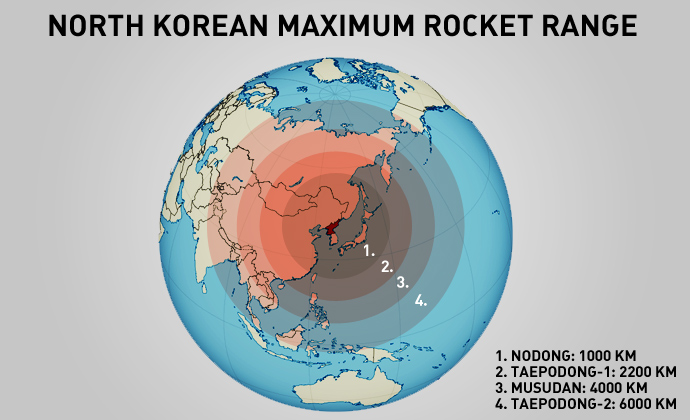
Recent warnings of instability on the Korean peninsula by Russia’s foreign minister Sergey Lavrov come at a most appropriate time – and indeed, there is a frightening possibility that the situation could spin out of control. Since the North was heavily penalized by UN sanctions following its recent satellite launch and nuclear test, Pyongyang has embarked on a near-daily onslaught of belligerent threats, some of which include its invalidation of the 1953 armistice agreement that ended the Korean War, threats to nuke the United States, and threats to occupy South Korea and subsequently take all Americans in the country hostage. Military analysts claim that North Korea is at least several years from building a nuclear warhead or a missile capable of reaching the US mainland – but there is no doubt that if the Kim regime oversteps their approach, it could certainly have severe repercussions for civilians in South Korea and Japan, both in range of North Korea’s rockets.
Despite regular threats of destruction and Pyongyang’s recent proclamation that the two Korean states are officially in a state of war, day-to-day life has retained its normality according to sources on the ground. Needless to say, there is no doubt that civilians on both sides are feeling tense in the current scenario, especially those on disputed South Korean islands in the West sea, just a stones throw away from the North Korean maritime border. The four thousands residents of the South’s Baengnyeong Island, which Kim Jong-un personally threatened to “wipe out” in early March, have been severely hindered from carrying out their day-to-day activities such as fishing due to the joint US-ROK military exercises in the area. Despite inter-Korean relations reaching their lowest point in recent times with the entire South on high alert, most South Koreans are adept at brushing off the North’s rhetoric, but they’re still proceeding with caution.Nile Bowie:
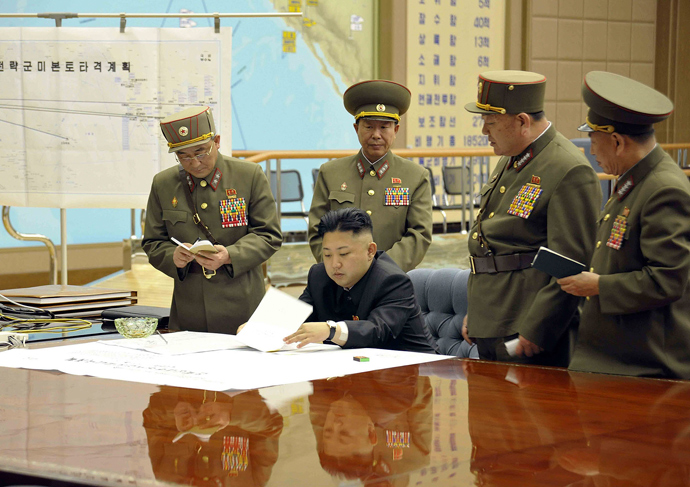
The question remains, what exactly is Kim Jong-un trying to achieve through this campaign of bellicosity? North Korean state media claims that the US “should clearly know that in the era of Marshal Kim Jong Un, the greatest-ever commander, all things are different from what they used to be in the past.” The current approach being taken by Pyongyang is multifaceted, but its central component is building up Kim’s image domestically and rallying people around the flag – this has been reinforced by daily public appearances and friendly photo-ops of Kim mingling with local people, as well as an internal propaganda campaign likening him to his grandfather Kim il-Sung, the founder and “Eternal President” of North Korea. The central message Pyongyang wants to send both internationally and domestically is that Kim Jong-un’s era is distinctly different from before – many South Korean observers have also noted this change in approach, designed to make the regime’s moves more difficult to predict.Most analysts are regarding the North’s rhetoric as their familiar brand of psychological warfare whereby it cranks up the tensions and threatens Seoul and Washington with destruction, and is then rewarded with food aid and concessions when it tones things down, which it has previously done in the months of April and May – harvest time. Pyongyang likely views the present scenario as an opportune time to test the water, keeping the new administrations of their neighbors in South Korea, China and Japan on their toes. Despite the muscle flexing and the foolish threats emanating out of Pyongyang, Washington’s recent deployment of two nuclear-capable US B-2 stealth bombers illustrates everything that is wrong with US policy toward the North – this kind of move only serves to raise antagonisms and it in fact legitimizes Pyongyang’s rhetoric of the US coaxing nuclear war on the peninsula.
In addition to joint US-ROK’s endless barrage of war games on North Korea’s doorstep, the brandishing of B-2 bombers, which carry bombs that can blast through 70 meters of reinforced concrete, is an unnecessary stunt that is both bold and needlessly provocative. In fact, the B-2 flyover helps Kim Jong-un in consolidating his political power at home by rallying domestic support behind the US threat and distracting North Koreans from economic problems. These moves beg the question, is the United States prepared to launch a full-scale war against North Korea? Despite the high public disapproval of overt warfare campaigns launched by the Bush administration, the unholy status North Korea enjoys in American mainstream media – coupled with its threats to nuke the United States and the simple fact that is it a communist state – is likely enough to coax the average American into supporting a war of aggression against Pyongyang.
Despite the fact that the war would be relatively easy to sell to the public, the United States is financially strained and in no position to engage North Korea and endure massive causalities within its military, not to mention the risk of pulling China into the fold. Therefore, Washington would likely find nuclear weapons to be the most cost-effective way to quell the North Korean threat, an equally unacceptable scenario. At this point, North Korea is a godsend for the US military industrial complex and the defense industry, and South Korea is set to keep its status as the world’s single biggest importer of US weaponry. As the Obama administration pursues its pivot the Asia-Pacific region, the colorful belligerence of North Korea is exactly what it needs not only to maintain its unpopular military presence in South Korea and Japan, but also to further bolster its military muscle on China’s doorstep.Despite North Korea’s threats being empty, one should not dismiss the possibility that they will respond to provocations with force, much like how they shelled South Korea’s Yeonpyeong Island in 2010 as a response to South Korean military exercises that fired live rounds into their territorial waters. This kind of small-scale fire exchange has the possibility to ignite the situation into a larger and more dangerous standoff, so it is of maximum importance that cool heads prevail and needlessly provocative displays of military muscle are scaled back. Koreans have historically seen themselves as a shrimp amongst whales – where they saw their peninsula abused by the US and the Soviet Union yesterday, they fear the same scenario repeating itself between the US and China today. If the Obama administration is not careful, it will provoke Pyongyang into doing something rash and by then, it will already be too late to rectify the situation.
Nile Bowie is an independent political analyst and photographer based in Kuala Lumpur, Malaysia. He has travelled North and South Korea extensively and can be reached at nilebowie@gmail.com
It does not take much to be a main stream propaganda personality. I mean let’s be honest here. It is not hard to regurgitate the propaganda that is spoon fed to them. Apparently it is so easy a computer or robot may take their jobs in the future!
‘Robo-reporter’ raises questions about future of journalists
By Jesse M. Kelly, Postmedia News vancouversun.com
Journalist Ken Schwencke has occasionally awakened in the morning to find his byline atop a news story he didn’t write.
No, it’s not that his employer, The Los Angeles Times, is accidentally putting his name atop other writers’ articles. Instead, it’s a reflection that Schwencke, digital editor at the respected U.S. newspaper, wrote an algorithm — that then wrote the story for him.
Instead of personally composing the pieces, Schwencke developed a set of step-by-step instructions that can take a stream of data — this particular algorithm works with earthquake statistics, since he lives in California — compile the data into a pre-determined structure, then format it for publication.
His fingers never have to touch a keyboard; he doesn’t have to look at a computer screen. He can be sleeping soundly when the story writes itself.
Just call him robo-reporter.
“I doubt that people who read our (web) posts — unless they religiously read the earthquake posts and realize they almost universally follow the same pattern — would notice,” Schwencke said. “I don’t think most people are thinking that robots are writing the news.”
But in this case, they are. And that has raised questions about the future of flesh-and-blood journalists, and about journalism ethics.
Algorithms are fairly versatile, and have been doing a great number of things we sometimes don’t even think about, from beating us at computerized chess, to auto-correcting our text messages. Continue Reading
What does that say about the current state of the main stream? A computer algorithm can do their job. Of course this is only for basic stories at this point. But everything has to start somewhere, and with the ways that our society/technology is progressing. Who knows where this could end up!




 It does not take much to be a main stream propaganda personality. I mean let’s be honest here. It is not hard to regurgitate the propaganda that is spoon fed to them. Apparently it is so easy a computer or robot may take their jobs in the future!

