Little Girls Accept Bitcoin at Their Coffee Stand
by Amanda Warren
Activist Post
Jan 10, 2014
Is this the first Bitcoin brick-and-mortar run by children?
These two little itty-bitty and enterprising girls are showing an even wider Bitcoin acceptance by allowing payment at their Noe Valley, San Francisco coffee stand. Are people actually paying them in Bitcoin?

Mia & Taylor’s Coffee Shop accepts the payment with a blown-up QR code. Coffee, lemonade and cookies are sold for around a buck – broken cookies are free. Awww…
A Tweet targeted to a Noe Valley event page got picked up from there. But actually, the image was taken and posted by Reddit user DorkusPrime which also went viral. The commenters there seem to believe they will soon be shut down by the police – yikes!
In Noe Valley even the girl scouts take bitcoin: http://t.co/7x18Wpvh6p cc @NoeValleySF
— Colby (@colbyh) December 31, 2013
They’ve received 33 transactions which some, of course, came in from the Reddit users who decoded their Bitcoin address. A week ago, they had gathered the equivalent of $70 in Bitcoin. (source)
The value of Bitcoin has seen some ups and downs, but for a few reasons, it might be here to stay. Larger businesses are responding to consumer interest in the totally decentralized form of payment. So from lemonade stands to top-dog corps – Bitcoin is now serving everywhere.
Also by Amanda Warren:
If You Are Waiting For An “Economic Collapse”, Just Look At What Is Happening To Europe
 by Michael Snyder
TheEconomicCollapseBlog.com
Jan 8, 2014
If you are anxiously awaiting the arrival of the “economic collapse”, just open up your eyes and look at what is happening in Europe. The entire continent is a giant economic mess right now. Unemployment and poverty levels are setting record highs, car sales are setting record lows, and there is an ocean of bad loans and red ink everywhere you look. Over the past several years, most of the attention has been on the economic struggles of Greece, Spain and Portugal and without a doubt things continue to get even worse in those nations. But in 2014 and 2015, Italy and France will start to take center stage. France has the 5th largest economy on the planet, and Italy has the 9th largest economy on the planet, and at this point both of those economies are rapidly falling to pieces. Expect both France and Italy to make major headlines throughout the rest of 2014. I have always maintained that the next major wave of the economic collapse would begin in Europe, and that is exactly what is happening. The following are just a few of the statistics that show that an “economic collapse” is happening in Europe right now…
-The unemployment rate in the eurozone as a whole is still sitting at an all-time record high of 12.1 percent.
-It Italy, the unemployment rate has soared to a brand new all-time record high of 12.7 percent.
-The youth unemployment rate in Italy has jumped up to 41.6 percent.
-The level of poverty in Italy is now the highest that has ever been recorded.
-Many analysts expect major economic trouble in Italy over the next couple of years. The President of Italy is openly warning of “widespread social tension and unrest” in his nation in 2014.
-Citigroup is projecting that Italy’s debt to GDP ratio will surpass 140 percent by the year 2016.
-Citigroup is projecting that Greece’s debt to GDP ratio will surpass 200 percent by the year 2016.
-Citigroup is projecting that the unemployment rate in Greece will reach 32 percent in 2015.
-The unemployment rate in Spain is still sitting at an all-time record high of 26.7 percent.
-The youth unemployment rate in Spain is now up to 57.7 percent – even higher than in Greece.
-The percentage of bad loans in Spain has risen for eight straight months and recently hit a brand new all-time record high of 13 percent.
-The number of mortgage applications in Spain has fallen by 90 percent since the peak of the housing boom.
-The unemployment rate in France has risen for 9 quarters in a row and recently soared to a new 16 year high.
-For 2013, car sales in Europe were on pace to hit the lowest yearly level ever recorded.
-Deutsche Bank, probably the most important bank in Germany, is the most highly leveraged bank in Europe (60 to 1) and it has approximately 70 trillion dollars worth of exposure to derivatives.
Europe truly is experiencing an economic nightmare, and it is only going to get worse.
It would be hard to put into words the extreme desperation that unemployed workers throughout Europe are feeling right now. When you can’t feed your family and you can’t find work no matter how hard you try, it can be absolutely soul crushing.
VIDEO — Fashion Fakes: Cheap Chinese clothes force Italian brands out
RT
Jan 12, 2014
In the midst of a financial storm, Italians are turning their backs on the designer brands that have made their country world-famous. And they are increasingly turning to Chinese producers for cheap goods, sometimes even labeled ‘Made in Italy’.
RT LIVE http://rt.com/on-air
Subscribe to RT! http://www.youtube.com/subscription_c…
Like us on Facebook http://www.facebook.com/RTnews
Follow us on Twitter http://twitter.com/RT_com
Follow us on Instagram http://instagram.com/rt
Follow us on Google+ http://plus.google.com/+RT
RT (Russia Today) is a global news network broadcasting from Moscow and Washington studios. RT is the first news channel to break the 1 billion YouTube views benchmark.
Employment Recovery? 1,600 Workers Apply For Just 36 Jobs At An Ice Cream Plant In Maryland
By Michael Snyder
TheEconomicCollapseBlog.com
Jan 7, 2014
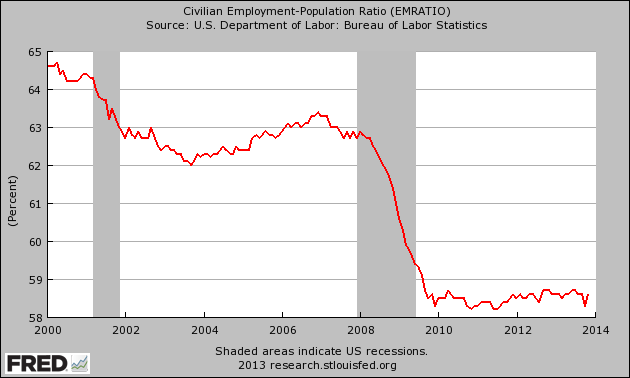
 The stock market may be soaring to unprecedented heights, but things just continue to get even tougher for the middle class. In this economic environment, there is intense competition for virtually all kinds of jobs. For example, more than 1,600 applications were recently submitted for just 36 jobs at an ice cream plant in Hagerstown, Maryland. That means that those applying have about a 2 percent chance of being hired. About 98 percent of the applicants will be turned away. That is how tough things are in many areas of the country today. It is now more than five years after the great financial crash of 2008, and the level of employment in the United States is still almost exactly where it was at during the worst moments of the last recession. And this is just the beginning. The next major financial crash is rapidly approaching, and once it strikes our employment crisis is going to get much, much worse.
Working at an ice cream plant does not pay very well. But at least it beats flipping burgers or stocking shelves at Wal-Mart. And in this economy, there is no shortage of desperate workers that are willing to take just about any job that they can find. The following is how a Breitbart article described the flood of applications that were received for just 36 positions at an ice cream plant owned by Shenandoah Family Farms in Hagerstown, Maryland…
Thanks to persistent unemployment and low availability of low-skill jobs, Shenandoah Family Farms’ ice cream plant in Hagerstown, Maryland has received over 1,600 applicants for a grand total of 36 jobs. Many of those applicants are former workers at the Good Humor plant that was bought by Shenandoah Family Farms. “You’d think that after 20-some-years working someplace at least somebody would think you area a good person, that you’d show up on time every day, and that would be worth something,” Luther Brooks, a 50-year-old former worker at the plant told the Washington Post. “I can’t get nothing. I’ve tried.”
Anyone that believes that the economic crisis is “over” is just being delusional. It may be “over” for the boys and girls that work on Wall Street, but even their good times are only temporary.
Of course most Americans are not fooled by the propaganda being put out by the mainstream media. According to a recent CNN poll, 70 percent of all Americans believe that “the economy is generally in poor shape”.
And according to another survey, the economy is still the #1 concern for American voters by a good margin and unemployment is still the #2 concern for American voters by a good margin.
In other words, “It’s the economy, stupid!”
The American people can see that mid-wage jobs are disappearing and that the middle class is being systematically eviscerated. The following is a short excerpt from a recent Business Insider article…
A startling number of middle-class jobs may be headed toward extinction.
More than any other job class, mid-level positions have struggled to recover from the recession, and only a quarter of jobs created in the past three years are categorized as mid-wage. There are high-skilled professional jobs that require college degrees and low-skilled service jobs for less educated workers, but the middle is getting squeezed.
As mid-wage jobs disappear, they are being replaced by low wage jobs. As I mentioned yesterday, one recent study found that about 60 percent of the jobs that have been “created” since the end of the last recession pay $13.83 or less an hour.
And this is just the beginning of the decline of the middle class. Another great financial crisis is rapidly approaching, and once it arrives things are going to get much worse than they are right now.
A number of very prominent experts believe that this next great financial crisis could begin in 2014. For example, in a recent article entitled “Top Ten Trends 2014: A Year of Extremes“, Gerald Celente warned that “an economic shock wave” could hit the United States by the middle of the year. Here are some excerpts from that article…
-“In 33 years of forecasting trends, the Trends Research Institute has never seen a new year that will witness severe economic hardship and social unrest on one hand, and deep philosophic enlightenment and personal enrichment on the other. A series of dynamic socioeconomic and transformative geopolitical trend points are aligning in 2014 to ring in the worst and best of times.”
[h/t: BeforeIt’sNews]
CDC Not Required to Tell the Truth About Anything, Including Vaccines
 by Christina Sarich
Natural Society
Jan 9, 2014
Since the American Congress of Obstetricians and Gynecologists (ACOG) and the Centers for Disease Control (CDC) aren’t legally required to tell the truth about anything, why should they? Maybe this is just one of many reasons the public is unaware of the many problems revolving around America’s health system.
The CDC is perhaps the most malicious in their information-twisting. Consider this recent upheaval about flu vaccinations. According to Dr. Peter Doshi in a British Medical Journal article review (BMJ 2013; 346:f3037):
“. . .perhaps the cleverest aspect of the influenza marketing strategy surrounds the claim that ‘flu’ and ‘influenza’ are the same. The distinction seems subtle, and purely semantic. But general lack of awareness of the difference might be the primary reason few people realize that even the ideal influenza vaccine, matched perfectly to circulating strains of wild influenza and capable of stopping all influenza viruses, can only deal with a small part of the ‘flu’ problem because most ‘flu’ appears to have nothing to do with influenza. Every year, hundreds of thousands of respiratory specimens are tested across the US. Of those tested, on average 16% are found to be influenza positive.”
Food stamps won’t buy marijuana cookies in Colorado
RT
Jan 10, 2014

Marijuana laced cookies for sale at a medical marijuana “club” (AFP Photo / Robyn Beck)
A new bill that’s been introduced before the Colorado General Assembly will make sure residents there won’t be able to use their food stamp benefits to buy legal weed or marijuana-infused products sold in dozens of new state-sanctioned dispensaries.
Reports have yet to surface indicating that Coloradoans have used government-provided EBT cards to purchase pot products under new state laws, but lawmakers there want to make sure that won’t become a reality.
Under state law, residents can’t use their electronic benefit transfer accounts in liquor stores, casinos, gun shops and similar establishments. With recreational marijuana now legal for adults to buy and use in Colorado, though, state officials fear some of the new dispensaries may let customers cash out with their EBT cards.
“We need this bill, if for nothing else, as a statement,” State Rep. Jared Wright (R-Grand Junction) told the Associated Press this week.
“We shouldn’t be enabling anyone to buy a substance that is banned under federal law. It’s not a good use of taxpayer money,” he said.
Wright is intent on changing that, and is now proposing an amendment to state law that would add weed dispensaries to the list of establishments where EBT cards can’t be used.
Exporting Apartheid to Sub-Saharan Africa. The Legacy of Nelson Mandela
by Prof Michel Chossudovsky
Global Research
Dec 13, 2013
 This article was first published in French in the Monde diplomatique in April 1997. It was subsequently published in the African Journal of Political Economy and in the author’s book: The Globalization of Poverty and the New World Order.
The policy of land expropriation in Mozambique leading to the establishment of White Afrikaner farms using indentured Mozambican farm workers had the support of the ANC government. It also had the the personal blessing of President Nelson Mandela “who had delegated Mpumalanga Premier Matthews Phosa to the SACADA Board of Governors.
Premier Phosa, a distinguished ANC politician and among the most prosperous black businessmen in Mpumalanga province (East Transvaal), contributed to laying the political ground work for the expansion of White Afrikaner business interests into neighbouring countries.
 The SACADA project was coordinated by the leader of the right wing Freedom Front and former South African Defense Force Chief General Constand Viljoen
Viljoen developed a close personal relationship with Nelson Mandela. He had convinced Mandela that promoting White Afrikaner farms in neighbouring countries “would provide food and employment for locals”. What was not discussed was that this ANC government policy implied a de facto process of land expropriation which went against the basic tenets of the ANC’s struggle for land rights for African peasants.
From the outset, international corporate agribusiness and the World Bank were involved in this project. It is worth noting that during the period of “Transition” preceding the 1994 presidential elections, General Constand Viljoen had been “plotting an Afrikaner guerrilla war against multiracial rule”. (Financial Times, December 5, 2013)
While Mandela “believed in action” … at the core of [his] militancy was always a desire to get the white colonial regime to come to the table and talk.” (Mail and Guardian, December 12, 2013). This stance largely characterized his relationship with General Viljoen.
It is worth noting that in the 1980s General Viljoen as Chief of the South African Defence Force led South African troops into Angola. In 1993, he participated in the establishment of the Right wing racist Afrikaner Volksfront (AVF). He later formed the Freedom Front Party which presented candidates to the April 1994 elections.
 The article on Exporting apartheid was the object of controversy.
Its publication in Le Monde diplomatique in April 1997 coincided with the hearings of the South Africa Truth Commission led by Rev Desmond Tutu, which focused on the role of General Constand Viljoen as South African Defense Force Chief during the Apartheid period. (General Viljoen testified in May 1997 before the Truth Commission
The article was the object of a June 1997 law suit claiming defamation directed against the author and Le Monde diplomatique by the South African Chamber for Agricultural Development (SACADA) and the leader of the Freedom Front and former SADF Chief General Constand Viljoen.
The law suit launched in Paris was subsequently thrown out by the Paris Court of Justice.
Michel Chossudovsky, December 12, 2013
Exporting Apartheid to Sub-Saharan Africa
by Michel Chossudovsky
The right wing Afrikaner Freedom Front (FF) headed by General Constand Viljoen plans to develop a “Food Corridor” extending across the Southern part of the continent from Angola to Mozambique. Afrikaner agri-business is to extend its grip into neighbouring countries with large scale investments in commercial farming, food processing and eco-tourism. The agricultural unions of the Orange Free State and Eastern Transvaal are partners; the objective is to set up White-owned farms beyond South Africa’s borders.
The “Food Corridor,” however, does not mean “food for the local people.” On the contrary, under the scheme the peasants will lose their land, with small-holders becoming farm labourers or tenants on large scale plantations owned by the Boers. Moreover, the South African Chamber for Agricultural Development (SACADA) which acts as an umbrella organization also includes, centrally, several right wing organizations including the Freedom Front (FF) led by Viljoen, whose grim record as South African Defence Force (SADF) Commander in Chief during the Apartheid regime is well known.
The Freedom Front, although “moderate” in comparison to Eugene Terre’Blanche’s far-right Afrikaner Weerstandsbeweging (AWB), is a racist political movement committed to the Afrikaner Volksstaat. The SACADA-Freedom Front initiative has nonetheless the political backing of the African National Congress as well as the personal blessing of President Nelson Mandela who has delegated Mpumalanga Premier Matthews Phosa to the SACADA Board of Governors. All the other governors are members of the Freedom Front. Premier Phosa, a distinguished ANC politician and among the most prosperous black businessmen in Mpumalanga province (East Transvaal), has also contributed to laying the political ground work for the expansion of White Afrikaner business interests into neighbouring countries.
In discussions with President Mandela, General Viljoen had argued that “settling Afrikaner farmers would stimulate the economies of neighbouring states, would provide food and employment for locals, and that this would stem the flow of illegal immigrants into South Africa.” Viljoen has also held high level meetings on Afrikaner agricultural investments with representatives of the European Union, the United Nations and other donor agencies.
In turn, Pretoria is negotiating with several African governments on behalf of SACADA and the Freedom Front. The ANC government is anxious to facilitate the expansion of corporate agri-business into neighbouring countries. As one newspaper account affirms, “Mandela has asked the Tanzanian government to accept Afrikaner farmers to help develop the agricultural sector” while SACADA itself has approached some 12 African countries “interested in White South African farmers.” In a venture set up in 1994 under the South African Development Corporation (SADEVCO), the government of the Congo had granted to the Boers 99 year leases on agricultural land; President Mandela endorsed the scheme calling on African nations “to accept the migrants as a kind of foreign aid.”
The African host countries have on the whole welcomed the inflow of Afrikaner investments. With regard to regulatory policies, however, the Bretton Woods institutions and the World Trade Organization (WTO) (rather than national governments) call the shots, invariably requiring (indebted) countries to accept “a wide open door to foreign capital.” In this context, the liberalization of trade and investment under donor supervision, tends to support the extension of Afrikaner business interests throughout the region. Moreover, in the sleazy environment shaped by transnational corporations and international creditors, corrupt politicians and senior bureaucrats are often co-opted or invited to become the “business partners” of South African and other foreign investors.
The expropriation of peasant lands
The “Food Corridor” initiative will displace a pre-existing agricultural system: it not only appropriates the land, it takes over the host country’s economic and social infrastructure and, almost inevitably, spells increased levels of poverty in the countryside. It will most likely provide a fatal blow to subsistence agriculture as well as to the peasant cash crop economy, displacing local level agricultural markets and aggravating the conditions of endemic famine prevailing in the region. As if this were not enough, Jen Kelenga, a spokesperson for a pro-democracy group in Zaire, also sees, at the heart of the initiative, the Boers “in search of new territories to apply their racist way of living.”
The “Food Corridor” if carried through, could potentially alter the rural landscape of the Southern African region, requiring the uprooting and displacement of small farmers over an extensive territory. Under the proposed scheme, millions of hectares of the best farmland would be handed over to South African agri-business. The Boers are to manage large scale commercial farms using the rural people both as “labour tenants” as well as seasonal agricultural workers.
Such initiatives also dovetail with World Bank directives regarding land-use in the region. Indeed, the Bank has pressed for land legislation throughout Sub-Saharan Africa that would abrogate the right to land of millions of small-holders, with identical land legislation now being enforced throughout the region. The national level land laws (drafted under technical advice from World Bank Legal Department) are with some variations “exact carbon copies of each other”:
“The constitution [in Mozambique] says that the land is the property of the State and cannot be sold or mortgaged. There has been strong pressure particularly from the United States and the World Bank for land to be privatized and to allow mortgages …”
Under the proposed land legislation, both SACADA and the World Bank nonetheless tout the protection of traditional land rights. The small peasantry is to be “protected” through the establishment of “customary land reserves” established in the immediate vicinity of the White commercial farms. In practice, under the new land legislation, the majority of the rural people will be caged into small territorial enclaves (“communal lands”) while the bulk of the best agricultural land will be sold or leased to private investors.
This also means that peasant communities which practice shifting cultivation over a large land area, as well as pastoralists, will henceforth be prosecuted for encroaching on lands earmarked for commercial farming, often without their prior knowledge. Impoverished by the macro-economic reforms, with no access to credit and modern farm inputs, these customary enclaves will, as noted, constitute “labour reserves” for large scale agri-business.
Afrikaner farms in Mozambique
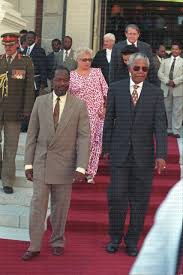 SACADA has plans to invest in Mozambique, Zaire, Zambia and Angola, “with Mozambique being the test case.” President Joaquim Chissano of Mozambique and President Nelson Mandela (1994 picture right) signed an intergovernmental agreement in May 1996 which grants rights to Afrikaner agri-business to develop investments in at least six provinces encompassing territorial concessions of some eight million hectares. According to one South African official:
“Mozambique needs the technical expertise and the money, and we have the people … We favour an area which is not heavily populated because it is an Achilles heel if there are too many people on the land … For the Boers, Land is next to God and the Bible.”
In SACADA’s concessionary areas in Mozambique, the Frelimo government will ensure that there is no encroachment; rural small-holders and subsistence farmers (who invariably do not possess legal land titles) will either be expelled or transferred into marginal lands.
In Mozambique’s Nissan province, the best agricultural land is to be leased in concession to the Afrikaners for fifty years. At the token price of some $0.15 per hectare per annum, the land lease is a give-away. Through the establishment of Mosagrius (a joint venture company), SACADA is now firmly established in the fertile valley of the Lugenda river. But the Boers also have their eyes on agricultural areas along the Zambezi and Limpopo rivers as well as on the road and railway facilities linking Lichinga, Niassa’s capital to the deep seaport of Nagala. The railway line is being rehabilitated and modernized (by a French contractor) with development aid provided by France.
In the initial stage of the agreement, concessionary areas in Niassa province were handed over to SACADA in 1996 to be settled by some 500 White Afrikaner farmers. These lands are earmarked for commercial farming in both temperate highveld and sub-tropical lowveld. The available infrastructure including several state buildings and enterprises will also be handed over to the Boers.
The Boers will operate their new farms as part of their business undertakings in South Africa, dispatching White Afrikaner managers and supervisors to Mozambique. The Boers will bring from South Africa their Black right-hand men, their tractor operators, their technicians. In the words of the project liaison officer at the South African High Commission in Maputo: “Each and every Afrikaner farmer will bring his tame Kaffirs” who will be used to supervise the local workers. The number of White settlers in the concessionary areas in Niassa is likely to be small.
SACADA has carefully mapped out the designated areas by helicopter, South Africa’s agricultural research institutes have surveyed the area, providing an assessment of environmental as well as social and demographic conditions.

 PN
PN