
Deodorant contains dangerous ingredients: MAKE YOUR OWN
Natural Cures Not Medicine
February 22, 2013
Your favorite deodorant might contain dangerous ingredients that can cause cancer, brain damage, and even liver abnormalities.
 Just a couple simple ingredients is all you need for your All-Natural Deodorant:
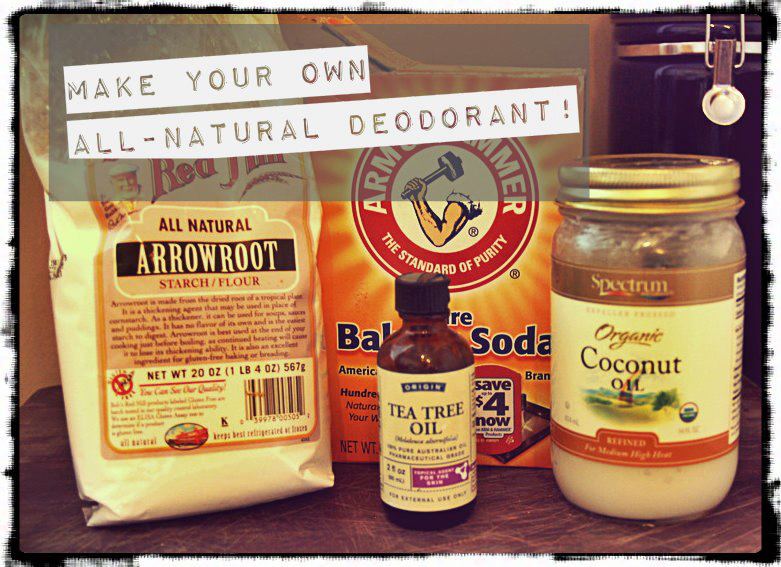
1/4 Cup of Baking Soda (neutralizes odor)
1/4 Cup of Arrowroot starch (absorbs moisture)
4 Tb Coconut Oil (anti-bacterial and moisturizing) 1/4 tsp Tea Tree Oil (anti-bacterial)
Mix all ingredients together to form a paste/cream… and that’s it!
WHY SHOULD YOU MAKE YOUR OWN OR NOT USE ANY?
3 of the worst deodorant ingredients are:
Parabens: (On the label* methylparaben, ethylparaben, propylparaben, butylparaben or isobutylparaben) These are used in many skin care and cosmetic products. They act as a preservative to discourage bacteria and fungus. Research shows that parabens from lotions and deodorants can absorb into the body and weakly mimic estrogen causing damage to the endocrine system.
Aluminum: One of the main ingredients in many deodorants and antiperspirants is aluminum, which actually blocks the body from producing sweat. Aluminum has been known to cause neurological damage and contribute to diseases like Alzheimer’s and Parkinson’s. Aluminum has been found to be able to enter and remain in a human bloodstream for up to two weeks after just one application of deodorant or antiperspirant.
Propelene Glycol: is often used in deodorants and is also an ingredient in antifreeze. Factory workers who are exposed are warned of the danger of kidney, brain, and liver damage through skin contact.
Canadian Government Folding To American Pressure To Implement “ACTA” With Introduction Of Bill C-56 “Combating Counterfeit Products Act”?
 by Terry Wilson
Canadian Awareness Network
March 4, 2013
On Friday March 1st 2013, Bill C-56 was introduced in the house of commons by Conservative MP Christian Paradis. The bill strongly resembles ACTA (Anti-Counterfeiting Trade Agreement), Which Canada has signed on to, but has not ratified.
Read the full test of Bill C-56 HERE
The United States has been pushing for Canada to comply with ACTA regulations very recently.
In the 2013 Trade Policy Agenda and 2012 Trade Policy Report, the Office of the United States Trade Representative has encouraged Canada to “meet its Anti-Counterfeit Trade Agreement (ACTA) obligations by providing its customs officials with ex officio authority to stop the transit of counterfeit and pirated products through its territory.”
Source
Bill C-56 will:
– Give border officers the authority to detain suspected commercial shipments and contact the rights holders;allow Canadian businesses to file a request for assistance, with the CBSA, in turn, enabling border officers to share information with rights holders regarding suspect shipments.
– Provide new criminal offences for the commercial possession, manufacture or trafficking of counterfeit trademark goods.
– Provide rights owners with new tools to protect their rights and take civil action against infringers.
– Create new offences for trademark counterfeiting, and
– Provide better tools to investigate commercial counterfeiting.
Source
Bill C-56 seems to fall right in line with the Americans suggestion to implement ACTA. Which should be sounding alarm bells in the Canadian public.
Despite being rejected by the European Parliament, 31 nations have signed on to ACTA and the agreement only requires that 6 of them ratify the agreement for it to come into force. We as Canadians must ensure that Canada does not become one of those 6 nations, regardless of external pressures.
If you are not aware of ACTA here is a brief video explaining what it involves.
In Focus: Kenya on the brink [video]
PressTV
March 4, 2013
IMF food subsidy cuts, import-dependent staple food, an independence movement by Muslims in Mombasa and many more, has put Kenya in serious trouble. Hunger speculators lead by financial terrorists such as Goldman Sachs are using the drought in the USA, the world’s largest producer of maize and corn, to drive prices to what are predicted to be record levels, more than doubling by early 2013. This forces Kenya’s imported maize dependent population’s malnutrition rate into meltdown status. It was record food prices that triggered the “Arab Spring” in Tunisia and Egypt and Kenya stands on the brink of a similar explosion.
The US instigated Kenya’s criminally foolhardy invasion of Somalia and has landed the Kenyan military, an ill-disciplined, brutal and corrupt band of uniformed hoodlums, in a quagmire that is spreading the flames of rebellion throughout Kenya’s north eastern Somali population. “Riots” and “terrorist attacks on police” are taking place mainly in the port city of Mombassa, home to a simmering independence movement amongst the long marginalized Muslim population. On this week’s INFocus, we discuss if Kenya will see a civil war splinter the country in 2013.
Watch this video on our Website: http://www.presstv.ir/Program/291855….
Follow our Facebook on: https://www.facebook.com/presstvchannel
Follow our Twitter on: http://twitter.com/presstv
Follow our Tumblr on: http://presstvchannel.tumblr.com
Researchers Link MSG to Weight Gain, Obesity
by Elizabeth Renter
Natural Society
February 24, 2013
 Monosodium glutamate is a food additive used in many foods to enhance taste, but this additive is also toxic. Known as an excitotoxin – which ‘excites’ the cells of the body into overproducing a particular chemical, thus burning them out prematurely – MSG is thrown in everything from Ramen noodles to potato chips, all to “enhance” the flavors in these quasi-foods. But while MSG is said to improve taste, it has many—more sinister—effects. Many people know that MSG can sometimes be blamed for headaches and possibly even ADHD, but the link to obesity often goes unrecognized.
From animal research to studies in humans, scientists have consistently demonstrated that there is a link between the consumption of MSG and obesity.
In Spain, researchers found that rats who eat MSG experience an increase in appetite of 40%. This is dramatic. And because the food’s flavors are enhanced, there’s a good chance that humans are eating more of them too.
But more than just tasting good, some scientists have suggested that MSG actually interferes with leptin, responsible for controlling our appetites. One study showed that those people who eat the most MSG also have the most leptin, perhaps creating an environment of leptin resistance, or one where the appetite becomes more or less uncontrollable.
Interestingly, MSG could be causing obesity even without increased food consumption. The link between MSG and weight gain or obesity holds true even when excess calories are accounted for.
In the United States, it’s estimated that the average person consumes about a half a gram of MSG daily, and for many sensitive people, this is enough to trigger a migraine. But, it’s minimal when compared with the amount consumed in some Asian countries. It’s estimated in countries like Japan that MSG consumption is anywhere from 1.5 to 10 grams per day.
Studies in these countries have found a similar link between MSG and obesity. The reason we don’t see Asian countries with obesity rates comparable to ours, scientists surmise, is because they are more active and have a (generally) better diet.
Sicne producers aren’t always transparent with MSG’s inclusion in food products (shocker, I know), it may be tricky to reduce MSG consumption. Check the ingredients for inclusions like: glutamate, glutamic acid, gelatin, calcium caseinate, hydrolyzed vegetable protein, whey protein, textured protein, yeast extract, autolyzed yeast, and more. Better yet, to ensure you aren’t getting MSG, don’t eat processed foods at all.
Additional Sources:
 The Basics on How to Be Healthy – You Are What You Eat
 Warning: 3 Fast Food Ingredient Secrets
 Is this Flavor Enhancer Making You and Your Children Sick and Fat?
 Halting the Obesity Epidemic: Discover the Truth About Weight Loss
 The New Health Paradigm
U.S.-EU Trade Deal is the Foundation For a New Global Economic Order
by Dana Gabriel
Be Your Own Leader
February 25, 2013
 The U.S. and EU have agreed to launch negotiations on what would be the world’s largest free trade deal. Such an agreement would be the basis for the creation of an economic NATO and would include trade in goods, services and investment, as well as cover intellectual property rights. There are concerns that the U.S. could use these talks to push the EU to loosen its restrictions on genetically modified crops and foods. In addition, the deal might serve as a backdoor means to implement ACTA which was rejected by the European Parliament last year. A U.S.-EU Transatlantic trade agreement is seen as a way of countering China’s growing power and is the foundation for a new global economic order.
In his recent State of the Union address, President Barack Obama officially announced that the U.S. would launch talks on a comprehensive Transatlantic Trade and Investment Partnership with the European Union (EU). A joint statement issued by European Commission President Jose Manuel Barroso, European Council President Herman Van Rompuy and U.S. President Obama explained that, “Through this negotiation, the United States and the European Union will have the opportunity not only to expand trade and investment across the Atlantic, but also to contribute to the development of global rules that can strengthen the multilateral trading system.” In a separate speech, European Commission President Barroso also emphasized that, “A future deal between the world’s two most important economic powers will be a game-changer. Together, we will form the largest free trade zone in the world. So this negotiation will set the standard – not only for our future bilateral trade and investment, including regulatory issues, but also for the development of global trade rules.”
The decision to pursue a free trade deal was based on the recommendations put forth by the High Level Working Group on Jobs and Growth which was created to deepen U.S.-EU economic integration. In their final report, they called on leaders from both sides to, “initiate as soon as possible the formal domestic procedures necessary to launch negotiations on a comprehensive trade and investment agreement.” According to U.S. and EU officials, talks could start in June with the hopes of completing a deal by the end of 2014. The proposed trade pact would include removing import tariffs, dismantling hurdles to trade in goods, services, and investment, as well as harmonizing regulations and standards. It would also cover intellectual property protection and enforcement. This could be used as an opportunity for a backdoor implementation of the Anti-Counterfeiting Trade Agreement (ACTA). It was a result of public pressure associated with risks to internet freedom and privacy which lead to ACTA being rejected by the European Parliament in July of 2012. There have already been attempts to use Canada-EU trade negotiations to sneak in parts of ACTA.
Public Citizen’s Global Trade Watch Director, Lori Wallach cautioned how U.S.-EU talks, “are aimed at eliminating a list of what multinational corporations call ‘trade irritants’ but the rest of us know as strong food safety, environmental and health safeguards.” She went on to say, “European firms are targeting aspects of the U.S. financial reregulation regime, our stronger drug and medical device safety and testing standards and more.” Wallach further added, “U.S. firms want Europe to gut their superior chemical regulation regime, their tougher food safety rules and labeling of genetically modified foods.” In a press release, Earth Open Source warned that, “An EU-U.S. free trade deal would obliterate EU safeguards for health and the environment with regard to genetically modified (GM) crops and foods.” Research Director Claire Robinson pointed out, “If the new trade agreement goes through, it will be illegal under World Trade Organisation rules for the EU to have a stronger regulatory system for GMOs than the U.S. system.” This is disturbing considering that in many cases, GM foods in the U.S. do not require any special regulatory oversight or safety tests.
Overshadowed by the proposed U.S.-EU trade deal is ongoing Canada-EU negotiations on a Comprehensive Economic and Trade Agreement (CETA). Despite talks being in their final stages, both sides still have some important gaps to be bridged before a deal can be reached. Thomas Walkom of the Toronto Star acknowledged that, “Europe’s real interest in negotiating a trade deal with Ottawa was to demonstrate to the Americans that a trans-Atlantic free trade pact was possible.” He noted, “EU negotiators will be even more reluctant to make concessions to Canada for fear of weakening their bargaining hand with the Americans.” Walkom argued that, “Canada is under more pressure to make a deal while Europe is under less.” He concluded that. “A Canada-EU deal seems inevitable. But now, with America in the mix, the terms for Canada may be even less favorable than expected.” The Globe and Mail recently reported that the EU is demanding additional concessions from Canada before any agreement can be signed. In order to wrap things up, a desperate Canada may be willing to give up even more. This was a bad deal from the start and it would be in their best interest to just walk away from CETA.
In the coming months, you can expect the anti-corporate globalization movement on both sides of the Atlantic to mobilize against the U.S.-EU trade agreement. It is big business and financial institutions who are pushing this deregulation agenda which threatens health, environmental and food safety standards. Just like NAFTA, the proposed U.S.-EU trade deal is also likely to include an investor-state dispute process which would give corporations the right to challenge government policies that restrict their profits. A trade agreement between the U.S. and EU is the building blocks for a new global trading system. If you combine NAFTA, the Trans-Pacific Partnership and a U.S,-EU Transatlantic trade deal, you have the makings for a global free trade area.
Related articles by Dana Gabriel:
Deepening the U.S.-EU Transatlantic Trade Partnership
Growing Opposition to the Canada-EU Trade Agreement
Advancing the Transatlantic Agenda
From NAFTA to CETA: Canada-EU Deep Economic Integration
Dana Gabriel is an activist and independent researcher. He writes about trade, globalization, sovereignty, security, as well as other issues. Contact: beyourownleader@hotmail.com Visit his blog at Be Your Own Leader
VIDEO — Is Your ‘Beef’ Really Horse and Donkey Meat?
The Truther Girls
February 19, 2013
All over the UK and Europe, horse and donkey meat is turning up in ‘beef’. What else don’t we know about what is in our food?
http://www.telegraph.co.uk/finance/ne…
http://abcnews.go.com/International/h…
http://www.dailymail.co.uk/news/artic…
Extra-caffeinated soda and chemical sweeteners for breakfast? PepsiCo introduces ‘Kickstart’ soda for people who absolutely hate themselves
 by Mike Adams, the Health Ranger
Editor of NaturalNews.com
February 19, 2013
(NaturalNews) Ah, there’s nothing like a heavy dose of caffeine, corn syrup and highly acidic phosphoric acid in the morning. And bringing it to you is none other than PepsiCo, the company that habitually uses aspartame, MSG and GMOs across its product line. Apparently drinking an aspartame-laced, caffeine-spiked soda for lunch and dinner isn’t enough: PepsiCo wants to own your breakfast, too.
This new “Kickstart” soda reportedly is made with 5% juice (meaning it’s 95% corn syrup, phosphoric acid and other ingredients). But here’s where the laughter really begins: According to the FDA, a beverage containing at least 5% juice isn’t considered a “soda.” It’s actually JUICE!
Yep, this means Kickstart can be served to your children in public school, because it’s “not soda” according to the agreement between the FDA and the soda industry.
Except, of course, it is 95% soda. But that doesn’t count by the FDA’s “new math” in which 5 > 95.
Artificial sweeteners, too
Oh, it gets even better. Kickstart is formulated with artificial chemical sweeteners from the start. And it has more caffeine than a can of Mountain Dew, clocking in at 92 milligrams per 16 ounces.
Hold on, let me get this straight: A liquid concoction spiked with caffeine, chemical sweeteners, phosphoric acid and corn syrup is now “juice” according to the soda industry? Yep!
Does this mean NY mayor Michael Bloomberg will let you buy an extra large cup of it? Does the “5% juice” get retailers off the hook if they want to sell large quantities?
Overall, I’m not sure who’s more stupid in all this: The company making it, the government agency regulating it, or the people buying and drinking it. To me, it all seems to be a collision of caffeinated morons. What kind of fool wants to wake up in the morning and chemically kick themselves in the b#lls while ingesting phosphoric acid, an extra dose of caffeine and synthetic chemical sweeteners?
Can you say, “Kickstart diabetes?”
Big Pharma and the entire health care industry will be thanking PepsiCo big time for this one. If Kickstart catches on, America can fully expect to be financially suffocated under a wave of bank-busting obesity and diabetes for generations to come. This is a great time to buy more PepsiCo stock, because if there’s one thing Americans all agree on, it’s that our retirement accounts should financially benefit from the companies that are destroying our children.
P.S. I invented my own soda called Monster Chemo Agent Orange Diet Fluoride Soda! Here’s the advertisement:
Source:
ABC News:
http://www.cbsnews.com/8301-505123_162-57568740/pepsico-introduces-mo…

 PN
PN 