
How to Clean Your Liver with 5 Natural Liver-Cleansing Tips
 by Elizabeth Renter
Natural Society
May 21, 2013
Your liver is like the maid of your body, cleaning up all the toxins you put into it, and therefore keeping all internal systems running smoothly. The modern diet, environmental pollutants, and our increasing dependence on toxic personal care products have put our livers on serious overtime. For this reason, it’s important to know how to clean your liver thoroughly and effectively – oh, and naturally.
Your liver works to cleanse the blood and remove toxic substances that we’ve eaten, inhaled, or rubbed on our bodies. When it is overworked—as it is in many modern adults—or when you are under a significant amount of physical or even mental stress, your liver can struggle to keep up.
“The thousands of enzyme systems that are responsible for virtually every body activity are constructed in the liver,” explains Dr. Karl Maret, M.D. “The proper functioning of the eyes, the heart, the brain, the gonads, the joints, and the kidneys are all dependent on good liver activity. If the liver is impaired from constructing even one of the thousands of enzyme systems the body requires, there is an impairment in overall body function and a resultant greater metabolic stress on the individual.”
How to Clean Your Liver – No Products Required
So, what can you do about it? Well, you could try a quality liver detox supplement, or you could use some items found at your local health food store, your grocery store, or even some that are already in your kitchen. Here is how to clean your liver with 5 common food items.
- 1. Warm Lemon Water – Warm lemon water is a great way to detox your liver every single morning. This isn’t lemonade, so don’t add sugar or anything else. Just purified water and a healthy dose of fresh lemon juice. Some experts, like author A.F. Beddoe who wrote the book Biological Ionization as Applied to Human Nutrition, also believe that the liver produces more enzymes in response to water with lemon than to any other food.
- 2. Garlic – Add some garlic to your cooking or thinly slice a clove into your next salad. Garlic contains sulfur compounds that can help activate enzymes in the liver. It contains allicin and selenium, which are both good for liver protection.
- 3. Avocados – As if you need another reason to add avocados to your diet, a Japanese study found that avocados contain compounds that can protect the liver from damage. When compared with 21 other fruits, avocados had the most promise in protecting the liver from galactosamine, a “powerful” toxin that has been shown to produce a liver damage much like human viral hepatitis.
- 4. Cilantro – This versatile herb can be added to just about any dish, including salads or smoothies. This herb can help remove heavy metals from the body, something your liver could be struggling with right now.
- 5. Turmeric – Another powerful spice with a long list of benefits, turmeric is said to not only protect the liver from damage, but also encourage regeneration of liver cells. In addition, it increases natural bile production and aids in keeping the body toxin-free.
Cleansing your liver is crucial, so don’t hesitate to incorporate these liver-cleansing solutions right now. For more on how to clean your liver, check out these 4 natural liver cleansing foods outlined by Anthony Gucciardi.
How to control your emotional state through breathing

by Seppo
Natural News
May 24, 2013
(NaturalNews) For centuries, the art of breathing has been one of a myriad of tools employed by Yoga masters in order to calm the body and mind, in preparation for meditation, contemplation or simply to remain in control of one’s emotions. Long utilized as a spiritual practice, a recent study has now brought the use of breathing as a way to control emotions into the realm of neuroscience. The results are promising and could mean a reduction in the administration of drugs as a form of anxiety, depression and anger management.
The study and its findings
Carried out at the Universite de Louvain by Dr. Pierre Philippot, the research study focused on two groups with the aim of investigating whether breathing can generate and regulate emotions and their intensity.
While we are already aware that breathing has a calming effect on us, in situations such as when we are under pressure or in the midst of panic, it isn’t clear whether breathing actually generates emotions. This study helped immensely in that regard since it showed that each emotion actually has a specific breathing pattern associated with it.
For example:
Panic – Short, fast, shallow breaths
Anger – Long forced breaths
Calmness – Slow steady breaths
Happiness – Long inhalations, long exhalations
The first group was asked to generate each of the above emotions by modifying their breathing pattern and recalling a memory that helps in eliciting that emotion.
Each participant from group one also filled out a questionnaire, citing breathing patterns alongside each emotion according to their own experience. This questionnaire proved to be eye-opening as the answers garnered were in accordance with each other right across the board, for the most part. That is, each participant used a similar breathing pattern to generate happiness (and this holds true also for the other emotions).
The second group was asked to breathe using the breathing patterns from the first study group. Not long after, they began to experience the specific emotion attached to that particular breathing pattern made clear in the first part of the test.
The results suggest – just as Yoga masters and instructors have known for centuries, breathing really does affect one’s emotional state.
What does this mean for you?
Quite simply, it means that there is now another tried and tested method for controlling our emotional state, which previously was believed so difficult. Once this information is passed on to the general public, no longer just in possession of Yoga practitioners, we might see a slight improvement in the general mental health of the population.
Sufferers of anxiety, depression, anger etc. will be able to learn how to control their emotions through breathing and this could mean a drop in the dependence upon drugs as a treatment. For many, drugs are not working, and are in fact making things worse.
Granted, just as with anything that requires concentration, such as exercise or meditation, breathing to control one’s emotions undoubtedly requires discipline and diligence. Nevertheless, these results offer a much needed alternative to the limited techniques already in use for those in emotional turmoil and could one day be employed by therapists and counselors.
Sources for this article include:
http://www.psychologytoday.com
http://www.ecsa.ucl.ac.be/personnel/philippot/RespiFB010613.pdf
http://www.sciencedirect.com/science/article/pii/0167876094900272
About the author:
Seppo Puusa writes AcneEinstein.com blog – the place for science-based advice about alternative and natural acne treatments. We all love natural solutions to health problems, but with so many different solutions out there it can be hard to know what really works. That’s where AcneEinstein.com comes in. I scour the scientific literature and report back to you.
His book Clear for Life: Science-Based Natural Acne Treatment Program is available on Amazon.
Visit AcneEinstein.com to get science-based answers to your natural acne treatment questions.
Studies Show Marijuana Consumption Not Associated With Dangerous Driving
 The Weed Blog
May 22, 2013
Anyone who consumes cannabis on a regular basis knows that it doesn’t make you a dangerous drive. To many people, it makes them a safer, more focused driver that’s more aware of their surroundings and the dangers associated with controlling tons of gasoline-filled metal. Not only has this been an anecdotal truth for as long as cars and cannabis have been paired, science has also been clear that consuming marijuana doesn’t make you a dangerous driver, and may in fact make some people safer drivers. More research is needed, but it’s hard to deny that of the research we have, marijuana hasn’t been found to increase a person’s risk of an accident.
To back this claim up, here’s a list of studies and research conducted on this very topic, some of which were funded by national governments in hopes of different results. (Sources are hyperlinked).
- “20 years of study has concluded that marijuana smokers may actually have fewer accidents than other drivers.” – 4AutoInsuranceQuote.com; Reasons why marijuana users are safe drivers, 2012
- “States that legalize medical marijuana see fewer fatal car accidents, according to a new study, in part because people may be substituting marijuana smoking for drinking alcohol.” Time Magazine; Why Medical Marijuana Laws Reduce Traffic Deaths, 2011
- “No differences were found during the baseline driving segment (and the) collision avoidance scenarios,” – Research published in the Journal of Psychoactive Drugs, 2010
- “Although cognitive studies suggest that cannabis use may lead to unsafe driving, experimental studies have suggested that it can have the opposite effect.” – U.S. National Library of Medicine; The Effect Of Cannabis Compared With Alcohol On Driving, 2009
- “The evidence to suggest an involvement of cannabis in road crashes is scientifically unproven.” – Research paper; Cannabis and Cannabinoids: Pharmacology, Toxicology, and Therapeutic Potential, 2002
- “Cannabis alone, particularly in low doses, has little effect on the skills involved in automobile driving.” – Canadian Senate Special Committee on Illegal Drugs;Cannabis: Summary Report: Our Position for a Canadian Public Policy, 2002
- “There is no evidence that consumption of cannabis alone increases the risk of culpability for traffic crash fatalities or injuries for which hospitalization occurs, and may reduce those risks.” – Research paper published in Epidemiologic Reviews; Role of cannabis in motor vehicle crashes, 1999
- “Evidence from the present and previous studies strongly suggests that alcohol encourages risky driving whereas THC encourages greater caution” – University of Adelaide study; Marijuana’s effects on actual driving performance, 1995
- “Drivers under the influence of marijuana retain insight in their performance and will compensate when they can, for example, by slowing down or increasing effort. As a consequence, THC’s adverse effects on driving performance appear relatively small.” – U.S. Department of Transportation study; Marijuana and actual driving performance, 1993
Source: The Joint Blog
Anthony Gucciardi Talks With March Against Monsanto Director
by Anthony Gucciardi
Natural Society
May 19, 2013
I recently sat down with Nick Bernabe, a director from the March Against Monsanto campaign, to talk about the upcoming event and the massive outcry we’ve seen across the United States from ordinary people who have just about had it with the pervasive existence of Monsanto’s genetically modified organisms within the food supply.
I’ve been vocal about my support towards the March Against Monsanto initiative and its focus, which is rooted in a grassroots operation that calls for worldwide assemblies around the world in protest of Monsanto on this upcoming May 25th. Overall what I like about the campaign is the fact that it is ‘open source’ in that anyone can become a campaign manager in their area and rally at the local court house. From Austin and San Diego to New York City, thousands are already reporting in as attendees for the rallies that we see brewing in these areas.
VIDEO — Inventor of ADHD Confesses it’s a Made-Up Disease
The Truther Girls
May 23, 2013
Psychiatrist Leon Eisenberg confessed months before his death that his ADHD is a’ made-up disease’. But does that mean there is no problem and the symptoms are not real? Or is something else going on. TrutherGirl investigates!
‘I Read It On The Internet’ T-Shirt available at http://thetruthergirls.spreadishirt.com
Please like my FB page: http://facebook.com/thetruthergirls
Links:
http://www.worldpublicunion.org/2013-…
http://health.nytimes.com/health/guid…
BBC Documentary on ADHD:
https://www.youtube.com/watch?v=JpX7R…
http://www.forbes.com/sites/alicegwal…
http://www.psychologytoday.com/blog/s…
http://health.howstuffworks.com/menta…
http://www.thelancet.com/journals/lan…
Nuclear regulators acknowledge fault below Tsuruga reactor is active

via NewsOnJapan.com / May 23, 2013 /
The Nuclear Regulation Authority accepted on Wednesday an assessment that a reactor at the Tsuruga plant in western Japan is sitting above an active fault, making it increasingly difficult for the facility to resume operation.
It is the first time Japan’s regulatory authorities have acknowledged an existing reactor is located above a fault feared to move in the future, according to an NRA official. The judgment may leave plant operator Japan Atomic Power Co. with no option but to scrap the No. 2 reactor.
“We have received a report from a panel of experts that said there is an active fault…I think there is a need to accept the conclusion sincerely,” NRA Chairman Shunichi Tanaka said at a meeting attended by other commissioners to discuss the panel’s conclusion.
Electromagnetic Fields (EMFs), Extremely Low-Frequency (ELF) and Radiofrequency (RF): What are the Health Impacts?
 Global Research
May 20, 2013
by Alex Quinn
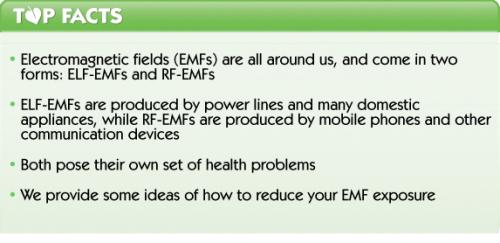
Particularly now that wireless communications are so closely integrated into our daily lives, electromagnetic fields (EMFs) are all around us.
Our cities, especially the larger ones, are perpetually shrouded in an invisible electrosmog, a ‘sea’ of EMFs through which we swim every day.
But does this momentous development in civilisation come with health effects – and if so, can we do anything to reduce them?
What is ELF-EMF and what are its sources?
It’s important to realise that there are two main forms of EMF: radiofrequency (RF)-EMF and extremely low-frequency (ELF)-EMFs. The frequency range of ELF-EMF is 1–300 Hz, and the Earth’s natural geomagnetic field strength varies from around 60 μT (microtesla) at the magnetic poles to around 30 μT at the equator.
Many man-made sources of ELF-EMF exist. Prime among these artificial sources are power lines and electronic appliances, with vacuum cleaners, electric can-openers, microwave ovens, shavers and hair dryers among the most powerful. These appliances emit ELF-EMF at field intensities ranging from 17.44 to 164.75 μT, measured from 5 cm away. Since the intensity of magnetic fields decreases dramatically with increased distance from the source, the corresponding range of magnetic field intensities at 50 cm is 0.12–1.66 μT.
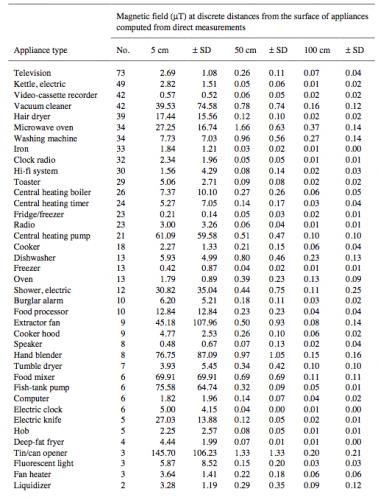
 Table 1. ELF-EMFs produced by domestic appliances. Taken from IARC Monograph Volume 80 (2002).
The International Commission on Non-Ionizing Radiation Protection (INCIRP) has set limits of 1 mT (millitesla) for occupational exposure to ELF-EMF, and 200 μT for general public exposure. While these limits are not breached by individual man-made sources, additive effects must also be considered, as we shall see.
What is RF-EMF and what are its sources?
The frequencies of RF-EMFs are considerably higher than ELF-EMFs, ranging from 100 kHz to 300 GHz. As its name suggests, the main uses of RF-EMF are in broadcasting information. In today’s data-driven world, this means that RF-EMF is constantly around us: it is produced by things such as mobile phone base stations, cordless phones, utility ‘smart’ meters, remote control toys, wireless networks, radar and baby monitors. In addition, there are various natural sources of RF-EMF, including the Earth, the Sun and other black body radiators.
Here’s a shocking statistic: did you know that having a cordless phone base station in your house can expose you to the same level of RF-EMFs as having a mobile phone mast in your back garden?
Do EMFs pose health problems?
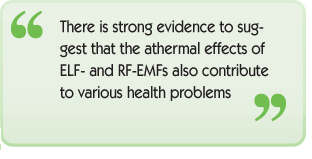
The mainstream view is that the only potential danger from EMFs stems from their heating effects on tissue, in the case of RF-EMF, or of electrical currents induced in the body for ELF-EMF. However, there is strong evidence to suggest that the athermal effects of ELF- and RF-EMFs also contribute to various health problems.
 Childhood leukaemia
According to the BioInitiative report, evidence indicates that risk of childhood leukaemia in young boys doubles when they are exposed to ELF-EMF levels of 1.4 mG (milligauss), while other studies indicate that leukaemia risks begin at 2, 3 and 4 mG. This occurs in the context of an ICNIRP limit of 1000 mG.
The BioInitiative report also found that ELF-EMFs interfered with recovery from childhood leukaemia: if a child was exposed to levels of ≥2 mG during recovery, their risk of death increased by 300%, while at levels of ≥4 mG that risk increased to 450%.
Alzheimer’s disease
ELF-EMF has also been found to increase the risk of Alzheimer’s disease by increasing levels of a protein called amyloid beta, a leading risk factor for Alzheimer’s.
Melatonin
EMFs have also been found to decrease the levels of melatonin in the body. Melatonin is produced in the pineal gland of the brain, which produces melatonin when it directly or indirectly detects low light levels. EMFs may interfere with this mechanism because the brain confuses them with light waves, thus suppressing the pineal gland’s melatonin production. Melatonin is an absolutely vital hormone. It acts as a powerful antioxidant, and has been found to aid in the prevention of Alzheimer’s, depression, cardiovascular diseases, insomnia, mood disorders, tinnitus and various cancers.
Brain and auditory nerve cancers
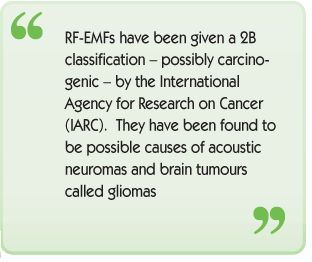
RF-EMFs have been given a 2B classification – possibly carcinogenic – by the International Agency for Research on Cancer (IARC). They have been found to be possible causes of acoustic neuromas and brain tumours called gliomas. Studies have shown that using cordless phones, which produce RF-EMFs, can increase the risk of brain tumours by up to 470% after ≥10 years of use when habitually used on one side of the head. Mobile phones, in the same scenario, can increase the risk by up to 200%. Both mobiles and cordless phones can trigger reactions in people who suffer from electrohypersensitivity.
What about interactions between EMFs and other factors?
Of course, EMFs don’t affect us in isolation: everyone living in a city, for example, is bombarded by numerous chemical toxins and other environmental pollutants, and many of them take multiple pharmaceutical drugs – in addition to constant EMF exposure. We are at an early stage of investigating and defining these complex interactions, but existing research indicates that these combinations can have both beneficial and adverse effects. For example, in vitro DNA damage was caused by a 7 mT magnetic field in combination with ferrous chloride, but not with either agent alone. Other combinations of EMFs and agents enhanced analgesia and neural performance.
Call to action: Reduce your EMF exposure!
Thus, you should take as many steps as possible to reduce your exposure to EMFs. Suggested strategies include:
- Using fibre-optic cables for your broadband
- Using wired connections whenever possible
- Keeping mobile and cordless phones away from your body
- Using wired baby monitors: children are more effected by EMFs than adults
- Keeping wireless routers or cordless phones out of regularly used bedrooms or children’s bedrooms
- Reducing time spent in calls when using mobile or cordless phones
- Reducing children’s exposure to wireless devices as much as possible
- Avoiding using microwave oven
- Avoiding placing wireless computers on your lap
- Avoiding allowing your children to use remote-control toys for long periods of time, if at all
ANH Europe Homepage
ANH EMR campaign page

Related content:
-

Electromagnetic radiation (EMR): The most pervasive environmental exposures
BioInitiative Report: A Rationale for a Biologically-based Public Exposure Standard for Electromagnetic Fields (ELF and RF) September 18, 2007 – BioInitiative Report / Complete 610 pp (pdf) From http://www.bioinitiative.org/report/index.htm I. SUMMARY FOR THE PUBLIC A. Introduction You cannot see it,…
-

Smart Meter Dangers: The Health Hazards of Wireless Electromagnetic Radiation Exposure
Over the past two years, there has been mounting medical and scientific evidence of the grave biological dangers to humans from so-called “Smart” Meters exposure that are being installed by the hundreds of thousands all over North America and Europe.…
-

Brain interactions with RF/microwave fields generated by mobile phones
Neither radiofrequency (30 kHz-300MHz) nor microwave fields (300-3000 MHz) exist as significant components of the natural terrestrial electromagnetic environment. In consequence, our human generation is the first to voluntarily expose itself to artificial RF/microwave fields that cover a wide spectrum…

Disclaimer: The contents of this article are of sole responsibility of the author(s). The Centre for Research on Globalization will not be responsible for any inaccurate or incorrect statement in this article. The Center of Research on Globalization grants permission to cross-post original Global Research articles on community internet sites as long as the text & title are not modified. The source and the author’s copyright must be displayed. For publication of Global Research articles in print or other forms including commercial internet sites, contact: publications@globalresearch.ca
www.globalresearch.ca contains copyrighted material the use of which has not always been specifically authorized by the copyright owner. We are making such material available to our readers under the provisions of “fair use” in an effort to advance a better understanding of political, economic and social issues. The material on this site is distributed without profit to those who have expressed a prior interest in receiving it for research and educational purposes. If you wish to use copyrighted material for purposes other than “fair use” you must request permission from the copyright owner.
For media inquiries: publications@globalresearch.ca


