
VIDEO — Secret ‘Minority Report’ Tech In All Post-2010 iPhones
Infowars
Jan 20, 2014
Apple installed secret ‘Minority Report’ tracking technology in all iPhones from 2010 and only just told you about it.
Minority Report Is Here: Chicago Residents Get Police Visit Based on Pre-Crime Surveillance List
by Nicholas West
Activist Post
Feb 19, 2014

Chicago’s “Heat List” – image source
As we look around at the Police State being built across the world, combined with enhanced mind control techniques, it is easy to draw direct parallels with books like 1984 and Brave New World. It’s almost as if these books formed a clear blueprint for anyone seeking control over large populations.
With the quickening pace of technological advancement it is no surprise to see “ideas” become reality quicker than ever before. Philip K. Dick explored the concept of pre-crime in his short story “The Minority Report” in 1956, but it wasn’t until Steven Spielberg offered it on the big screen as Minority Report in 2002 that the audience got a true look at a potential day-to-day existence under corporate and government data management and control.
We are now at the point where “Minority Report” is being used as a sound description of current technological applications, even in mainstream news, which means that the future is actually the present. Below you will find 10 signs that we have now entered the world depicted in fiction.
The latest news from Chicago only adds to this list, as police are moving beyond simply possessing the technology and are now putting it into effect.
Chicago’s “Heat List” is an index of approximately 400 people who have been identified by a computer algorithm as being future threats to commit violent crime. Without having actually committed a crime, some of those on the list are beginning to get visits from Chicago police warning them that they are already being watched:
When the Chicago Police Department sent one of its commanders to Robert McDaniel’s home last summer, the 22-year-old high school dropout was surprised. Though he lived in a neighborhood well-known for bloodshed on its streets, he hadn’t committed a crime or interacted with a police officer recently. And he didn’t have a violent criminal record, nor any gun violations. In August, he incredulously told the Chicago Tribune, “I haven’t done nothing that the next kid growing up hadn’t done.” Yet, there stood the female police commander at his front door with a stern message: if you commit any crimes, there will be major consequences. We’re watching you.
Chicago is apparently considering this to be part of “policing in the 21st century.” A report from The Verge explains how Chicago has taken the lead in predictive behavior police tech:
In 2009, the National Institute of Justice (NIJ) made millions of dollars in grants available for any police department with a burgeoning predictive program. Police all over the country applied to tap into those NIJ dollars. The big winner was Chicago; its combination of headline-making homicide rates and already established data- and tech-focused policing made it a perfect fit. The CPD received more than $2 million to test two phases of its experimental program.
Though it took awhile to get started in earnest (staff turnover and internal politics in 2011 and 2012 stalled the project), last year the CPD’s predictive program picked up steam. One man behind that progress was Miles Wernick.
Wernick is the Motorola professor and director of the Medical Imaging Research Center at Illinois Institute of Technology (IIT) in Chicago. He says he’s been doing predictive analysis work since the 1980s, when he worked with the US military to recognize potential targets in the battlefield. From there he proceeded to medical imaging. A lot of his current work focuses on analysing data and brain scans to make automated diagnoses of dementias in elderly patients — not exactly police work.
These paragraphs encapsulate two of the major warnings that the alternative media has been shouting for years: namely that military tech always trickles down into local law enforcement; and, secondly, that Big Data initiatives which are heralded by the establishment as solutions in the computing and medical fields have a range of privacy-killing additional applications that affect people far beyond the initially stated reach.
Also highlighted are the same concerns that are cropping up in the area of NSA spying – association is an assumption of tendency toward eventual guilt. Miles Wernick goes on to say:
“It’s not just shooting somebody, or being shot,” he says. “It has to do with the person’s relationships to other violent people.”
This is in line with what Andrew Papachristos, a Yale sociologist and Chicago native, calls a social networking theory. When it comes to violence, Papachristos recently told Chicago Magazine, “It’s not just about your friends and who you’re hanging out with, it’s actually the structure of these networks that matter.”
So while Wernick acknowledges that sometimes people such as Robert McDaniel — who haven’t been convicted of a violent crime — may find themselves in the wrong social networks, their presence on the list is not random.
A commander of the program stated it even more simply:
If you end up on that list, there’s a reason you’re there.
This indicates a fundamental shift in the way policing will be done in the future of America. Until now, we have been reporting on this type of technology and have been forced to speculate about its coming implementation. Well, now there is no doubt. And lest anyone believe that this is just an outcropping of Chicago’s notoriously Police State-happy mentality, Police Commander Jonathan Lewin matter-of-factly states the following:
This [program] will become a national best practice. This will inform police departments around the country and around the world on how best to utilize predictive policing to solve problems. This is about saving lives. [emphasis added]
Whether it will actually save lives is debatable. Has the No-Fly List saved lives? Have any of the other of the many lists one can be added to these days actually saved any lives? These lists are secretive and have become nearly impossible to independently verify as to how someone got on the list, if they deserve to be there; and, if not, how to get off the list … or if the lists are effective.
The Verge article linked below highlights the potential racial profiling of such policies – and indeed this has happened in the case of New York’s own low-tech Stop-and-Frisk policy.
So the verdict is out on saving lives. But one thing is for certain: the arrival of the high-tech Police State is certainly not about saving freedom, nor is it about preserving a Constitution designed to protect us from a Minority Report society.
Source:
http://www.theverge.com/2014/2/19/5419854/the-minority-report-this-computer-predicts-crime-but-is-it-racist
____________________________________________________________________________
10 Signs We Live In a “Minority Report” World
Individual pieces of news often get lost or forgotten rather easily in today’s fast-paced news cycle, so let’s look at an aggregate of 10 mainstream news items that offer a comprehensive picture of where we are and where we are likely to be headed both from a government surveillance standpoint, as well as targeted advertising.
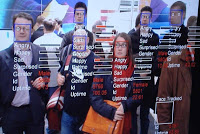
1. They’re watching … Japanese electronics company NEC develops ‘Minority Report’ style billboard, The Telegraph, 3/10/2010: “Engineers have developed the billboard, similar to one used in the Tom Cruise blockbuster, that uses built in cameras to instantly identify a shopper’s age and gender as they walk past. The facial-recognition system, called the Next Generation Digital Signage Solution, then offers consumers a product it thinks is suited to their demographic.”
2. Microsoft Kinect Learns to Read Hand Gestures, Minority Report-Style Interface Now Possible, IEEE Spectrum, 3/10/2013:
3. The Long Eye of the Law: So Who’s Ready for a ‘Minority Report’-Style Future? Motherboard, 3/20/2013: On Monday, Japanese tech developers Fujitsu announced they had created . . . a bit of technology that can measure a person’s pulse using a camera or a computer webcam, just by analyzing that person’s face . . . It’s Minority Report-style technology, to be sure—another in a burgeoning list of tech-driven ways police could prevent crimes before they happen.”
*Also see New York’s Domain Awareness System helped along by Microsoft.
4. Minority Report moves step closer as Lord Sugar launches face recognition adverts, The Telegraph, 7/9/2013: “The media company has launched OptimEyes, which will be used in more than 6,000 of its screens to target over 50m people in the UK, Germany, Poland, Switzerland, UAE, Oman, Kenya, Angola and South Africa. However, the majority of the screens, some 3,561, are in the UK in doctors’ surgeries, hospitals, convenience stores, petrol forecourts, Halifax banks, airports and train stations . . . The product comes less than a week after Sky Deutschland revealed it has developed technology to transfer adverts from train windows directly and silently into commuters’ heads.
5. Brain scans of inmates could lead to ‘Minority Report’ style ability to predict if they will re-offend, The Daily Mail, 7/15/2013: “Groundbreaking new research could allow scientists to predict if prisoners will re-offend – potentially condemning those convicted of serious crimes to a lifetime behind bars . . . It could also be used to the benefit of society in using brain imaging in deciding parole.”
6. Gesture Through News Minority Report-Style With New York Times’ Leap Motion App, Fast Company, 7/18/2013: Rather than having to flick through headlines on a touch-screen device or scroll through articles using a mouse — how antiquated! — the company’s new app allows readers to navigate through stories by motioning their hands in mid-air, with Leap Motion sensors interpreting the signals . . . The New York Times has also suggested it will give the company an opportunity to implement new advertising capabilities ‘that [will] allow brands to connect with readers using motion-controlled ad units.'”
7. Minority Report finally becomes a reality: new hi-tech video wall will let law enforcement agencies sift through data with a wave of their hand, The Daily Mail, 7/23/2013: “The hi-tech computer system behind the film Minority Report – where Tom Cruise speeds through video on a large screen using only hand gestures – is making its way into the real world. American computer experts have revealed the software has become a reality – and they hope to sell it to law enforcement agencies around the world. The interface developed by scientist John Underkoffler has been commercialized by the Los Angeles firm Oblong Industries as a way to sift through massive amounts of video and other data.”
*Also see this report on Big Data and pre-crime software.
8. Control Google Earth with Minority Report-style gestures, via Leap Motion, TNooz, 8/5/2013:
9. Minority Report-style Advertising Coming to NYC, 247Sports, 8/8/2013: “Recycling bins data mine your smartphone when you are in proximity to tailor ads when you walk by the screen and stuff. Already in London, looking to expand to NYC and other World cities soon.”
10. Google Submits Patent For Minority Report Style Eye Tracking Device, Prison Planet, 8/15/2013: “The patent filing describes a “head mounted device”, for example hi-tech glasses, that would have the ability to track eye movement, effectively monitoring reactions to external stimuli, including changes in emotion.” From The Verge: “Google could be betting that advertisers will pay to know whether consumers are actually looking at their billboards, magazine spreads, and online ads.”
From the patent application, which was filed in May 2011:
Pay per gaze advertising need not be limited to on-line advertisements, but rather can be extended to conventional advertisement media including billboards, magazines, newspapers, and other forms of conventional print media. Thus, the gaze tracking system described herein offers a mechanism to track and bill offline advertisements in the manner similar to popular online advertisement schemes.
***********
The ways that we are tracked, traced, and databased are increasing every day. Some of it is arriving without our agreement and is being utilized by private corporations and governments without our explicit approval, as the recent revelations of data spying have exposed. If we have learned one thing it is that information is knowledge and knowledge is power. The power of data collection in the hands of those who wish to exert more control is not likely to halt. And all indications show that it is not enough to have logged and charted where we have been; the surveillance state wants to know where we are going.
Our Orwellian world is beginning to look nostalgic compared to what is in production. Neuroscientists in 2010 stated that they know you better than you know yourself. Meanwhile, it is being estimated that computers know to a 93% accuracy where you will be, before you make your first move. The recent major global funding of neuroscience and narrative control indicates that the final target is the human brain and every thought that resides there.
However, we ought to be aware that much of our data is willingly being given via social media and the gadgets we choose to buy. As technology continues to march forward at an exponential rate, we might do well to consider how much of this we are comfortable buying into. And if we must, should we be seeking ways to subvert the information stream?
Recently From Nicholas West:
VIDEO — It Is Zionism Conquering Ukraine and Venezuela – Morris
108morris108
Feb 20, 2014
Creating shortages was the way that opposition to Morsi was created.
I wonder if Russia is being placated with Egyptian and Algerian lucrative contracts – not that i think that will work.
VIDEO — CrossTalk: Geneva 2 Intentional Failure?
RT
Feb 19, 2014
How likely are Western powers to retract their ‘Assad must go’ statements? Could we again see the possibility of the US striking the Assad regime? And what needs to happen for a breakthrough in the Syria talks? CrossTalking with Daniel Serwer, Christoph Horstel and Richard Rubenstein.
RT LIVE http://rt.com/on-air
Syria’s Chemical Weapons Stockpiles to be Transferred to the Italian Mafia?
 by Felicity Arbuthnot
Global Research
Feb 18, 2014
Does the disposal of Syria’s chemical weapons by the two selected waste disposal companies, namely Finland’s Ekokem and France’s Veolia require a contractual arrangement (or “agreement”) with Italy’s most powerful criminal syndicate on behalf of the Nobel Peace Prize winning Organisation for the Prohibition of Chemical Weapons (OPCW)?
Read down. Its a long saga…
On September 12, last year, Syria’s President al-Assad committed to surrender Syria’s chemical weapons, with the caveats that the United States must stop threatening his country and supplying weapons to the terrorists. He has been as good as his word. The same cannot be said for the US and its boot licking allies.
Three days earlier US Secretary of State John Kerry – who had been killing Vietnamese in the US onslaught on Vietnam as American ‘planes rained down 388,000 tons of chemical weapons on the Vietnamese people (i) – had threatened Syria with a military strike if the weapons stocks were not surrendered within a week, stating that President Assad: “isn’t about to do it and it can’t be done.”
 The ever trigger-happy Kerry was right on the second count, it can’t be done for two reasons, extracting dangerous chemicals from a war zone is, to massively understate, a foolhardy and hazardous business. Additionally it seems having received Syria’s agreement, the “international community” and the Nobel Peace Prize winning Organisation for the Prohibition of Chemical Weapons (OPCW) had no disposal plan in place and had not a clue what to do with them, whilst at every turn Syria is blamed.
As ever double standards and hypocrisy rule. According to CNN (10thOctober 2013):
“The United States estimates it will be at least another decade before it completes destruction of the remaining 10% of its chemical weapons, estimated at more than 3,100 tons.”
And Syria? “U.S. intelligence and other estimates put its chemical weapons stockpile at about 1,000 tons.” they are believed to be “stored in dozens of sites”, in the circumstances a logistical nightmare and a massive danger to the public and those driving them to be insisting on transporting them anywhere.
CNN also quotes Wade Mathews who had worked on “the U.S. project to destroy its chemical stockpile” who doubted that Syria could meet the deadlines. The US operation, he said: “took billions of dollars, the cooperation of many levels of government – including the military – and a safe environment to make sure the destruction was done safely.”
“We had a coordinated effort, we had a government that insisted that it be done safely and that the community was protected … I don’t think those things are in place in Syria.”
Shopping Around for a Country to Destroy the Weapons
Having received Syria’s compliance, the OPCW started shopping around for a country -any country it seems – to destroy the weapons. Norway, approached by the US, was first choice. They declined, since the country had no experience in dealing with chemical weapons, the Foreign Ministry website stating: “… Norway is not the most suitable location for this destruction.”
VIDEO — Battle for Yabroud – What the Media won’t tell you
Syrian Girl
Feb 19, 2014
Battle for Yabroud – What the Media won’t tell you
All rebel groups agreed to be under AlQaeda command and their holding hostage a group of 12 nuns from Ma’loula. Meanwhile Congress approve arms and Saudi starts arming..
VIDEO — Endless Standoff? Bahrain burns with protests 3yrs on
RT
Feb 13, 2014
Shia villages outside Bahrain’s capital have been left shrouded in tear gas after fierce clashes between police and anti-government demonstrators. The protest movement is marking three years of its uprising against the ruling Sunni monarchy, which has been met with a relentless crackdown and thousands of arrests. RT’s Alexey Yaroshevsky reports on the long-running standoff.
READ MORE: http://on.rt.com/4mqipf
RT LIVE http://rt.com/on-air


