by Stephen Lendman
Global Research
February 23, 2013
 Make no mistake. Syria is Washington’s war. It was planned years ago. Regime change is policy. At issue is replacing Assad’s government with a pro-Western puppet one.
Washington tolerates no independent governments. It demands subservience to US policies. Outliers are targeted for removal. Options include war.
Mass slaughter and destruction don’t matter. Unchallenged dominance is policy. It’s longstanding, ruthless and lawless.
Western-recruited death squads ravage Syria. They’ve done so for two years. They’re imported from abroad. Rules of engagement include mass murder, torture, and other atrocities.
Pro-Assad loyalists are prime targets. Innocent civilians are massacred. Doing so is official US policy. Imperial wars are called liberating ones. Terrorism is what they do, not us.
Syria was peaceful before US proxies invaded. So was Libya in 2011. It was ravaged and destroyed. It remains unstable and violent. Libya 2.0 looms.
Syria may become NATO’s latest charnel house. It’s well along the way already. Countries are ravaged on the pretext of liberating them. Empires never say they’re sorry. Policy isn’t pretty. It’s violent and lawless.
It reflects state terrorism. It proliferates death and destruction. It prioritizes wealth, power, privilege and dominance. Direct and proxy wars are waged.
Cutthroat killers are used. They’re recruited abroad. They’re heavily armed, trained, funded and directed. They’re ordered to commit mass murder. Obama bears full responsibility. He’s a war criminal multiple times over.
On February 22, the Syrian Arab News Agency (SANA) headlined “Fifty-Three Civilians Martyred, 235 Others Injured so far in Terrorist Bombing in al-Thawra Street in Damascus.”
Attacks struck central Damascus’ Mazraa neighborhood. Health Minister, Dr. Saad al-Nayef, said “terrorist bombing reflects the criminal nature of its perpetrators.”
Innocent men, women, children, the elderly and infirm were massacred. Syria continues to be ravaged and destabilized.
Al-Hayat Hospital and Abdullah Bin al-Zubir school were heavily damaged. So was Russia’s embassy. Itar Tass quoted a diplomat saying “The building has really been damaged. The windows are shattered.”
Other car bombs struck Damascus’ Barzeh neighborhood. A police station, telecommunications facility, and drug enforcement agency were targeted.
Mortar fire hit Syria’s Army General staff headquarters, Tishreen Sports City and residential buildings. Authorities said a car loaded with tons of explosives was stopped before it exploded.
Perhaps the terrorist group Jabhat al-Nusra was involved. It’s become Washington’s lead belligerent. It vows to “liberate” Damascus. It claims responsibility for 17 or more February Damascus area terrorist attacks. They included at least seven bombings.
Syrian communities abroad, Russia, China, Iran and Hezbollah condemned Thursday’s bombings.
Russian Foreign Ministry spokesman Alexander Lukashevich said:
“Once again, we call upon all countries and parties, which might influence the extremists and radicals, to pressure them and demand immediate stop of such terrorist acts and armed violence in order to create appropriate atmosphere to hold a Syrian dialogue that is based on Geneva statement issued last June, 2010.”
UN Secretary-General Ban Ki-moon showed which side he supports. He’s an imperial tool. He shames the office he holds. He violates UN Charter provisions. He urged both sides to show restraint. He called for ending Syria’s crisis politically.
Syria’s Foreign and Expatriates Ministry addressed two identical letters to the Security Council president and Ban. They condemned Thursday’s bombings. They called them cowardly acts.
They targeted crowded civilian areas. They followed previous ones conducted by Al Qaeda linked groups. They get “financial and logistic support and media and political coverage from regional and (Western) countries.”
SANA said:
“The Ministry added that the credibility of combating terrorism which has always been a matter of concern for the international community is now under unprecedented test as the most disgusting form of terrorism hit the Syrian civilians with no mercy or differentiating between an elderly man or a child.”
“The letters added that Syria, in its previous letters to the UN Security Council and the UN Secretary General, called for firm and clear condemnation of these heinous terrorist crimes by the UN member states and for holding countries which support such acts as responsible, whatsoever the form of such support was.”
“The Ministry said that Syria hopes the UN Security Council now will be able to adopt a firm stance which proves its commitment to combating terrorism regardless of its timing or place.”
If the Security Council turns a blind eye, “it will deepen doubts in its seriousness in combating terrorism and its commitment to implementing its resolutions in this regard, in addition to the fact this will be considered as a kind of political concealment of these crimes.”
The international community’s credibility “is at test,” it added. Failure to condemn this type terrorism is morally unconscionable.
It provides evidence of Western double standard duplicity. It reflects support for “organized terrorism.” Doing so won’t deter government forces from defending its citizens. Assad is committed to do so.
On February 21, Washington vetoed a Russian draft statement. It condemned Wednesday’s terrorist attacks. Moscow denounced US policy. It reflects support for what demands condemnation.
Foreign Minister Sergey Lavrov left no doubt where Russia stands, saying:
“This opposition by our American partners….is not the first time in which they seek a form that justifies those who fight the Syrian regime.”
“Russia sees in the American position an application of double standards and a dangerous approach in terms of the Americans moving away from the main principle of condemning terrorism in all its forms.”
Russia’s UN mission issued a statement saying:
“It is obvious that by doing so, the US delegation encourages those who have been repeatedly targeting American interests, including US diplomatic missions.”
It’s not the first time Washington obstructed responsible policy, it added. Moscow called doing so unacceptable. It reflects support for mass murder. It’s official US policy.
It threatens Lebanon. Free Syrian Army General Selim Idriss accused Hezbollah of shelling villages around Qusayr in Homs Governorate.
He issued an ultimatum. He threatened to respond if attacks don’t stop in 48 hours. He accused Hezbollah of sending combatants to Syria.
“As soon as the ultimatum ends,” he added, “we will start responding to the sources of fire.”
Hezbollah’s Hassan Nasrallah categorically denies sending fighters to Syria. At the same time, he said party members may be acting individually. He added that around 30,000 Shitte Lebanese inhabit 22 Syrian villages. Volunteers defend them against terrorist attacks.
On February 21, Lebanon’s Daily Star headlined “FSA claim of strikes on Lebanon false.”
An FSA statement claimed otherwise. It said one of its battalions targeted two Hezbollah bases. It struck with mortars, “machine guns and anti-tank missiles.” It did so near the Syrian/Lebanon border. It vowed more “surprises” ahead.
Longstanding Washington/Israeli policy prioritizes destabilizing Lebanon. At issue is replacing Hezbollah with pro-Western puppets, toppling Assad, isolating Iran, and solidifying US regional control.
Lebanon is small and vulnerable. From 1975 – 1989, it was wracked by internal conflict. From 1982 – 2000, Israel occupied southern Lebanon.
Hezbollah arose out of Israel’s 1982 invasion. It’s falsely called a terrorist organization. It’s for political reasons. It’s part of Lebanon’s government. It’s also a social, charitable, educational, and medical organization.
It provides essential social services. It’s military wing is defensive. It threatens no one. It’s prepared to respond forcefully if attacked. Israel learned the hard way in 2006. Its forces were outfoxed and humiliated. Israel yearns for revenge.
Involving Lebanon in Syria’s war may be planned. Obama and Netanyahu may have that in mind.
On February 21, Mossad-connected DEBKAfile (DF) headlined “Hizbollah on high alert, jockeys for a role in potential Syrian peace accord,” saying:
Its forces went on alert after the FSA’s ultimatum expired. Will its Beqaa Valley serve Assad, DF asked? Will its forces get involved? Are ceasefire talks credible?
According to DF, Assad’s military largely controls most of Syria. Ties to Hezbollah and Iran are firm. Each ally helps the others.
At the same time, FSA fighters may escalate conflict. They may conduct cross-border attacks. They’re no match for Hezbollah’s “far more organized and professional capabilities.”
“If they decide to go on the offensive, they are liable to suffer heavy losses.” Of greater concern is widening Syria’s conflict.
Israel’s currently involved. Last fall, IDF tanks shelled Syrian mortar batteries. Washington OK’d Israeli air strikes. Several targets were struck.
Israeli warplanes invade Lebanese airspace multiple times daily. They do so without permission. Policy is longstanding. It violates international law. Perhaps escalated conflict is planned.
It shouldn’t surprise. Washington and Israel partner in imperial lawlessness. Syria, Hezbollah, Hamas, and Iran are prime targets. Regional conflict may follow. What’s possible bears watching. Future updates will discuss more.
Stephen Lendman lives in Chicago and can be reached at lendmanstephen@sbcglobal.net.
His new book is titled “Banker Occupation: Waging Financial War on Humanity.”
http://www.claritypress.com/LendmanII.html
Visit his blog site at sjlendman.blogspot.com and listen to cutting-edge discussions with distinguished guests on the Progressive Radio News Hour on the Progressive Radio Network Thursdays at 10AM US Central time and Saturdays and Sundays at noon. All programs are archived for easy listening.
http://www.progressiveradionetwork.com/the-progressive-news-hour
http://www.dailycensored.com/washington-backs-syrian-anti-goverment-terrorism/
Related content:
-
Syrian government expels Western ambassadors
The Syrian Foreign Ministry has said in a statement that Damascus expelled the ambassadors of the US, Britain, France, Turkey and some other states. Ministry spokesman Jihad Makdissi announced the list of expelled diplomats on Tuesday. The expulsions came after…
-
Bush administration endorses anti-Palestinian, anti-Syrian offensive in Lebanon
The Lebanese government of Fuad Siniora is threatening to send the army into the Palestinian refugee camp of Nahr el Bared to crush the terrorist Fatah al Islam group. Such a move threatens a loss of innocent civilian lives that…
-
Terrorist Stronghold Destroyed: Syrian government troops chasing armed extremists in the suburbs of Damascus
Terrorist strongholds were destroyed and dozens of mercenaries were killed and wounded during an operation in the Daraya, Diyabiya and Babilla neighborhoods, the Syrian television reports. Fierce clashes continue in the Yarmouk Palestinian refugee camp near Damascus following an attack…
-
After veto of UN war resolution: Washington steps up drive to overthrow Syrian regime
Following its failure to ram through a resolution against Syria at the United Nations Security Council last week, the administration of Barack Obama has intensified its preparations to gather a “coalition of the willing” to oust the government of Syria…
February 23, 2013 | Categories: China, co-opting and/or destabilization, Iran, Israel, Lebanon, news, Russia, sovereignty, Syria, tyranny, UN, US, war | Leave a comment
Friends of Syria
February 11, 2013
The leader of the foreign-backed Syrian opposition coalition, Ahmed Moaz al-Khatib, has pledged allegiance to the Israeli regime if he manages to form a “new regime in Syria.”
 In a recent interview with the Israeli daily Yedioth Ahronoth, Khatib stated that Israel should not be worried about the Syrian government’s chemical weapons as his so-called Syrian National Coalition ‘is working with other countries to prevent chemical munitions from falling to the hands of the Lebanese resistance movement, Hezbollah.’
This is while the Syrian government has taken measures to further secure its chemical arsenal and has warned that the militants may use such arms against the people.
Khatib added that, “We’ll spare no effort to prevent any military or chemical weapons passing to it (Hezbollah). We realize that this topic is of major concern to Israel.”
Khatib also admitted to having received information from US, French and German intelligence agencies on the bases and movements of the Syrian army.
The remarks come nearly two weeks after an Israeli airstrike on a military complex near the Syrian capital of Damascus.
The Syrian army said in a statement on January 30 that two people were killed and five others injured in an Israeli airstrike on a scientific center in Jamraya, located 25 kilometers (15 miles) northwest of Damascus.
Syria has been experiencing unrest since March 2011. Many people, including large numbers of security forces, have been killed in the turmoil.
The Syrian government says the chaos is being orchestrated from outside the country, and there are reports that a very large number of the militants are foreign nationals.
http://www.presstv.ir/detail/2013/02/11/288377/khatib-vows-allegiance-to-israel/
February 17, 2013 | Categories: co-opting and/or destabilization, Israel, news, sovereignty, Syria, tyranny, war | Leave a comment
PressTV
January 26, 2013

Hezbollah leader Seyyed Hassan Nasrallah
The secretary general of Lebanon’s resistance group Hezbollah says the results of the general elections in Israel indicate that the regime will suffer from a deep political leadership “crisis.”
“The Israeli election results showed a retreat of parties that founded and led the entity, such as Likud” Seyyed Hassan Nasrallah said in a speech broadcast on Al-Manar television channel on Friday.
The results of the polls show incumbent Prime Minister Benjamin Netanyahu’s hard-line Likud-Beitenu bloc and their allies have won a narrow majority in the Israeli general election. The right wing coalition secured only 31 seats, losing a quarter of its seats in the Knesset.
Nasrallah went on to say that no party had achieved a decisive victory, “as Netanyahu hoped in order to lead Israel.”
He added that the results demonstrated a “crisis for the new political leadership, a crisis for the parties and a crisis of confidence” in the new Israeli cabinet.
The new centrist party, Yesh Atid (There is a Future), led by journalist-turned-politician Yair Lapid, won 19 seats, followed by left-leaning Labor, with 15 seats.
In the end, the right-wing bloc won 61 of the 120-seat Knesset, while 59 seats went to center-left parties.
After the election, Netanyahu vowed to reach out to other parties to form a large coalition. “Tomorrow we start anew.”
“Netanyahu’s victory is a Pyrrhic victory, and it is not clear he will be the next prime minister,” Israeli political analyst Yaron Ezrahi said on Wednesday. “Netanyahu will face difficulty in constructing a viable coalition,” he added.
Ezrahi said he believed the next Israeli government would only last about 18 months.
DB/MA
January 26, 2013 | Categories: Israel, Lebanon, news, sovereignty, tyranny | Leave a comment
 by Patrick Henningsen
21st Century Wire
January 16, 2012
BEIRUT – On arrival to Lebanon’s capital city, all seems very functional and normal on the surface, as the city runs business as usual.
Below the surface however, there is a feeling of trepidation, an unspoken collective worry that a city and country who has gradually managed to pick up the pieces from the decades-long conflict which stretched through the 70’s and 80’s, an Israeli occupation of its south, followed by a brief, albeit destructive, ‘33 Day War’ with Israel in 2006 – might once again be dragged into another sub-regional conflict. It goes without saying that police and security services in Lebanon are on high alert.
Tourism Hit Hard
The neighboring conflict has also had a very negative impact on Lebanon’s tourism, keeping away the much-needed outside currency for which many jobs, independent hotels and other SMEs are dependent for their economic survival. But despite the recent problems, Beirut is still moving ahead, still attracting some foreign investment made visible by the hundreds of new building projects springing up all over the city. And as expected, the restaurants seem busy and the cafes are still buzzing.
Already there is a tangible presence of Syrian refugees in Lebanon and in the capital Beirut, who have fled from the fighting and breakdown of society currently unfolding next door. The impact of the Syrian conflict on its neighbor Lebanon in such a short space of time is substantial.
Latest reports put the number of Syrian refugees recently accumulated in Lebanon at 300,000. This figure is contrasted by the number of Palestinian refugees whose ancestors fled Israel’s ethnic cleanings in 1947-48, still housed in Lebanon today – which is currently estimated at 500,000.
The Issue of Sectarianism
Lebanon is, more than ever, a demonstration of sectarianism par excellence. In of country of 4 million, there is differentiation within the Christian community – Greek Orthodox, Maronite, Melkite, Greek Catholic and Roman Catholic, as well as within and the Muslim community – Sunnis, Shi’ites, and Druze. In addition to this, there is a substantial Armenian community, a large community of foreign nationals from the US and Europe, Asian and African migrant workers, and a small Jewish community. One might also note that the internal rifts between Christian and Muslim factions are almost as great as the polarity separating Christians and Muslim as a whole.
That said, it is also the only society in the region where contrasting religions and cultures are completely intermingled and where tolerance has evolved into a virtue.
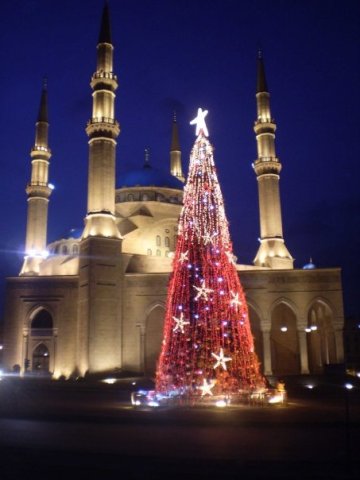
Co-existance: A scene from a recent Christmas illustrates the country’s diversity (PHOTO: Mary Henningsen)
In its totality, Lebanon consists of some of 19 religions and dozens more ethnic , groups. Many a thesis and book have sought to chronicle (and will continue to argue no doubt) this strive towards cultural détente in the Levant. One such writer is Lebanese-American Professor Walid Phares, who sums up the country’s current alignment as follows:
“Although multi-ethic and multi-religious, Lebanon was viewed by the political establishment as a unitary republic which can only have a majority and a minority. Therefore, and without a mechanism of decentralization, Federation or simply pluralism, that establishment was vying over who really represents the “majority” of all Lebanese, and who reduced to a “minority.” The debate was then about numbers, census, demographic changes, communities who have allegedly increased in numbers because of poverty versus communities who have decreased in numbers because of emigration. But that was a false problem.”
Much of the country’s political energy has been expended over the course of the last half century in determining who is the majority and who is the minority, and although the intention was to present a fair solution to representation in its central government, it has also been the source of internal power-politics, which some believe laid down a fertile soil for the sharp upheaval Lebanon experienced from 1975 onward.
Nowhere is the nation’s simmering ‘political ratio’ reflected more than in its own constitution – a document which goes to extraordinary lengths to secure some form of socio-religious balance. The Lebanese constitution mandates that the office President should be held by a Maronite Christian, the Speaker of the House held by a Shi’ite Muslim, and the post of Prime Minister held by a Sunni Muslim.
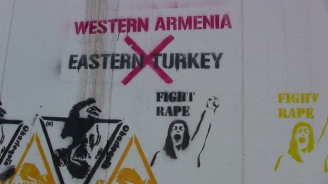
Beirut shoulders a diverse collection of ethnic groups, along with their corresponding political issues (PHOTO: Patrick Henningsen)
Many academics such as Phares, feel that the future would be brighter if Lebanon would embrace its multicultural reality and take a feather out of Belgium’s or Canada’s cap, and consider phasing out its historical obsession with ethnic and religious minorities and majorities. In other words, if Lebanon could embrace ‘multiculturalism’, it wouldn’t need the old system. This idea is easier said than done, as vested political interests and blood spilled over decades has, to a large degree, cemented traditional political and social paradigms into place.
Syria Simmering Next Door
What’s foremost on the minds of Lebanese in 2013 is what will happen with Syria, and will Lebanon we dragged to their war. Alongside this, many are left questioning whether or not Lebanon will ever achieve some form of long-term peace with its southern neighbor Israel. The former is the key to its short-term prosperity, while the latter is the key to healing wounds still festering from the wars, as well as the influx of Palestinians it has had to shoulder since 1948.
The situation in Syria is made even more complex by the fact that a number of foreign powers with vested interests in Damascus regime change are supplying fighters, arms, logistics, money and mass media support – which has always been a recipe for chaos throughout history. Among these foreign actors vying for position in Syria are Saudi Arabia, Qatar, Jordan, Turkey, US, UK and France (somehow, it’s all beginning to look more and more like pre-WWI power-politics).
Syria has long played an overshadowing role in the stability – and destiny of its smaller neighbor Lebanon. The scares still run deep from Syria’s obtuse and often disjointed alliances with different factions over the course of Lebanon’s Civil Wars in the 70’s and 1980’s. The result of Syria’s hand in those affairs has been a dysfunctional, and often times confusing relationship between Damascus and Beirut, as well as the cause for political dysfunction within Beirut itself.
In 2013, however, the alignments are markedly different from previous decades. For starters, Syria, itself, is now a major piece on the global chessboard, not least of all because of its three major allies, all of whom seem to run contrary to ‘central planning‘ in the West – namely, Hezbollah in Lebanon, Iran and now Russia. All interested parties see Syria as the key domino, and this, rightly so, is the cause for much worry right now.

Stunning countryside: Sunset over the historic Chouf mountain range in southern Lebanon (PHOTO: Patrick Henningsen)
Lebanon has a number of internal issues I’m sure it would prefer to sort out first before being dragged into another sub-regional conflagration – like it’s own central government, its economy, its potentially massive tourism trade, and of course, the Palestinian refugee issue.
Yesterday, I was able to travel south the ancient city of Tyre, some 16km from the the Israeli border. The ruins are stunning, but so are the Palestinian refugee camp which runs alongside it. It’s was a little tragic, if not amusing to discover there that some Palestinians in need of rock for building their homes had permanently borrowed some of the antiquity ruins next door. In a certain way, some five millennia of history puts the current protracted upheaval into some perspective.
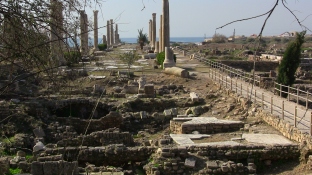
Ancient city of Tyre in Lebanon (PHOTO: Patrick Henningsen)
The recent past certainly has pulled Lebanon down in a spiral of social tension and extreme economic strife, but set against the larger backdrop of successive empires and cultures who have been overlaid on to this small, but historically pivotal region, it’s merely the latest chapter in a much larger epic novel. Many people outside of Lebanon – academics, archeologists, tourists – all long to see Lebanon achieve stability and one day showcase its incredible cultural and historical wealth to the world.
In essence, making the difficult transition from a fractured state, to one of stability and eventual prosperity. I talked about this to one long-term Beirut resident, named Jamal, who put it simply, “To do all this, first we need to have peace.”
It’s that simple. On paper anyway.
….
Writer Patrick Henningsen is a roving correspondent for the UK Column, as well as host of 21st Century Wire TV programme airing Thursdays at 6pm on PSTV SKY channel 191 in the UK.
….
January 16, 2013 | Categories: France, Israel, Lebanon, news, Palestine, Saudi Arabia, Syria, Turkey, tyranny, UK, US | Leave a comment


 by Patrick Henningsen


 PN
PN 