
Banking culture breeds dishonesty, scientific study finds
By Kate Kelland, Health and Science Correspondent
LONDON Reuters
Nov 19 (Reuters) – A banking culture that implicitly puts financial gain above all else fuels greed and dishonesty and makes bankers more likely to cheat, according to the findings of a scientific study.
Researchers in Switzerland studied bank workers and other professionals in experiments in which they won more money if they cheated, and found that bankers were more dishonest when they were made particularly aware of their professional role.
When bank employees were primed to think less about their profession and more about normal life, however, they were less inclined to dishonesty.
“Many scandals..have plagued the financial industry in the last decade,” Ernst Fehr, a researcher at the University of Zurich who co-led the study, told reporters in a telephone briefing. “These scandals raise the question whether the business culture in the banking industry is favouring, or at least tolerating, fraudulent or unethical behaviours.”
Fehr’s team conducted a laboratory game with bankers, then repeated it with other types of workers as comparisons.
[…CONTINUE READING THIS ARTICLE]
[hat tip: Drudge Report]
VIDEO — Orgone Energy — A breakthrough that has already happened – GLOBAL BEM conference Nov 2012
Georg Ritschl
Mar 27, 2013
My presentation on Orgonite and orgone energy at the Global Breakthrough Energy Movement (BEM) conference in Nov 2012, Hilversum, Netherlands. See also http://orgoniseafrica.com for more information
Acid Rain Has Turned Canadian Lakes into a Kind of Jelly
by John Metcalfe
CityLab
Nov 19, 2014
A legacy of industrial pollution is allowing slimy ooze to thrive.
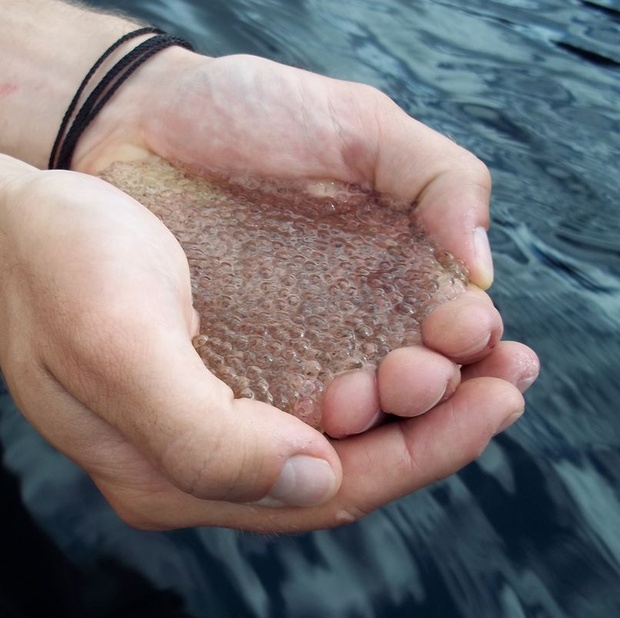
Yum! A researcher holds slimy plankton taken from a lake in Ontario. (Ron Ingram/MECC)
Swimmers who dive into a number of Canadian lakes might not emerge clean and refreshed, but dripping with globs that resemble slimy fish eggs. A legacy of industrial pollution has caused great changes in the country’s water chemistry, creating a boom in tiny organisms that transform lakes into “jelly.”
That’s the gooey news from scientists behind a new paper in Proceedings of the Royal Society B, who say that populations of this particular organism have doubled since the 1980s in many of Ontario’s lakes. The reasons involve a complex dance of species, but here’s the short version: Acid rain caused by smelting operations and other human activity removed calcium from the soil in drainage areas. That depleted the calcium levels in many lakes, which has hurt a kind of plankton (Daphnia) that needs the element to build armor. Enter a competing plankton, Holopedium, which requires far less calcium to bulk up and is coated with a gel that’s excellent at repelling predators.
[…CONTINUE READING THIS ARTICLE]
[hat tip: Frank Gotz]
The dark side of social media: Baroness Susan Greenfield says social media is rewiring our brains
news.com.au
Nov 17, 2014

Baroness Susan Greenfield is a brain scientist who says time spent with electronic devices is rewiring the brain. Source: News Limited
WE’RE all guilty of it. We’re at the pub, dinner table or enjoying a fun arvo with a group of friends and, instead of talking to the people we’re with, we’re preoccupied with our phones.
Facebook, Instagram, Twitter, video games and — dare I say it — news.com.au all provide endless distractions, as well as more opportunities to share, connect and spout your views than ever before.
But what effect is this having on us? More crucially, how is it affecting our brains?
Renowned British neuroscientist Baroness Susan Greenfield says modern technology is not only changing the way we interact, it is changing the wiring in our brain.
Professor Greenfield, who is also a member of the British upper house, says the hyper-connectedness of today’s youth gives them shorter attention spans and makes them more narcissistic, more susceptible to depression and anxiety, and less empathetic.
“The mid-21st century mind might almost be infantilised, characterised by short attention spans, sensationalism, inability to empathise and a shaky sense of identity,” she told parliament in 2009.
Her interest in the subject has culminated in her book Mind Change, released in August, in which she argues:
● That social media is affecting our sense of identity and ability to empathise,
● That video games are shortening attention spans, and increasing our recklessness and aggression, and
● That search engines are making us confuse information for knowledge.
Prof Greenfield says that the brain is exquisitely designed to adapt to its environment and, because technology has created a vastly changed social environment, it follows that our brains may also being changing in an unprecedented way.

What effect does our addiction to screens have on the way we relate to each other? Source: Supplied
She argues that today’s youth are developing in a world where relationships are increasingly formed online, which means we are less able to rehearse important social skills.
“Human beings love talking about themselves. Nature has developed body language so you can be sure that your interaction is reasonably secure, and you don’t make yourself vulnerable, through eye contact, gestures and pheromones,” Prof Greenfield told news.com.au.
But words — the primary means through which people interact on social media — make up only 10 per cent of the impact made when you meet someone.
“If you are not rehearsing those visual clues, you are going to be at a disadvantage,” Prof Greenfield said.
She said people were much more likely to insult others online because they didn’t have those cues.
“If someone says ‘I hate you’ to someone’s face, they may not say it again because the way it makes that person feel may be extremely hurtful, which can give the person who said it a physiological churning,” Prof Greenfield said.
“Those constraints are not available on social networking. You don’t have that handbrake … That’s what I’m concerned about.”
[…CONTINUE READING THIS ARTICLE]
[hat tip: Neil Sanders]
Google Is Making Magnetic Nanoparticles That Will Search For Disease Inside Your Body
Canadian Awareness Network
Nov 3, 2014

by JILLIAN D’ONFRO OCT. 28, 2014, 1:27 PM
Google is in the early stages of creating tiny, magnetic nanoparticles that will be able to search the human body for cancer and other diseases, The Wall Street Journal’s Alistair Barr and Ron Winslow report.
Google’s goal is “an early heads-up” on disease to ultimately facilitate more effective treatment by making medicine proactive instead of reactive.
Google’s particles will be less than 1/000 the width of a red blood cell and will attach themselves to specific cells, proteins, and other molecules inside the body, depending on what they’re “decorated” with. For example, Google could coat its nanoparticles with a specific antibody that would recognize and attach to a protein on the surface of a tumor cell.
Google is also working on a small wearable device that would attract and count the particles. In that way, the system would be used for testing and monitoring health: You could be alerted through the wearable if a lot of the particles were attaching to tumor cells. Google admits, however, that it still needs to better understand what constitutes as a healthy level of disease-carrying molecules in the blood and what would be a cause for a concern (Google’s “Baseline Study” is already trying to define what a healthy human looks like). The idea is that people would be constantly monitoring their bodies, so they wouldn’t wait until they felt physically sick to go to the doctor.
Google would likely let people consume its nanoparticles through a pill, but is reportedly at least five to seven years away from a product that would be approved by doctors.
“Every test you ever go to the doctor for will be done through this system,” Andrew Conrad, head of the Life Sciences team at Google X and the man leading the project, said at The Wall Street Journal’s “WSJD Live” conference. “That’s our dream.”
Conrad told The Wall Street Journal that Google would not collect or store any medical data itself, but would license the technology out.
“We’re going to be inventors that work on the technology— disruptive, innovative technology—and then we’re going to look for partners who will bring it forward,” Conrad told Backchannel’s Steven Levy.
More than 100 Googlers — with backgrounds including chemistry, astrophysics, and electrical engineering — are working on this nanoparticle project. The company is also collaborating with MIT, Stanford, and Duke.
Watch a video from the WSJ conference:
Read more Here
VIDEO — UFO? Meteor? Blast? Massive light flash over Russian Urals stuns locals, scientists (DASHCAM)
RT
Nov 18, 2014
A huge flash lit up the early evening darkness, as shown by images taken from a dashcam on a road close to Yekaterinburg. Emergency services refuse to comment cause of extraordinary blast in the dark sky.
NASA-affiliated scientists invent self-destructing bio-drone made of fungus and bacteria
End the Lie
[Nov 14, 2014]
A biodegradable drone made out of fungus, bacteria and wasp spit built by NASA-affiliated scientists may pave the way for future spyware, which would simply self-destruct if it crashes, leaving behind only minute remnants.
The biological drone would simply melt away, according to its designers. “No one would know if you’d spilled some sugar water or if there’d been an airplane there,” Lynn Rothschild of NASA’s Ames Research Center in California told New Scientist. The model was conceived by a group of scientists from across Stanford, Brown and Spelman College.
The bio drone completed its first flight earlier this month at the International Genetically Engineered Machine competition in Boston. It is primarily made of a fungal material called mycelium – the vegetative part – and looks a little bit like a cardboard drinks holder.
After the main body was produced, the outer skin had to be made out of bacterial cellulose sheets, which were grown in a laboratory and take on a sticky, leathery type consistency. It was then waterproofed, but this still had to allow for its immediate biodegradability.
The solution was to coat the device in proteins, which had been cloned from paper wasps’ saliva – what they use to gel their nests together and waterproof them.
However, the problem is that key components of the machine could not be made biodegradable for obvious reasons – propellers, batteries and controls had to be separately sourced.
“There are definitely parts that can’t be replaced by biology,” team member Raman Nelakanti of Stanford University told New Scientist.
Nevertheless, it will not stop further attempts by the team to develop sustainable bio-material replacements for as many parts as possible. The team has expressed a desire to develop sensors made out of E.coli bacteria.
The biological drone was an entry for the International Genetically Engineered Machine (iGEM 2014) competition. The team has shared the drone designs on their website so that people can try 3D-printing their own models.
Source: RT

 PN
PN 