
VIDEO — 8/30/2014 — Freak Late Summer SNOW STORM at Yellowstone National Park
Dutchsinse
Aug 30, 2014
A late summer snow storm at Yellowstone national park?!
The national park webcams showed the freak snow event (August 30, 2014) from Mt. Washburn facing Northeast.
The camera refreshes once every 1-2 minutes, time lapsed in fast forward, then slowed down for easier viewing.
Download the individual frame stills from the NPS here:
http://uploadshed.com/public/yellowst…
_____
Music is my own original composition 🙂
_____
National weather service watch / warning here:
http://alerts.weather.gov/cap/wwacapg…
Nanotechnology: Are You Ready To Be Reengineered? w/infographic
by Nicholas West
Activist Post
May 24, 2014
Nanotechnology is probably not the reading material sitting on the coffee tables of most people. Yet, it is already beginning to have an impact on everything from electronics to alternative energy to food, cosmetics and clothing. In fact, several hundred common products contain nanomaterials, which has prompted lawsuits against the FDA for failure to properly regulate them.
For futurists and Transhumanists, the human body is the final frontier.
The nanotech revolution has been heavily invested in by the U.S. government, as outlined in their National Nanotechnology Initiative Strategic Plan, which involves 20 federal agencies and partners. This must-read document lays out a projected future to understand and control matter for the management of every facet of the environment, health and safety.
We are beginning to see the dividends being paid to Big Pharma through edible nano-sized microchips and other “smart” pills aimed to surveil the internal workings of the body, and one day perhaps completely reengineer humanity from the atomic level on up … including the brain.
The infographic below offers a comprehensive overview of how this reengineering will take shape. Now is the time to start paying close attention to these developments, as what has been considered to be science fiction conspiracy theory thus far is now being openly discussed on the world stage as Humans 2.0.
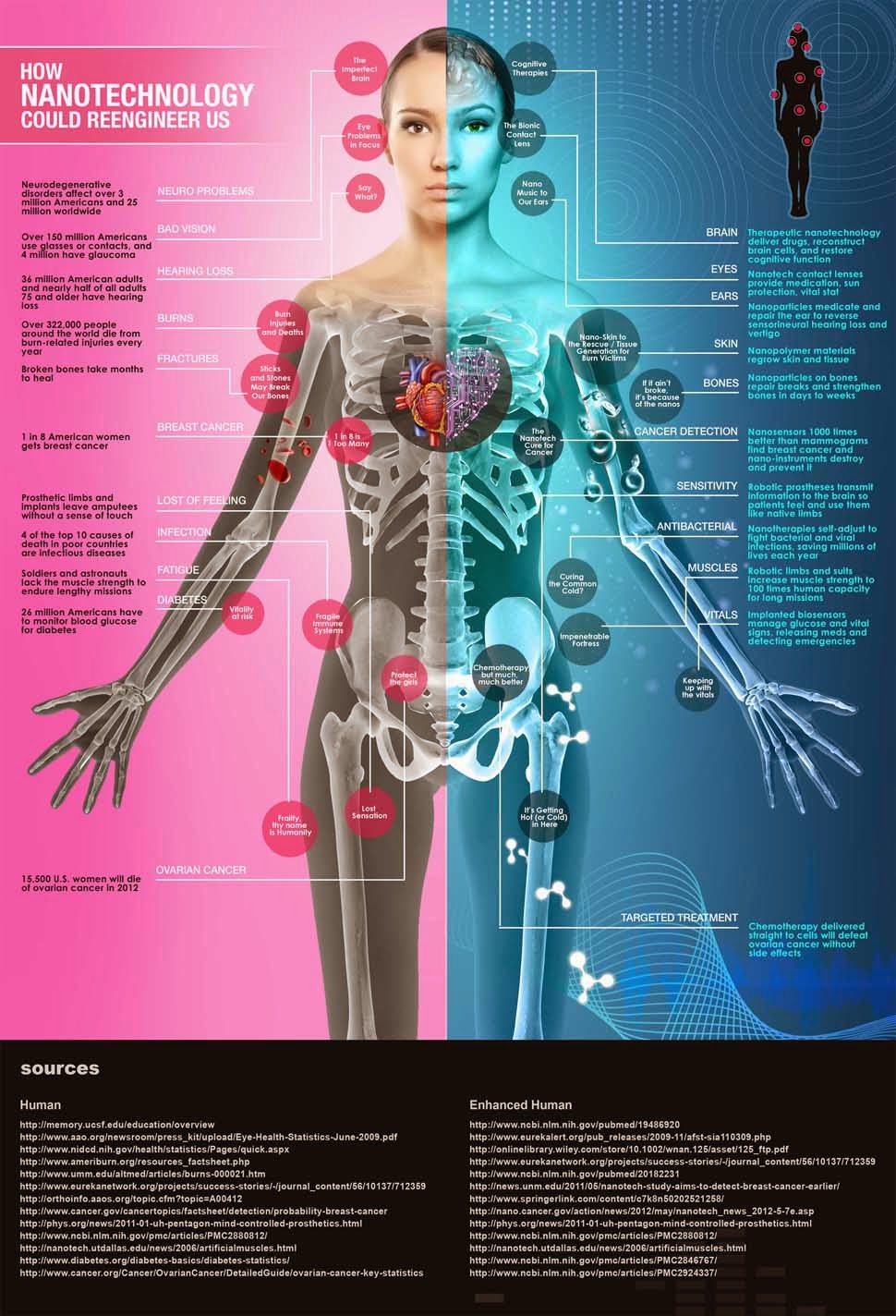
Source, and for larger image:
How Nanotechnology Could Reengineer Us – Keithley Instruments
Hat tip: 33rd Square
Recently by Nicholas West:
Researchers Achieve First Successful Telepathic Transfer
Zen Gardner
Aug 22, 2014

by Nicholas West
There has been much speculation about what could be achieved in the area of human brain-to-brain transfer of information.
A series of studies have intimated at the possibilities:
- Brain-to-Brain Control Established Between Humans and Animals at Harvard
- Remote Controlled Humans Via Internet Now a Reality
- New Mind Reading Research Aims to Synchronize Humans
Now an international team is declaring a successful brain-to-brain data transfer between a person sitting in India to a receiving person in France.
The evolution of civilization points to a progressive increase of the interrelations between human minds, where by “mind” we mean a set of processes carried out by the brain [1]. Until recently, the exchange of communication between minds or brains of different individuals has been supported and constrained by the sensorial and motor arsenals of our body. However, there is now the possibility of a new era in which brains will dialogue in a more direct way [2]. … Pioneering research in the 60′s using non-invasive means already demonstrated the voluntary control of alpha rhythm de-synchronization to send messages based on Morse code [11]. Over the last 15 years, technologies for non-invasive transmission of information from brains to computers have developed considerably, and today brain-computer interfaces embody a well-established, innovative field of study with many potential applications[12]–[16]. Recent work has demonstrated fully non-invasive human to rat B2B communication by combining motor imagery driven EEG in humans on the BCI sidewith ultrasound brain stimulation on the CBI-rat side [17]. … Here we show how to link two human minds directly by integrating two neurotechnologies – BCI and CBI –, fulfilling three important conditions, namely a) being non-invasive, b) cortically based, and c) consciously driven (Fig. 1). In this framework we provide the first demonstration of non-invasive direct communication between human minds. (emphasis added)
The method used was Transcranial Magnetic Stimulation, which has shown the most promise in directly accessing the brain and “thought.”
The intensity of pulses was adjusted for each subject so that a) one particular orientation of the TMS-induced electric field produced phosphenes [19](representing the “active direction” and coding the bit value “1”), and b) the orthogonal direction did not produce phosphenes (representing the “silent direction” and coding the bit value “0”). Subjects reported verbally whether or not they perceived phosphenes on stimulation.
This resulted in online data transfer from mind to mind to mind – telepathic e-mail, essentially:
On March 28th, 2014, 140 bits were encoded by the BCI emitter in Thiruvananthapuram and automatically sent via email to Strasbourg, where the CBI receiver (subject 3) was located. There, a program parsed incoming emails to navigate the robot and deliver TMS pulses precisely over the selected site and with the appropriate coil orientation. A similar transmission with receiver subject 2 took place on April 7th, 2014. In both cases, the transmitted pseudo-random sequences carried encrypted messages encoding a word – “hola” (“hello” in Catalan or Spanish) in the first transmission, “ciao” (“hello” or “goodbye” in Italian) in the second. Words were encoded using a 5-bit Bacon cipher [31] (employing 20 bits) and replicated for redundancy 7 times (for a total of 140 bits). The resulting bit streams were then randomized using random cyphers selected to produce balanced pseudo-random sequences of 0′s and 1′s (for subject blinding and proper statistical analysis purposes in addition to providing word-coding). On reception, de-cyphering and majority voting from the copies of the word were used to decode the message.
All of this is a technical way of saying that, for the first time, not only has there been a signal transfer representing data, the potential has opened up for the transmitting of emotions – a mind-to-mind transfer, not merely brain-to-brain.
Learning a Second Language Staves off Cognitive Decline
 by Elizabeth Renter
Natural Society
Aug 23, 2014
Do you speak more than one language? If so, you could be less likely to suffer from age-related cognitive decline, as reported by recent research. If you don’t speak another language, don’t worry; it’s never too late to learn!
According to a new study published in the Annals of Neurology, knowing more than one language can help protect your brain from decreased performance later in life. And the evidence says you can even reap the benefits if you don’t learn the language until later in adulthood.
“Our study is the first to examine whether learning a second language impacts cognitive performance later in life while controlling for childhood intelligence,” said lead researcher Dr. Thomas Bak of the Centre for Cognitive Aging and Cognitive Epidemiology at the University of Edinburgh.
Could Japan’s Fukushima Radiation be Mutating Vegetables?
 by Christina Sarich
Natural Society
Aug 23, 2014
An artist that lives in the northern portion of the Mie Prefecture, in Western Japan (but still within Fukushima’s radiation-circle) has posted pictures on Pinterest of some very outlandish looking carrots that he dug up from his own garden.
The poster simply comments, “The carrots that grew in my garden look too abnormal this year . . .”
Some refute the ‘mutant fruits and vegetable’ pictures popping up on different Internet sites, stating that they are a hoax, and others are insistent that the pictures they are posting are real. There have been mutant cabbages, 4 times the normal size, and tomatoes that seem to have exploded, but is this all sensationalized news, or something we should really be concerned about?
[…CONTINUE READING THIS ARTICLE]
[related: Reports of Genetic Abnormalities in Birds, Insects, Plants Near Fukushima]
Japan landslide emergency worsens
The Guardian
Friday 22 August 2014 06.46 BST
Agence France-Presse in Tokyo
Rescuer and boy he was trying to save are swept away as number of missing rises and Hiroshima braces for more rain

Japanese soldiers search for survivors in the mud and wreckage from landslides on the outskirts of Hiroshima. Photograph: Toru Hanai/Reuters
The death toll from huge landslides in western Japan could more than double, police have said, as the number of missing people rose to 52 in addition to the 39 confirmed dead.
Dozens of homes were destroyed when mountainsides collapsed on the outskirts of Hiroshima on Wednesday, with tonnes of mud, rocks and debris crashing into suburban communities.
More than 4,000 people have been ordered to evacuate their homes after forecasters warned more rain was on the way to already soaked hillsides, heaping misery on an area that has seen record downpours.
Firefighters, police and soldiers had to abandon search efforts on Thursday night because of the risk of further landfalls. One rescuer was killed in a secondary mudslide on Wednesday along with a small boy he was trying to carry to safety.
The confirmed death toll on Friday stood at 39 but the number of missing was raised to 52, having risen steadily over the last two days from initial single figures.
Officials said improved co-ordination between emergency services and local authorities meant they were aware of more people who had not been heard of since the disaster.
“We initially counted only the people who were certain to be missing, such as those witnessed being carried away in gushing water,” said a spokesman at Hiroshima prefecture police.
“As we continued to investigate and assess the situation, the number rose,” he said.
Firefighters and soldiers were still keeping heavy machinery away from collapsed houses, preferring to remove debris by hand in the hope of finding survivors.
The Music Industry Is Literally Brainwashing You to Like Bad Pop Songs — Here’s How — video included
Canadian Awareness Network
Aug 13, 2014
By Tom Barnes August 4, 2014
Last summer it was “Blurred Lines.” This summer it’s “Fancy.” Every year, there’s a new song that we all hate until we don’t anymore (see: playcounts). And it turns out that’s because we were brainwashed to like them.
Research suggests that repeated exposure is a much more surefire way of getting the general public to like a song than writing one that suits their taste. Based on an fMRI study in 2011, we now know that the emotional centers of the brain — including the reward centers — are more active when people hear songs they’ve been played before. In fact, those brain areas are more active even than when people hear unfamiliar songs that are far better fits with their musical taste.
This happens more often than you might think. After a couple dozen unintentional listens, many of us may find ourselves changing our initial opinions about a song — eventually admitting that, really, Katy Perry’s “Dark Horse” isn’t as awful as it sounds. PBS’ Idea Channel‘s Mike Rugnetta explains, it’s akin to a musical “Stockholm syndrome,” a term used originally by criminologist Nils Bejerot to describe a phenomenon in which victims of kidnapping may begin to sympathize with their captors over time.

 PN
PN 