
Ebola: Panic or Pandemic? – An open source investigation — video included
by James Corbett
corbettreport.com
August 6, 2014
This post is intended as a round-up of available information on the current Ebola outbreak from various sources around the web. Corbett Report members are encouraged to debate and discuss the situation in the commments thread below, ask questions, suggest links, and otherwise contribute to this investigation. The comments will be used to piece together an upcoming episode of The Corbett Report Podcast on this subject [UPDATE: The podcast is now available for download here]. [Not a Corbett Report member? Sign up today.]
Overview: Official information on Ebola virus
 Ebola haemorrhagic fever is the human disease caused by the Ebola virus. According to the World Health Organization (WHO), the disease has a fatality rate of up to 90% and is “one of the world’s most virulent diseases.” The disease first appeared in 1976 in two simultaneous outbreaks, one in the Congo (near the Ebola river) and the other in a remote area of Sudan. It transfers through close contact with blood of an infected animal (including chimpanzees, gorillas, fruit bats, monkeys, forest antelope and porcupines) and spreads human-to-human through direct contact with infected blood or other bodily fluids, or through contact between broken skin or mucous membranes of a healthy person and the contaminated possessions (blankets, bedclothes, needles) of an infected person.
Symptoms include “sudden onset of fever, intense weakness, muscle pain, headache and sore throat” followed by “vomiting, diarrhoea, rash, impaired kidney and liver function, and in some cases, both internal and external bleeding.”
There is currently no licensed or authorized treatment or vaccine for Ebola virus. Serum containing antibodies from previously infected survivors of Ebola disease was used to successfully treat seven out of eight patients in the 1995 Congo outbreak (although those results have been disputed repeatedly), and other experimental treatments are currently being developed including monoclonal antibodies and prototype vaccines. Controversy has arisen in the current outbreak over the unauthorized use of an experimental treament (“Zmapp“) to treat two cases in the US (see below).
Timeline of the 2014 outbreak
On March 22 2014, an epidemic emergency is declared after an outbreak of Ebola haemorrhagic fever in southern Guinea. That day, Médecins Sans Frontières announces they have already deployed 24 nurses, doctors, logisticians and hygiene and sanitation experts to the country with 33 tons of supplies leaving France and Belgium on the way.
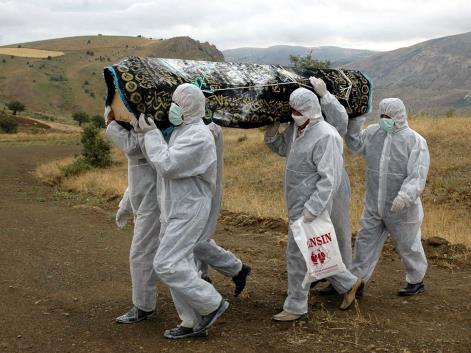 By March 25th, the BBC reports 62 confirmed deaths from the disease, including five people in Liberia who died “after crossing from southern Guinea for treatment.” As the BBC report notes, “It is the first time Ebola has struck Guinea, with recent outbreaks thousands of miles away, in Uganda and the Democratic Republic of Congo.”
On March 31st, Ebola is confirmed to have spread to Liberia where two sisters (one of whom has just returned from Guinea) are found to be carrying the disease. The death toll rises to 78 people.
In early April West Africa begins mobilizing to combat the spread of the disease, including sending health teams to border territories.
By May 27th the death toll rises to 187 and the virus is confirmed to have spread to Sierra Leone.
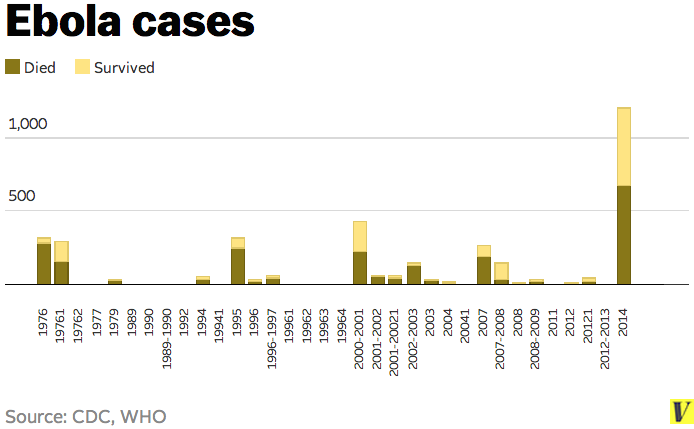
By mid-June, WHO data shows 333 total deaths, making this the deadliest outbreak in recorded history. The previous most deadly outbreak was the 1976 outbreak in Congo, with 280 reported deaths.
On July 3rd and 4th the WHO convenes a two-day Emergency Ministerial meeting on Ebola Virus Disease in Ghana where West African countries and various international organizations agree to adopt a strategy of “cross-border collaboration” for combating the outbreak. They also decide that the “WHO will establish a Sub-Regional Control Center in Guinea to act as a coordinating platform to consolidate technical support to West African countries by all major partners; and assist in resource mobilization” and that the WHO will be a lead organization in coordinating action on the issue.
The agreement includes resolutions to:
- Convene national inter-sectoral meetings involving key government ministries, national technical committees and other stakeholders to map out a plan for immediate implementation of the strategy.
- Mobilise community, religious, political leaders to improve awareness, and the understanding of the disease
- Strengthen surveillance, case finding reporting and contact tracing
- Deploy additional national human resources with the relevant qualifications to key hot spots.
- Identify and commit additional domestic financial resources
- Organise cross-border consultations to facilitate exchange of information
- Work and share experiences with countries that have previously managed Ebola outbreaks in the spirit of south-south cooperation
They also decide that the “WHO will establish a Sub-Regional Control Center in Guinea to act as a coordinating platform to consolidate technical support to West African countries by all major partners; and assist in resource mobilization.”
On July 25th the WHO confirms a probable case of Ebola in Nigeria, although an undated post on the Nigerian Federal Ministry of Health website claims to “debunk” Ebola in Nigeria, claiming that it is in fact Dengue Fever.
 On July 30th, Germany agrees to a WHO request to accept two Ebola infected patients for treatment at the university clinic in Hamburg-Eppendorf. According to Deutsche Welle: “The university clinic has made six beds available in a segregated part of the facility. In this isolation unit, no liquids, gases or particles in the air can reach the outside world. Access is only possible through three airlocks. In the first, the air pressure is slightly reduced; in the second and the third even more so. That’s to ensure clean air from outside is able to come in, but contaminated air from inside is not able to go out. Up until now, the unit has only been used for training.”
On August 2nd, an infected American aid worker traveled from Liberia to the United States to receive treatment at Emory University Hospital in Atlanta. According to Reuters: “The facility at Emory, set up with the U.S. Centers for Disease Control and Prevention, is one of only four in the country with the facilities to deal with such cases.” A second American aid worker, also infected in Liberia, arrived at the same facility two days later.
As of August 6th, the disease is confirmed to be spreading in Guinea, Sierra Leone, Liberia and Nigeria. Suspected cases are currently being tested in Lagos, the Philippines, and Saudi Arabia. The total number of confirmed cases stands at 1,711 with 932 deaths. An emergency meeting of “global health experts” has just been convened by the WHO in Geneva to address the situation.UPDATE: On August 8th, the WHO declared the current Ebola outbreak a “Public Health Emergency of International Concern” This is an instrument under the International Health Regulations, a legally-binding international agreement on disease prevention and control. The declaration allows for potential international coordination of the crisis and grants the WHO powers to obtain and share information about the crisis anywhere within the IHR territories with or without the consent of the individual governments involved. According to Stephen Morrison, the director of the Global Health Policy Center at the Center for Strategic and International Studies, this potentially allows for “boots-on-the-ground” intervention by the US military or other NATO member countries to operate in these environments in terms of ground transport, supply chain, and distribution of commodities. This is only the third time a PHEIC has been declared, the first being the 2009 swine flu outbreak and the second a declaration related to polio earlier this year.
Controversies, Contradictions and Conspiracies
Despite repeated denials and downplaying of the possibility by health authorities, there is growing evidence that this strain of Ebola may be airborne (transmissible from human to human through the air, not direct contact). A 2012 study examining “Transmission of Ebola virus from pigs to non-human primates” concluded: “Our findings support the hypothesis that airborne transmission may contribute to ZEBOV spread, specifically from pigs to primates, and may need to be considered in assessing transmission from animals to humans in general.” Despite the fact that even the official CDC guidelines for how airlines should handle the Ebola crisis contains the concern tha the virus may be airborne, a concerted effort is being made online to ridicule those hypothesizing that the current Ebola outbreak represents an airborne strain of the virus:
According to Bloomberg: “Despite the deadly nature of the disease, the relative rarity of outbreaks and their confinement to primarily rural areas of poor African nations make Ebola an unattractive target for big drugmakers.” An American or German outbreak, would, of course, change that calculus, and just last month a potential treatment for the disease was put on hold by the FDA due to safety concerns. Now, controversy is arising after experimental medicine was given to the two stricken American aid workers without FDA approval. The BBC describes the medicine as a “ZMapp drug, which has only been tested on monkeys.” For many, the idea that the WHO is heavily involved in a pandemic emergency in which drug companies are looking to circumvent traditional approval processes raises eerie parallels with the 2009 swine flu scare, which followed this pattern almost exactly, and was later ruled by both the British Medical Journal and the Council of Europe to have been a sham pandemic declared by a Big Pharma-connected WHO panel on behalf of the vaccine manufacturers themselves.
Others point to the possibility that this Ebola has been weaponized, or is part of a planned bioterror release. These reports focus on Dr. Charles Arntzen, a researcher at the University of Arizona who helped develop the experimental Ebola treatment given to the two American aid workers. In 2012, Dr. Arntzen joked about using genetic modification to create a “better virus” to cull 25% of the human population:
This is in line with similar statements by fellow biologists, including Dr. Eric Pianka at the University of Texas at Austin, who eyewitnesses claim used his acceptance speech for the 2006 Distinguished Texas Scientist Award from the Texas Academy of Science to muse on “the elimination of 90 percent of the human population” through an airborne disease like the Ebola virus.
Some have pointed to the long, documented history of government research into biological weapons and intentional government releases of biological agents on their own citizens in the past as a sign that the current outbreak could be some form of intentional bioweapon release by a government agency or rogue actor.
Yet others argue whether the current outbreak is being deliberately downplayed to hide the severity of what is happening or deliberately overhyped to panic the public and make them acquiesce to medical martial law or other dramatic maneuvers. Some even question whether or not the entire pandemic is a hoax.
FBI uses facial recognition to arrest 14-year fugitive overseas
End the Lie – Independent News
[Aug 13, 2014]
After spending 14 years on the run from American law enforcement authorities, a man suspected of child sex abuse was detained in by the FBI using the State Department’s new facial recognition technology.
The case marks a notable milestone for the FBI, which has also recently been beefing up its ability to identify individuals through face-scanning software.
Announced on Tuesday by the FBI, the case in question actually began back in 1999, when New Mexico resident Neil Stammer was arrested on multiple charges, including child sex abuse and kidnapping. After posting bail, Stammer fled the United States and never appeared for this arraignment. When federal fugitive charges were filed a month afterwards, the FBI became involved.
Catching Stammer proved to be particularly tricky, the FBI said, especially since the fugitive spoke about a dozen languages and could have potentially been anywhere in the world. In January 2014, the FBI’s fugitive coordinator Russ Wilson created a new “wanted” poster for Stammer after the case caught his eye, inadvertently causing the hunt to heat up once again.
Around the same time as this poster was drafted, the US State Department began trying out its own newly designed facial recognition software, which was intended to catch passport fraud. Luckily for the FBI, a security service agent within the State Department decided to test the software out on the Bureau’s wanted posters – a course of action that ultimately matched Stammer’s face with someone named Kevin Hodges.
“When he came upon Stammer’s poster online, a curious thing happened. Stammer’s face matched a person whose passport photo carried a different name,” the FBI said in its statement.
 Former New Mexico resident Neil Stammer was captured in Nepal earlier this year after 14 years on the run. (Image from http://www.fbi.gov)
Further investigation revealed that Hodges – teaching English classes in Nepal and routinely visiting the local US Embassy to prolong his stay – was actually Stammer. Soon enough, he was arrested and extradited to the US.
“He was very comfortable in Nepal,” Wilson said. “My impression was that he never thought he would be discovered.”
The arrest comes as the FBI continues to expand its facial recognition database. As RT reported in April, the agency projects that it will have 52 million images stored in its Next Generation Identification (NGI) program by 2015. The NGI database currently features more than 100 million records, including those that link an individual’s fingerprints, palm prints, iris scans, and personal information like addresses and legal status. The next step for the FBI is to flesh out its trove of facial images.
In some more local cases, meanwhile, facial recognition technology is already being used by law enforcement. According to Fox News, officials in Iowa said the software enabled them to track down and arrest an armed robber in June – about 41 years after he escaped from a North Carolina jail.
Source: RT
Oh, Great: Robots Are Set to Conduct National Security Clearance Interviews
by Lucas Cort
Canadian Awareness Network
Jul 28, 2014

Oh, Great: Robots Are Set to Conduct National Security Clearance Interviews
Written by STEPHEN BURANYI
July 22, 2014 // 01:32 PM EST
Advancing a career in the US government might soon require an interview with a computer-generated head who wants to know about that time you took ketamine.
Psychologists at the National Center for Credibility Assessment (NCCA) are developing an interview system that uses a responsive on-screen avatar for the first stage of the national security clearance process.
Initial screening for a variety of government jobs currently requires applicants to fill out a form disclosing past drug use, criminal activity, and mental health issues, which is then reviewed during an interview—with a human.
But a recent NCCA study published in the journal Computers and Human Behavior asserts that not only would a computer-generated interviewer be less “time consuming, labor intensive, and costly to the Federal Government,” people are actually more likely to admit things to the robot.
The study used US Army basic trainees as volunteer subjects for a mock national security clearance interview. The trainees were not told that the questions would be asked by a robot. After being hooked up to electrodes for cardio graphic and electrodermal (heart and skin) responses the volunteers were told that the interview would be with a computer avatar, and were left alone in a chamber with their on-screen interrogator.
The program used for the study was capable of responding to vocal cues and taking multiple conversation paths depending on the subject’s answers. The researchers were hoping to leverage the power of presence: the idea that people recognize another sentient being in the environment, and are more responsive as a result.
The bot is racially ambiguous and looks like a sort of cross between Barack Obama and Vladimir Putin. Clean-shaven and all business, the bot asks you to divulge your most embarrassing personal mistakes in the name of national security and trustworthiness.
And apparently these computer-generated heads had a lot of presence. Volunteers in the study were significantly more likely to disclose alcohol use and mental health issues to the avatar than to the questionnaire. Responses for drug use and criminal charges were about the same.
Using the avatar also allowed the researchers to measure pauses in conversation and take advantage of questions that would seem out of place on a paper form. At the end of each interview section the computer-generated interviewer asked the volunteers “if there was anything at all” they wished to discuss—with over 10 percent then responding with more information.
The researchers concluded, in so many words, that national security clearance interviews can totally be outsourced to a computer-generated agent. That’s not an empty recommendation: The NCCA grew out of the Department of Defense Polygraph Institute and is still responsible for “lie detection” training for all branches of government. It’s also tasked with developing new technologies for credibility assessment.
In other words, when “Blade Runner” is an actual job, they will likely be trained at the NCCA headquarters in South Carolina.
The NCCA predicts a bright future for its virtual agents. The study notes that computer-generated interviewers might help mitigate the gender and culture bias that affects human interviewers. It also recommends using avatars with distinctive physical characteristics and “culture-specific utterances.”
The interviewer isn’t quite a sentient AI; it relies on a dialogue tree similar to telephone customer service: tell the computer all the simple things, then press 0 for a human to explain the story behind your streaking arrest.
Still the idea of a computer conducting national security clearance interviews, even with human oversight, is bound be unsettling for some. But depending on the system’s effectiveness and the potential cost savings, we may see national security screening being done by a screen in the very near future.
Read More Here
Transcendence and DARPA’s Restoring Active Memory
by Tony Cartalucci
LocalOrg

July 15, 2014 (LocalOrg) – In the movie “Transcendence,” the lead character, an artificial intelligence researcher, is uploaded to a super-computer before his body dies. His consciousness survives and his mind, unencumbered by the weakness of his physical body, begins expanding exponentially. While science fiction, the movie’s premise is not entirely impossible. While the human brain is highly complex, accessing it, decoding it, and interfacing with it has long-ago already begun.
The US Department of Defense’s Defense Advanced Research Projects Agency or DARPA, has announced its “Restoring Active Memory (RAM)” project – which intends to develop a prosthetic for the brain to record and store memories for those with degenerative neurological conditions such as Alzheimer’s disease or victims of traumatic brain injuries (TBIs).
Science Daily in its article, “DARPA taps Lawrence Livermore to develop world’s first neural device to restore memory,” reported:
The research builds on the understanding that memory is a process in which neurons in certain regions of the brain encode information, store it and retrieve it. Certain types of illnesses and injuries, including Traumatic Brain Injury (TBI), Alzheimer’s disease and epilepsy, disrupt this process and cause memory loss. TBI, in particular, has affected 270,000 military service members since 2000.
The goal of LLNL’s work — driven by LLNL’s Neural Technology group and undertaken in collaboration with the University of California, Los Angeles (UCLA) and Medtronic — is to develop a device that uses real-time recording and closed-loop stimulation of neural tissues to bridge gaps in the injured brain and restore individuals’ ability to form new memories and access previously formed ones.
The research is funded by DARPA’s Restoring Active Memory (RAM) program.
In essence, RAM would also allow humans to expand their brains into non-organic systems. While the project states it intends to restore memory function to those with deficiencies, the same prosthetic could also be used to expand the memory capacity of people with normal brain functions. While the device currently is intended to be an implant, future reiterations may include external devices either linked physically or perhaps even wirelessly. The implications may lead to devices and systems that allow our “minds” to expand beyond the physical confines of our biological brains, opening the doors to both great opportunities and equally frightful threats.
Threats and Opportunities

For starters, the digitization of our neurology opens the doors to all the threats and opportunities that befall or benefit existing digital devices, including those connected to the Internet. Collaboration, control, viruses, hacking, surveillance, exponential intellectual progress, personal empowerment, and even human-drones are all in the cards.
And while a climatic and apocalyptic “war with the machines” lingers menacingly in the back of our collective minds, what if devices like that which DARPA is developing led to man merging with machines instead? There would be no war with machines, we would be the machines.
In this context, we face two possible futures: one like that portrayed in science fiction films like Terminator or the Matrix where humans hide amid the ruins of their once proud civilization fighting a desperate resistance against far superior machines that turned on them, or a future like that portrayed in the Japanese anime films and series, Ghost in the Shell. In the latter, the lines are blurred between man and machine and a tenuous balance of power is maintained throughout human civilization, between extremes of both organic and cybernetic natures.
With advances like that announced by DARPA, the latter scenario is the most likely one. A merge between man and machine is the most likely scenario – whomever controls cybernetic technology however, will determine how utopian or dystopian our future will be. Currently, DARPA and other corporate-financier monopolies control this research and technology, while they monopolize other realms of scientific progress including molecular biology, genetic engineering, and information technology. This power in such few hands is surely a recipe for disaster – at least for those without access or say in how the technology is used – or in other words – for the vast majority of us.
A consumerist paradigm that has neurological implants tied to our information technology infrastructure would lead to abuses that would make the NSA’s current overreaching authority look placid in comparison. It could also transform our military’s abilities into the most effective and most horrifying of both human and drone combat.
Instead, this technology must be democratized, ofpened up, and disseminated across society. People to be fully free and in charge of their destiny must not focus on “democracy” and “civil literacy,” but rather on technological literacy, as it is technology that forms the foundation upon which modern society is built and controlled. If we want a say in this modern, technological society, we must understand how it works – currently such an understanding lies in so few hands.
We will not “un-invent” neurological implants that expand the landscapes in which our minds may occupy. We can either choose to boldly embrace and take control of such technology, or cower and complain as others leverage this technology against us to cement an ever expanding disparity between their domination of humanity, and our subservient futility under their dominion.
Is this really why Ebola health workers are collapsing?
Is this really why Ebola health workers are collapsing?
Ebola health workers in boiling hot suits, toxic chemicals
by Jon Rappoport
August 5, 2014
In recent articles, I stated it’s a mistake to jump to a conclusion about what’s really making doctors and nurses sick in African Ebola clinics. (see here and here).
Here’s a missing factor in understanding what is happening to some of those doctors and nurses.
I’m not talking about Ebola. I’m talking about physiological shock, huge and sudden dehydration, and more.
On top of that, factor in a falsely positive diagnostic Ebola test for a few of those health workers, and what do you have? A nightmare.
From the Daily Mail, August 5, an article headlined, “In boiling hot suits…”:
“Doctor Hannah Spencer revealed how she wills herself to feel safe inside a boiling hot air-sealed Hazmat suit…”
“Boiling: Doctors and nurses lose up to five litres in sweat during an hour-long shift in the suits and have to spend two hours rehydrating after…”
“To minimise the risk of infection they have to wear thick rubber boots that come up to their knees, an impermeable body suit, gloves, a face mask, a hood and goggles to ensure no air at all can touch their skin.”
“Dr. Spencer, 27, and her colleagues lose up to five litres of sweat during a shift treating victims and have to spend two hours rehydrating afterwards.”
“At their camp they go through multiple decontaminations which includes spraying chlorine on their shoes.”
“Dr. Spencer: ‘We would like to keep a [patient] visit between 45 minutes and one hour, but now, we’re stretching it to almost two hours. We put ourselves through a very strong physiological stress when we’re using personal protection gear.’”
“‘We sweat, we’re losing water; we’re getting hotter and it wreaks havoc on the body. Our own endurance starts to wear down.’”
From another Daily Mail article (see “What’s shocking is how Ebola patients look before they die…”), Dr. Oliver Johnson describes working in protective gear: “The heat of the suits is quickly overwhelming, as your goggles steam up and you feel the sweat dripping underneath. And the smell of chlorine is intense.”
PODCAST — News update – Joe Atwill and Rima Laibow – “Preventing and Treating Ebola” – #206 | Gnostic Media
Gnostic Media
Aug 7, 2014

This episode is a news update / public service announcement: Preventing and Treating Ebola.
Released on Wednesday, August 07, 2014, and was recorded on Monday, August 07, 2014.
In this episode we have Joe Atwill – the author of Caesear’s Messiah, who’s been on many times before; And also Dr. Rima Laibow, who has been on my show once before, and I on her show twice. This is her second time on the Gnostic Media podcast, and we’ve also interviewed her husband General Albert Stubblebine.
Joe Atwill’s websites:
www.caesarsmessiahdoc.com
http://caesarsmessiah.com/
http://caesarsmessiah.com/blog/
Rima Laibow’s websites:
www.naturalsolutionsfoundation.com
http://drrimatruthreports.com/
http://www.drrimaknows.com
www.nsfmarketplace.com
Rima’s Stop Ebola page:
http://TinyURL.com/StopEbola
Selected Nano Silver Ebola references:
http://drrimatruthreports.com/wp-content/uploads/Selected-Nano-Silver-Ebola-Reference-Citations.pdf
Analysis of DTRA Nano Silver study:
http://drrimatruthreports.com/wp-content/uploads/Analysis-of-DTRA-Nano-Silver-Study.pdf
Scientific American Ebola:
http://www.scientificamerican.com/article/largest-ever-ebola-outbreak-is-not-a-global-threat/
Scientist working on Gov’t Ebola drug Joked About Culling Population with GMO:
http://www.zerohedge.com/news/2014-08-07/did-creator-experimental-ebola-drug-joke-about-culling-25-worlds-population
https://www.youtube.com/watch?v=fsD7l9xENRQ
Safety:
http://drrimatruthreports.com/dr-rima-beware-ebola-disinformation/
Colloidal silver and nano silver are not the same:
https://www.youtube.com/watch?v=mdZsDF0B7cU&list=UUpgvIebAMVqdN8kvYxzLBfw
Send Bitcoin donations for this episode to:
12EQTDMzU5mxtEd8ZfyrHrxABZi3jtaCCo
Please make other forms of donations here:
http://www.gnosticmedia.com/donate/
Donations. This episode is brought to you by:
Marie
Arno
Eve
Barry
Scott
BTC:
Podcast: Play in new window | Download (Duration: 1:05:20 — 60.0MB) | Embed
Why Monsanto’s ‘Cure’ For World Hunger Is Cursing The Global Food Supply
Sayer Ji
Green Med Info
August 4, 2014
 What if the very GM agricultural system that Monsanto claims will help to solve the problem of world hunger depends on a chemical that kills the very pollinator upon which approximately 70% of world’s food supply now depends?
A new study published in the Journal of Experimental Biology titled, “Effects of field-realistic doses of glyphosate on honeybee appetitive behavior,” establishes a link between the world’s most popular herbicide – aka Roundup – and the dramatic decline in honeybee (Apis mellifera) populations in North American and Europe that lead to the coining of the term ‘colony collapse disorder‘ (CCD) in late 2006 to describe the phenomena.[1]
The researchers found that concentrations of glyphosate (GLY) consistent with the type of exposures associated with standard spraying practices in GM agricultural- and neighboring eco- systems reduced the honeybee’s sensitivity to nectar reward and impaired their learning abilities – two behavioral consequences likely to adversely affect their survival abilities. Moreover, while sub-lethal doses were not found to overtly affect their foraging behavior, they hypothesized that because of their resilience, “..forager bees could become a source of a constant inflow of nectar with GLY traces that could then be distributed among nest mates, stored in the hive and have long- term negative consequences on colony performance.”
A Deeper Look at the New Study: Roundup Interferes with Bee Appetite and Learning
Roundup herbicide is a ubiquitous toxicant, with an accumulating body of research now showing it is a common contaminant in our air, water, rain, soil and food, and in physiologically relevant concentrations (even the part-per-trillion concentration range demonstrates endocrine disruptive and potentially carcinogenic properties) to microbial, insect, animal and human life.
When Roundup herbicide was first evaluated for toxicity to the honeybee, the focus was on acute toxicity of the ‘active ingredient’ and not sub-lethal and prolonged exposure effects; and certainly not the amplified toxicological synergies present in glyphosate formulations like Roundup, which when the so-called ‘inert’ adjuvant ingredients (e.g. surfactants) are taken into account, have been found to be at least 125 times more toxic than glyphosate alone. By only taking into account acute toxicity – as measured by the so-called LD50 (lethal dose, 50%) – on the ‘active’ ingredient, government regulators approved glyphosate as relatively harmless to honeybees prematurely.
The researchers expanded on the topic:
“Glyphosate [GLY] toxicity tests on Apis mellifera for product approval did not consider sub-lethal nor prolonged exposure effects. Studies were only focused on obtaining LD50 (lethal dose, 50%) as a measure of the effect of an acute exposure, but nevertheless, they were carried out on the basis that honeybees might in fact be exposed to GLY in their natural environment, either through the consumption of contaminated resources or through a direct exposure as a result of inadvertent spraying (Giesy et al., 2000). Even though LD50 results seem to indicate that GLY is not harmful for honeybees, the fact that honeybees are potentially exposed to GLY motivated us to pursue further analysis and to address the lack of chronic studies.”
The authors of the new study set out to test whether doses of glyphosate bees would realistically encounter in the field (field-realistic doses) could affect their feeding behavior (appetitive behavior) in a deleterious manner.
They exposed honeybees to field-realistic doses of glyphosate chronically and acutely, and observed: “a reduced sensitivity to sucrose and learning performance for the groups chronically exposed to GLY concentrations within the range of recommended doses,” as well as significant decrease in elemental learning, non-elemental associative learning, and short-term memory retention, when exposed to acute GLY doses.
Roundup Already Identified As Likely Cause of Colony Collapse Disorder
This latest study is not the first to link glyphosate to the vanishing honeybee.
Extensive research on the topic performed by Dr. Don D. Huber and summarized in an article published last year titled, “Is glyphosate a contributing cause of bee colony collapse disorder (CCD)?,” lead him to conclude that the 880 million pounds of glyphosate released into the environment worldwide has been contributing to the collapse of the honeybee. The paper revealed the following six ways that glyphosate could contribute to CCD:
- Glyphosate chelates minerals, lowers nutrients in plants: In CCD, Malnutrition is universally present.
- Glyphosate acts like an antibiotic to beneficial bacteria: In CCD, loss of Lactobacillus and other critical beneficial bacteria for digestion is commonly observed.
- Glyphosate is a neurotoxin: In CCD, honeybees experience neurological changes associated with disorientation.
- Glyphosate causes endocrine hormone & immune disruption: In CCD, immunity and other hormonal variables are altered or suppressed.
- Glyphosate stimulates fungal overgrowth: In CCD, the fungal pathogen Nosema increases.
- Glyphosate persists and accumulates: High environmental exposure, including glyphosate residues present in honey, nectar and other plant products, make honeybees susceptible to continual toxic challenge — which is believed to be a primary underlying cause of CCD.
Other Factors Contributing to Colony Collapse
While it is now increasingly acknowledged that many agrochemicals pesticides — especially neonicotinoids — are toxic to honeybees, there are other factors that likely play a role as well:
It should be pointed out that the last factor listed – infectious organisms – are likely more a symptom than a cause of honeybee morbidity and mortality. In other words, following electromagnetic, agrochemical and dietary assault, the immune system of the honeybee – and the collective immunity of the hive – weakens, leading to greater susceptibility to opportunistic infections.
One USDA study published in 2013 discussed the role of fungicidal contaminants in pollen leading to increased probability of Nosema fungal infection in bees who consumed pollen with a higher fungicide load.[3]
This linkage between chemical exposure > immune suppression, > opportunistic infection, is especially poignant when it comes to Roundup herbicide, which profoundly alters the makeup of the beneficial flora in exposed organisms, leading to the overgrowth of pathogenic bacteria. A 2012 PloS study found that lactic acid bacteria living in the crop (the part of the bee’s alimentary canal that stores food prior to digestion) of bees are vitally important for the health of honeybees, with some strains suggesting a history of association with bees stretching over 80,000,000 years ago. Various chemical are capable of damaging this vitally important locus for the honeybee’s immunity and digestion, and are likely exerting their adverse effects through sublethal, hard to detect mechanisms.
Why Does Monsanto Own Beelogics, ‘The Guardian of Bee Health Worldwide’?
On Sept. 28th, 2011, Monsanto announced that it was acquiring the company Beeologics, whose explicit goal is to become “the guardian of the bee health worldwide,” including finding ways to address CCD.
Here is their mission statement:
“Beeologics LLC is an international firm dedicated to restoring bee health and protecting the future of honey bee pollination. Beeologics’ mission is to become the guardian of bee health worldwide. Through continuous research, scientific innovation, and a focus on applicable solutions, Beeologics is developing a line of RNAi-based products to specifically address the long-term well being of honey bees, including the control of parasites and how they’re involved in Colony Collapse Disorder (CCD).”
A classical problem-solution approach, Monsanto creates a problem – a systemic herbicide intended to ‘save the world’ from hunger as part of its GMO Roundup-ready proprietary production system that actually destroys the pollinators required to maintain our global food supply – and then capitalizes on a GM solution on the backend, with patented RNA interference ‘solutions’ intended to, again, ‘save the world’ from hunger.
[1] Dennis van Engelsdorp, Diana Cox-Foster, Maryann Frazier, Nancy Ostiguy, and Jerry Hayes (5 January 2006). “Colony Collapse Disorder Preliminary Report”. Mid-Atlantic Apiculture Research and Extension Consortium (MAAREC) – CCD Working Group. p. 22. Retrieved 2007-04-24.
[2] Peng Han, Chang-Ying Niu, Antonio Biondi, Nicolas Desneux. Does transgenic Cry1Ac + CpTI cotton pollen affect hypo pharyngeal gland development and midgut proteolytic enzyme activity in the honey bee Apis mellifera L. (Hymenoptera, Apidae)? Ecotoxicology. 2012 Nov ;21(8):2214-21. Epub 2012 Aug 7. PMID: 22868904
[3] Jeffery S Pettis, Elinor M Lichtenberg, Michael Andree, Jennie Stitzinger, Robyn Rose, Dennis Vanengelsdorp. Crop Pollination Exposes Honey Bees to Pesticides Which Alters Their Susceptibility to the Gut Pathogen Nosema ceranae. PLoS One. 2013 ;8(7):e70182. Epub 2013 Jul 24. PMID: 23894612
Delivered by The Daily Sheeple
Contributed by Sayer Ji of Green Med Info.

 PN
PN 