
Oslo False Flag Confirmed: Police Told To Stand Down
By Zen Gardner
Before It’s News
January 23, 2012

A snowy Utøya Sunday night, six months after the terrorist attack on Utøya and government quarter, 22 July 2011. Photo: Håkon Mosvold Larsen (Scanpix)
Police on the way to Utøya should have been asked to pass
Police Crews from Southern Buskerud should have been told to overtake Utøya and meet up in Honefoss while shooting on Utøya happening. Half of the workforce should have refused to follow orders.
(Auto translation) Just 18 minutes after the first emergency services from Utøya were three cars with a total of eight police officers on the road from Drammen to the neighboring district to help colleagues. Along the way they were told over the police radio that they would attend the police station in Hønefoss, newspaper VG.
“I was surprised at this decision from the Northern Buskerud Police District, as it was ongoing shooting at Utøya and also possibly shooting on the mainland. Therefore we decided not to run to Hønefoss, “according to a report from one of the officials.
One of the patrols decided to follow the order and drove past Utøya and against Hønefoss, a detour of 48 kilometers, while the other two cars ignored the order and went to Storøya where they got hold of three boats that carried them over to Utøya, 21 minutes after emergency squad from Oslo was in place. MORE
‘Enemy Expatriation Act’ To Strip Americans of Citizenship [video]
The Truther Girls
January 14, 2012
It seems that if the US government can’t get around your constitutional rights one way, they will try to find another way to do it. Meanwhile, in Canada, we already have a program called ‘security certificates’ to detain refugees and permanent residents indefinitely without charge or due process, and without letting them see what evidence there is against them. This is often because the ‘evidence’ is flimsy nonsense based on lies made up by informants or things blurted out by people while under torture. Not something you would expect from a country like Canada, but that’s what our government is doing.
http://www.addictinginfo.org/2012/01/06/new-bill-known-as-enemy-expatriation-…
http://www.justiceforharkat.com/news.php
Strengthening U.S.-Canada Security Interests in North America and Around the Globe
By Dana Gabriel
Be Your Own Leader
February 6, 2012
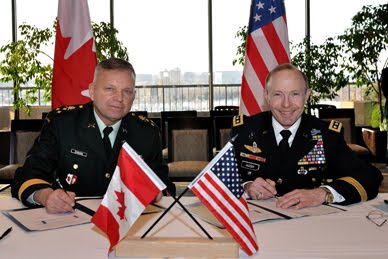 The U.S. and Canada recently signed several bilateral agreements that will further strengthen continental security and defense cooperation. Deeper military integration between both countries is part of efforts to establish a North American security perimeter and better address common global threats.
Following the recent Permanent Joint Board on Defense (PJBD) meeting which took place in Ottawa, the Commander of Canada Command, Lt.-Gen Walter Semianiw and the Commander of North American Aerospace Defense Command (NORAD) and United States Northern Command (USNORTHCOM), Gen. Charles Jacoby, Jr. signed three military documents. The first was the Combined Defense Plan which a backgrounder described as a, “planning framework between Canada Command, its counterpart USNORTHCOM, and NORAD for enhanced defense cooperation between Canada and the U.S. should governments require each other’s assistance.” The second is the Information Sharing Memorandum of Understanding, “an arrangement between Canada Command, its counterpart USNORTHCOM and NORAD to identify and provide for ease of sharing information amongst the three organizations.” The Civil Assistance Plan, which was originally signed in 2008 and allows the armed forces of one nation to support the other during an emergency was also renewed for two years.
Lee Berthiaume of Postmedia News reported that, “The Combined Defense Plan has been under discussion for several years and would further integrate cross-border military co-operation at a time when the Harper government is trying to reassure Washington it has a reliable partner in Canada when it comes to security.” Defense Minister Peter MacKay is quoted as saying, “This agreement provides a framework for the combined defense of Canada and the U.S. during peace, contingencies, and war.” He added, “The plan describes the authorities and means by which the two governments would approve homeland military operations in the event of a mutually agreed threat, and how our two militaries would collaborate and share information.” In his speech in front of the PJBD, Minister MacKay also called for, “increased military involvement implementing the Beyond the Border strategy, saying the Canadian Forces and its American counterparts should be supporting civilian agencies monitoring the cross-border security.” Also on the agenda at the defense forum was security cooperation in the Arctic, along with Canadian and U.S. engagement in the Western Hemisphere.
In an article for iPolitics, Colin Horgan wrote that at the recent bilateral defense meeting, “MacKay noted that such initiatives as Beyond the Border and the Regulatory Cooperation Council Action Plan will work to ensure that the vital economic partnership that joins our two countries continues to be the cornerstone of our economic competitiveness and security.” Defense Minister MacKay emphasized that security is linked to the economy and called for even greater cooperation to support the dual action plans. He stated, “We need to increasingly focus our military forces in support of those civilian departments and agencies that have the lead.” MacKay also explained, “We need to all work together to mitigate capability gaps, share best practices and co-operate on new approaches.” He went on to say, “there is still room for more integrated collaboration – domestically and bi-nationally.”
The latest military agreements further promote a perimeter approach to security. They are part of the Tri Command Vision efforts to merge NORAD, USNORTHCOM and Canada Command into one. As for the PJBD, it has once again become more relevant as a venue for bilateral security and military dialogue. Created in 1940 the panel, “is the senior advisory body on continental defense. It is composed of military and diplomatic representatives from both nations.” Over the years, it has, “served as a strategic-level military board charged with considering, in a broad sense, land, sea, air and space issues.” This includes areas concerning, “policy, operations, financial, logistics and other aspects of Canada-U.S. defense relations.” The PJBD is well positioned to play a significant role in plans for a fully integrated North American security perimeter, as well as in other facets of the evolving Canada-U.S. partnership.
On January 6, the Obama administration released the new document, Sustaining U.S. Global Leadership: Priorities for 21st Century Defense. The new strategy calls for maintaining a strong presence in the Middle East, as well as an expanding role in the Asia-Pacific region. Much of the focus will be on countering China’s rising power. This will include supporting large bases in Japan and South Korea, along with stationing troops in Australia. The U.S. will also continue efforts to forge stronger military alliances with the Philippines, Indonesia, Vietnam and Burma. While the plan envisions a leaner military force, there is little doubt that Washington will continue to police the world. How does Canada fit into this new realignment of American strategic priorities? It is clear that the U.S. will rely more on its allies during international missions. Canada may gain a greater voice in future military operations, but it will also mean that they will have to bear more of the burden. In the coming years, as NATO members begin cutting defense spending, Canada will be counted on to play an even bigger role in any possible overseas conflicts.
Whether it’s the perimeter security deal, the ongoing mission in Afghanistan or the bombing campaign that took place in Libya, the U.S. and Canada continue to enhance security and military cooperation. Under Prime Minister Stephen Harper, both countries have further deepened their defense relationship. In addition, Canada has pursued a more U.S.-style foreign policy. This includes imposing tougher sanctions on Iran, along with further expanding sanctions against Syria. Much like the U.S., Harper has singled out Iran as a threat to international peace and security. He has echoed the same sentiments that the regime is seeking a nuclear weapon and would be prepared to use it. Defense Minister Peter MacKay has also indicated that if necessary, Canada’s armed forces are ready to offer assistance in Syria. More than ever, the U.S, and Canada share a more common approach to advancing security interests in not only North America, but around the globe.
Related articles by Dana Gabriel
Pretext for a North American Homeland Security Perimeter
Canada Pursues U.S.-Style Security and Foreign Policy
Deepening Canada-U.S. Security and Military Ties
Perimeter Security and an Integrated North American Command
Dana Gabriel is an activist and independent researcher. He writes about trade, globalization, sovereignty, security, as well as other issues. Contact: beyourownleader@hotmail.com Visit his blog at beyourownleader.blogspot.com
Leaking & Damaged Nuclear Power Plants In The US Exposed [audio]
The Intel Hub News Brief
February 5, 2012
You can listen and download the mp3 here.
Across the United States numerous nuclear power plants are having problems which include damaged tubes and small releases of radiation.
The Intel Hub News Brief, speaking to the RadChick, recently released a podcast on these nuclear power plants problems.
The Intel Hub: http://theintelhub.com/
FederalJack: http://www.federaljack.com/
Fukushima Facts: http://www.fukushimafacts.com/
RadChick’s Facebook Page: http://www.facebook.com/pages/RadChick-Radiation-Research-Mitigation/26061096…
Corbett Report – Episode 216 – Who’s Gaming Who?
The Corbett Report
January 28, 2012
Science-fiction fantasy is becoming mundane reality and video games are increasingly merging with 21st century combat. The DoD recruits youth through traveling arcade exhibitions and new recruits are just as likely to end up behind a keyboard as behind enemy lines. What does this mean for the future of our predicatively programmed world, and should we be worried. Find out more in this week’s edition of The Corbett Report.
[hat tip: Media Monarchy]
The Front – Episode 181: Front Lines in the War on Humanity [audio]
The Front
February 2, 2012
Tonight on The Front: New World Order News – Pre-crime technology, what’s your defense if accused? Also, the outrageous things school kids have been arrested for leads to the question. Why are children being arrested in the first place? Health News – With everything from moving your legs at night to caring about the quality of food you fuel your body with being claimed as a “disorder,” being sad is now a disorder. Don’t worry, I’m sure there’s a pill for that. Also, planking, we’ll talk about why it’s so effective for core strength and overall health. Big Brother News – ACTA, the Anti Counterfeiting Trade Agreement. Survival/Prep News – Selco talks SHTF gunfights and we look at advice from Egypt during the western backed destabilization effort last spring. Divide and Conquer News – Anonymous outs Ron Paul as a racist, this should send the truth movement into a tizzy lol.
Warning: Show content may change without notice


