
U.S.-EU Trade Deal is the Foundation For a New Global Economic Order
by Dana Gabriel
Be Your Own Leader
February 25, 2013
 The U.S. and EU have agreed to launch negotiations on what would be the world’s largest free trade deal. Such an agreement would be the basis for the creation of an economic NATO and would include trade in goods, services and investment, as well as cover intellectual property rights. There are concerns that the U.S. could use these talks to push the EU to loosen its restrictions on genetically modified crops and foods. In addition, the deal might serve as a backdoor means to implement ACTA which was rejected by the European Parliament last year. A U.S.-EU Transatlantic trade agreement is seen as a way of countering China’s growing power and is the foundation for a new global economic order.
In his recent State of the Union address, President Barack Obama officially announced that the U.S. would launch talks on a comprehensive Transatlantic Trade and Investment Partnership with the European Union (EU). A joint statement issued by European Commission President Jose Manuel Barroso, European Council President Herman Van Rompuy and U.S. President Obama explained that, “Through this negotiation, the United States and the European Union will have the opportunity not only to expand trade and investment across the Atlantic, but also to contribute to the development of global rules that can strengthen the multilateral trading system.” In a separate speech, European Commission President Barroso also emphasized that, “A future deal between the world’s two most important economic powers will be a game-changer. Together, we will form the largest free trade zone in the world. So this negotiation will set the standard – not only for our future bilateral trade and investment, including regulatory issues, but also for the development of global trade rules.”
The decision to pursue a free trade deal was based on the recommendations put forth by the High Level Working Group on Jobs and Growth which was created to deepen U.S.-EU economic integration. In their final report, they called on leaders from both sides to, “initiate as soon as possible the formal domestic procedures necessary to launch negotiations on a comprehensive trade and investment agreement.” According to U.S. and EU officials, talks could start in June with the hopes of completing a deal by the end of 2014. The proposed trade pact would include removing import tariffs, dismantling hurdles to trade in goods, services, and investment, as well as harmonizing regulations and standards. It would also cover intellectual property protection and enforcement. This could be used as an opportunity for a backdoor implementation of the Anti-Counterfeiting Trade Agreement (ACTA). It was a result of public pressure associated with risks to internet freedom and privacy which lead to ACTA being rejected by the European Parliament in July of 2012. There have already been attempts to use Canada-EU trade negotiations to sneak in parts of ACTA.
Public Citizen’s Global Trade Watch Director, Lori Wallach cautioned how U.S.-EU talks, “are aimed at eliminating a list of what multinational corporations call ‘trade irritants’ but the rest of us know as strong food safety, environmental and health safeguards.” She went on to say, “European firms are targeting aspects of the U.S. financial reregulation regime, our stronger drug and medical device safety and testing standards and more.” Wallach further added, “U.S. firms want Europe to gut their superior chemical regulation regime, their tougher food safety rules and labeling of genetically modified foods.” In a press release, Earth Open Source warned that, “An EU-U.S. free trade deal would obliterate EU safeguards for health and the environment with regard to genetically modified (GM) crops and foods.” Research Director Claire Robinson pointed out, “If the new trade agreement goes through, it will be illegal under World Trade Organisation rules for the EU to have a stronger regulatory system for GMOs than the U.S. system.” This is disturbing considering that in many cases, GM foods in the U.S. do not require any special regulatory oversight or safety tests.
Overshadowed by the proposed U.S.-EU trade deal is ongoing Canada-EU negotiations on a Comprehensive Economic and Trade Agreement (CETA). Despite talks being in their final stages, both sides still have some important gaps to be bridged before a deal can be reached. Thomas Walkom of the Toronto Star acknowledged that, “Europe’s real interest in negotiating a trade deal with Ottawa was to demonstrate to the Americans that a trans-Atlantic free trade pact was possible.” He noted, “EU negotiators will be even more reluctant to make concessions to Canada for fear of weakening their bargaining hand with the Americans.” Walkom argued that, “Canada is under more pressure to make a deal while Europe is under less.” He concluded that. “A Canada-EU deal seems inevitable. But now, with America in the mix, the terms for Canada may be even less favorable than expected.” The Globe and Mail recently reported that the EU is demanding additional concessions from Canada before any agreement can be signed. In order to wrap things up, a desperate Canada may be willing to give up even more. This was a bad deal from the start and it would be in their best interest to just walk away from CETA.
In the coming months, you can expect the anti-corporate globalization movement on both sides of the Atlantic to mobilize against the U.S.-EU trade agreement. It is big business and financial institutions who are pushing this deregulation agenda which threatens health, environmental and food safety standards. Just like NAFTA, the proposed U.S.-EU trade deal is also likely to include an investor-state dispute process which would give corporations the right to challenge government policies that restrict their profits. A trade agreement between the U.S. and EU is the building blocks for a new global trading system. If you combine NAFTA, the Trans-Pacific Partnership and a U.S,-EU Transatlantic trade deal, you have the makings for a global free trade area.
Related articles by Dana Gabriel:
Deepening the U.S.-EU Transatlantic Trade Partnership
Growing Opposition to the Canada-EU Trade Agreement
Advancing the Transatlantic Agenda
From NAFTA to CETA: Canada-EU Deep Economic Integration
Dana Gabriel is an activist and independent researcher. He writes about trade, globalization, sovereignty, security, as well as other issues. Contact: beyourownleader@hotmail.com Visit his blog at Be Your Own Leader
OIC Islamic Nations Leaders Bow Down To Zionists – Sheikh Imran Hosein [video]
108morris108
February 8, 2013
But these leaders do not represent the views of the Muslim People.
Iran was one of the few countries at the OIC to voice reservations on referring Syria to the UN. (The UN is not an Islamic body)
Iran’s influence on Morsi is just window dressing. The Ikwhan (MB – Muslim Brotherhood Political Party) is fully aligned with Washington.
Ontario’s New “Sustainable” Premier
by Terry Wilson
Canadian Awareness Network
January 27, 2013
Liberal party delegates have elected Kathleen Wynne as the the next premier of Ontario. Wynne will be Ontario’s first female and openly gay premier, which marks a fantastic milestone in our province.
But not surprisingly, it does not seem that Wynne will bring much change to the table. She has stated that she will move forward with the plans for massive wind farms. (Totally ignoring the information coming in around the world about them Click Here to read more about them).
Wynne has also publicly announced her support sustainability and programs that clearly come from agenda 21 several times. Here is one example.
Statement from Minister Kathleen Wynne on Growth and Economic Development in Pickering
“”I am issuing a notice of proposed amendments to the Central Pickering Development Plan (CPDP). This provincial plan envisions a sustainable urban community in Seaton, integrated with a thriving agricultural community in the Duffins Rouge Agricultural Preserve and an extensive Natural Heritage System.
The goals of the plan include the provision of a range of housing types and densities and high-quality employment opportunities in Seaton, as well as a viable and permanent natural eco-system, including farm land and green spaces. The plan is part of the government’s overall strategy to promote sustainable development in the 905 region.
Continue Reading
Despite the leap forward in equal rights. This seems to be politics as usual. Different face, Same agenda.
U.S.-Canada Harmonizing Border Security and Immigration Measures
by Dana Gabriel
Be Your Own Leader
February 4, 2013
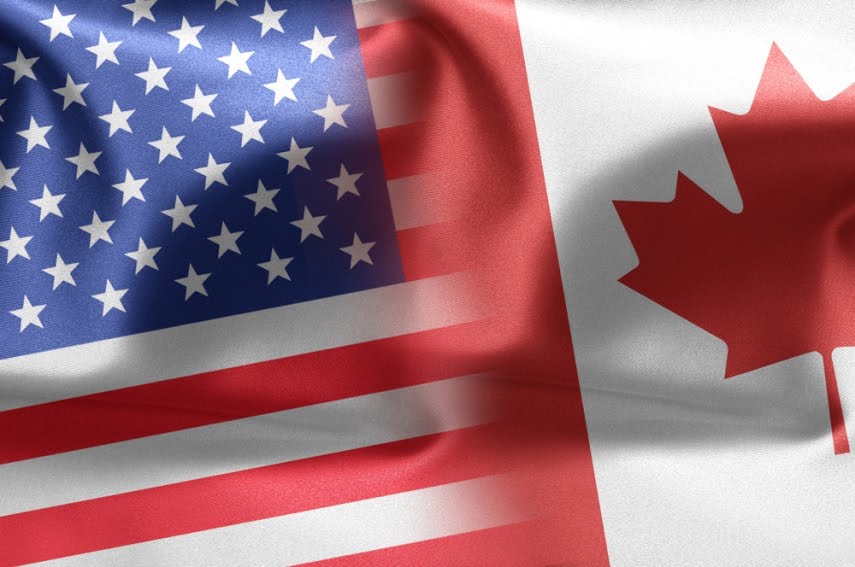
The U.S. and Canada have made significant progress in advancing the Beyond the Border deal and continue to implement various perimeter security initiatives. Without much fanfare, they have signed an immigration agreement that would allow them to share biographic and at a later date, biometric information. As part of a North American security perimeter, both countries are further harmonizing border security and immigration measures. Canada is further taking on U.S. security priorities and this could include a bigger role in the war on terrorism.
It’s been over a year since Prime Minister Stephen Harper and President Barack Obama announced the Beyond the Border and the Regulatory Cooperation Council action plans. On December 14, 2012, the U.S. and Canada issued the Beyond the Border implementation report that highlights the objectives that were achieved over the past year and the work that has yet to be done. It explained that moving forward, “Key future initiatives include harmonizing our trusted trader programs, making significant infrastructure investments at our key land border crossings, fully implementing an entry/exit program at the land border, expanding preclearance operations to the land, rail, and marine domains.” The report also acknowledged challenges facing the Next-Generation pilot project which would permit teams of cross-designated officers to operate on both sides of the border. It was originally scheduled to begin last summer. While steady progress has been made, a lot more work is needed to meet the goals of the Beyond the Border action plan. Over the next several years, other aspects of the deal will be phased-in incrementally with specific deliverables due this year, in 2014 and also in 2015.
Another important facet of the economic and security perimeter agreement is the U.S.-Canada Regulatory Cooperation Council (RCC). A progress report to the leaders outlines accomplishments made in aligning regulations in the areas of agriculture and food, transportation, the environment, health and personal care products, workplace chemicals, as well as nanotechnology. This includes cooperation on pilot projects, scientific and technical collaborations and harmonized testing procedures. RCC working groups have developed detailed work plans for the various initiatives with objectives that will be implemented over the next couple of years. In Canada, some fear that deepening regulatory integration with the U.S. could weaken and erode any independent regulatory capacity. This could lead to a race to the bottom with respect to regulatory standards.
In December of last year, the U.S. and Canada signed the Immigration Information Sharing Treaty which is tied to the Beyond the Border deal. Citizenship, Immigration and Multiculturalism Minister Jason Kenney stated that the, “agreement builds on our countries’ mutual efforts to protect our common borders and the surrounding perimeter, through improved screening of immigrants and visitors.” He went on to say, “Enhanced information sharing of foreign nationals will protect the safety and security of Canadians by helping us prevent terrorists, violent criminals, and others, who pose a risk, from entering Canada or the United States.” Under the treaty, Canada and the U.S. will share biographic information from third country nationals who apply for a visa, a travel permit or claim asylum. In 2014, it will also include the sharing of biometric information. There are privacy concerns on how far-reaching the data collected will be shared. This threatens the sovereignty of Canada with regards to retaining control over information at its own borders.
On December 28, 2012, President Obama signed into law, the Countering Iran in the Western Hemisphere Act which is designed to curb Iran’s presence and activity in the region. The bill calls on the Department of Homeland Security to work with Canada and Mexico, “to address resources, technology, and infrastructure to create a secure United States border and strengthen the ability of the United States and its allies to prevent operatives from Iran, the IRGC, its Qods Force, Hezbollah, or any other terrorist organization from entering the United States.” Julie Carmichael, spokeswoman for Public Safety Minister Vic Toews discussed Canada’s efforts to counter any perceived hostility from Iran in the Americas. She is quoted in the Globe and Mail as saying, “We continually assess threats while co-operating with international partners, including the U.S., to address threats to our common security.” Carmichael added, “The Beyond the Border Action Plan as announced by Prime Minister Harper and President Obama provides a framework to identify threats before they reach North America.” Under the perimeter security deal, Canada is further aligning itself with U.S. foreign policy interests and could be expected to play a greater role in the global war on terror.
Through the Beyond the Border agreement, the U.S. and Canada are deepening economic and security integration which is laying the foundation for a North American security perimeter. Both countries are also engaged in the Trans-Pacific Partnership negotiations with Mexico and other member nations. This is part of efforts to create a free trade area of the Asia-Pacific and could be used to update and expand NAFTA. Another key priority for U.S.-Canada relations is North America’s energy future. President Obama is expected to make a final decision on the Keystone XL pipeline sometime this year. Meanwhile, there is growing environmental opposition to the proposed project which would carry oil from western Canada to the Texas gulf coast.
Related articles by Dana Gabriel:
Merging U.S.-Canada Arctic Foreign Policy
U.S.-Canada Integrated Cybersecurity Agenda
Shaping the Future of North American Integration
Taking the U.S.-Canada Partnership to the Next Level
Dana Gabriel is an activist and independent researcher. He writes about trade, globalization, sovereignty, security, as well as other issues. Contact: beyourownleader@hotmail.com Visit his blog at Be Your Own Leader
The Tri-Command Strategy and Merging U.S.-Canada Arctic Foreign Policy
by Dana Gabriel
Be Your Own Leader
December 30, 2012
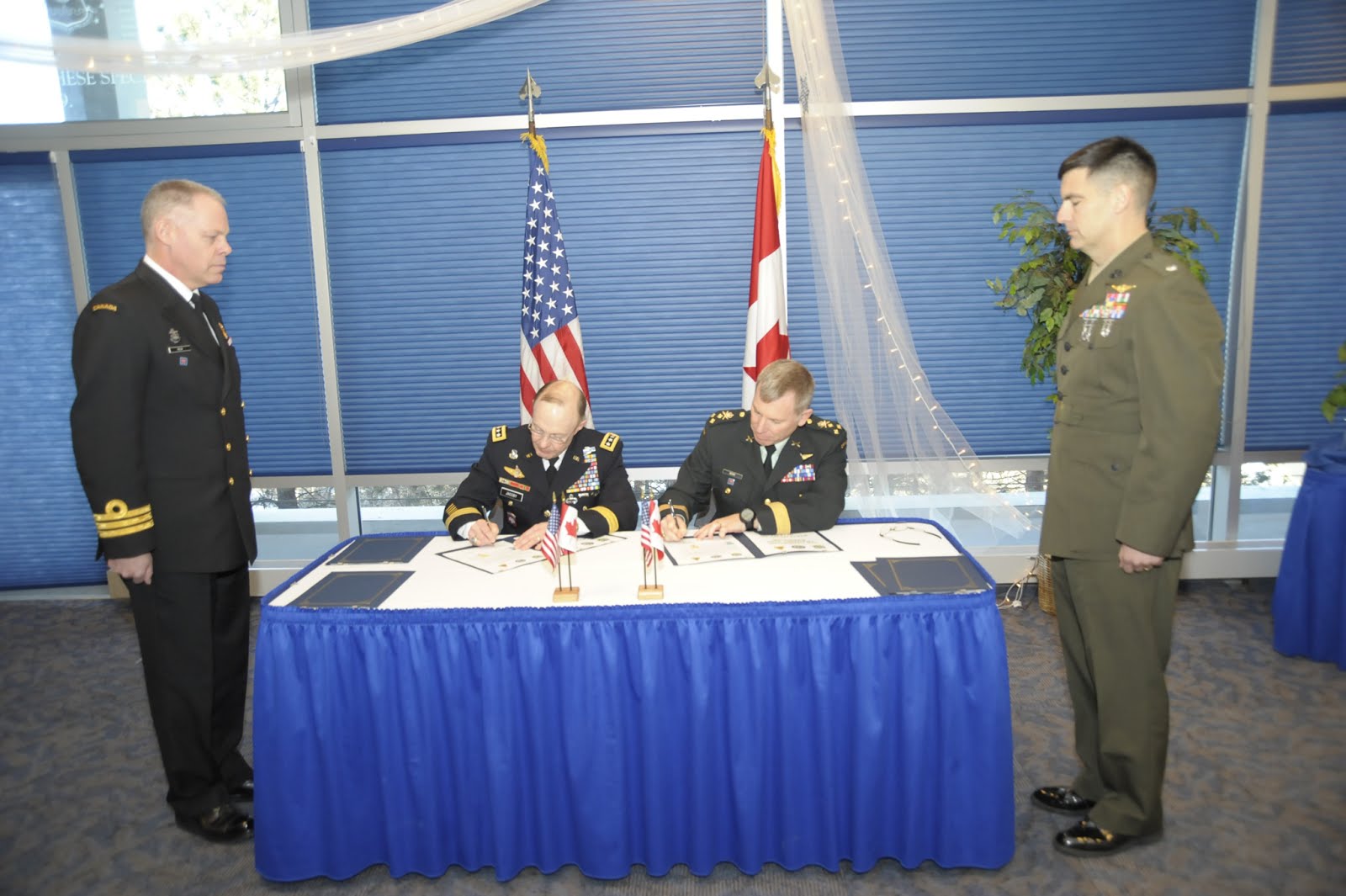
The Arctic has become an important part of North American perimeter security. Recently, the U.S. and Canada signed two new agreements that will expand bilateral military training, security and defense operations in the region. Both countries are working together to prepare for any real or perceived threats and are moving towards merging their Arctic foreign policies.
On December 11, 2012, the U.S. and Canada signed the Tri-Command Framework for Arctic Cooperation which will further integrate United States Northern Command (USNORTHCOM), Canadian Joint Operations Command (CJOC) and North American Aerospace Defense Command (NORAD). According to a press release, the framework is designed to, “promote enhanced military cooperation in the Arctic and identify specific areas of potential Tri-Command cooperation in the preparation for and conduct of safety, security and defense operations.” USNORTHCOM, CJOC and NORAD will work more closely in the region with regards to planning, domain awareness, information-sharing, training and exercises, operations, capability development, as well as in the area of science and technology. This also ties in with the Tri-Command Training and Exercise Statement of Intent. The newly signed military document is aimed at, “enhancing joint and combined readiness in support of safety, security and defense missions through combined training and exercises and reinforcing partnerships and collaboration among the Commands.”
The latest U.S.-Canada military agreements are part of the Tri-Command strategy and demonstrate the importance being placed on the Arctic. The Tri-Command Vision has previously called for USNORTHCOM, NORAD and Canada Command which has now been replaced by CJOC to, “Improve unity of effort with each other and with our respective mission partners; develop a culture of continuous collaboration and cooperation in planning, execution, training, information management, and innovation; enhance intelligence and information sharing and fusion.” In order to better achieve these objectives, “The Commands shall develop and share comprehensive, situational awareness and a common operating picture, and must strive to interact seamlessly with each other and with our respective civil authorities, non-governmental organizations and other mission partners.” The Tri-Command is part of efforts to merge both countries, security and military priorities under the umbrella of a single, U.S.-dominated North American Command.
As part of the April 2011 U.S. Department of Defense Unified Command Plan, responsibility for the Arctic region is now shared between USNORTHCOM and USEUCOM. With the move, USNORTHCOM was given the primary task of planning and advocating for future Arctic capabilities, as well as engaging with stakeholders across the U.S. military, other agencies and international bodies. This is significant considering USNORTHCOM’s partnership with CJOC, along with NORAD and was instrumental in the development of the Tri-Command Framework for Arctic Cooperation. In an example of what we can expect with regards to joint Arctic security, Canada’s 2010 military sovereignty exercise, Operation Nanook included the U.S. and Denmark. The Arctic is also an emerging issue for the NATO alliance. Canada and the U.S., along with other NATO member countries have participated in the annual Cold Response war games. Strengthening its military presence in the region and enhancing security collaboration with Canada and other northern partners has become an essential component of America’s Arctic strategy.
In mid-2013, Canada will begin chairing a two-year term of the Arctic Council with the U.S. assuming the leadership role from 2015–17. Many view this as an opportunity for both countries to advance a North American Arctic agenda. The intergovernmental forum which also includes Denmark, Finland, Iceland, Norway, Sweden and Russia promotes cooperation, coordination and interaction among the Arctic states. The Arctic Council has signed an Agreement on Cooperation in Aeronautical and Maritime Search and Rescue which became the first legally binding deal ever negotiated between all the eight Arctic nations. As far as military and security concerns go, in April 2012, Canada hosted a meeting of the Northern Chiefs of Defence to discuss shared Arctic interests. This included common safety and security issues in the region such as emergency response and support to civilian authorities. The conference provided a setting to hold multilateral and bilateral talks focused on the Arctic and there are calls to have similar meetings on a regular basis.
The U.S. and Canada share similar goals and concerns in the Arctic and are further building up their military presence in the region. With a strategic framework in place, both countries are working towards establishing a North American Arctic foreign policy. At times, Canadian and Russian rhetoric in regards to Arctic sovereignty has been reminiscent of the Cold War era. Rising tensions could further escalate the militarization of the far north. Increasing diplomatic efforts is the key to building the foundation for more multilateral cooperation in the area. While the process to resolve territorial disputes and the scramble to secure resources has thus far been peaceful, the Arctic still remains a potential flashpoint for conflict.
Related articles by Dana Gabriel
Strengthening U.S.-Canada Security Interests in North America
Future U.S.-Canada Joint Arctic Security and Control
NATO Arctic Security and Canadian Sovereignty
Perimeter Security and an Integrated North American Command
Dana Gabriel is an activist and independent researcher. He writes about trade, globalization, sovereignty, security, as well as other issues. Contact: beyourownleader@hotmail.com Visit his blog at Be Your Own Leader
Vatican calls for world government and a New World Order
by Andrew Puhanic, Contributor
Activist Post
December 10, 2012
 The leader of the Catholic Church, Pope Benedict XVI, has called for the establishment of World Government and a New World Order.
In a speech made at the Pontifical Council for Justice and Peace on Monday December 3 2012, the Pope called for the “construction of a world community, with a corresponding authority,” to serve the “common good of the human family”.
As a means of defending global peace and justice, the pope’s vision for the establishment of World Government and a New World Order is supposedly not to create a new superpower, but a new governing body that offers to those (politicians) who are responsible for making decisions, criteria for judgment and practical guidelines.
The Pope was quoted as saying:
The proposed body (World Government) would not be a superpower, concentrated in the hands of a few, which would dominate all peoples, exploiting the weakest.
The Pope also described his vision as a “moral force” or moral authority that has the “power to influence in accordance with reason, that is, a participatory authority, limited by law in its jurisdiction.”
These latest remarks made by the Pope and the Catholic Church come as no surprise considering that in 2010 the Catholic Church sought the establishment of a new Central World Bank that would be responsible for regulating the global financial industry and the international money supply.
It was reported that the Vatican sought “a supranational authority” which would have worldwide scope and “universal jurisdiction” to guide and control global economic policies and decisions.
China’s new push for closer ties with Russia, the growing intrusions from the United Nations with regards to control of the Internet and the latest remarks made by the Catholic Church all point to a new world order that will set in stone a path the world may not be able to recover from.
Andrew Puhanic is the founder of the Globalist Report. The aim of the Globalist Report is to provide current, relevant and informative information about the Globalists and Globalist Agenda. You can contact Andrew directly by visiting the Globalist Report
CrossTalk: Selective Justice [video]
Russia Today
December 12, 2012
Is the International Criminal Court unfair and biased? Is it really about geopolitics? The US refuses to sign up as member of the court while proclaiming itself a nation governed by the rule of law. Is this hypocrisy? A vast majority of investigations at the ICC come from Africa — but surely there have been other major crimes committed in other parts of the world. So why aren’t they looked into? CrossTalking with Lawrence Douglas, William Keylor and George Szamuely.
Follow Peter Lavelle on Twitter http://twitter.com/PLCROSSTALK
Watch all CrossTalk shows here:
http://www.youtube.com/playlist?list=PL75A81D67D2955F81 (Sep 2009 – Feb 2011)
http://www.youtube.com/playlist?list=PLPszygYHA9K12YqkZDcnaHfDd5cptKhs9 (Mar 2011 – Jul 2012)
http://www.youtube.com/playlist?list=PLPszygYHA9K1wI7Kcpxfq6NviCKYKjXAn (Jul 2012 – current)
RT LIVE http://rt.com/on-air
Subscribe to RT! http://www.youtube.com/subscription_center?add_user=RussiaToday
Like us on Facebook http://www.facebook.com/RTnews
Follow us on Twitter http://twitter.com/RT_com
Follow us on Google+ http://plus.google.com/+RT
RT (Russia Today) is a global news network broadcasting from Moscow and Washington studios. RT is the first news channel to break the 500 million YouTube views benchmark.

 PN
PN 