
Transcendence and DARPA’s Restoring Active Memory
by Tony Cartalucci
LocalOrg

July 15, 2014 (LocalOrg) – In the movie “Transcendence,” the lead character, an artificial intelligence researcher, is uploaded to a super-computer before his body dies. His consciousness survives and his mind, unencumbered by the weakness of his physical body, begins expanding exponentially. While science fiction, the movie’s premise is not entirely impossible. While the human brain is highly complex, accessing it, decoding it, and interfacing with it has long-ago already begun.
The US Department of Defense’s Defense Advanced Research Projects Agency or DARPA, has announced its “Restoring Active Memory (RAM)” project – which intends to develop a prosthetic for the brain to record and store memories for those with degenerative neurological conditions such as Alzheimer’s disease or victims of traumatic brain injuries (TBIs).
Science Daily in its article, “DARPA taps Lawrence Livermore to develop world’s first neural device to restore memory,” reported:
The research builds on the understanding that memory is a process in which neurons in certain regions of the brain encode information, store it and retrieve it. Certain types of illnesses and injuries, including Traumatic Brain Injury (TBI), Alzheimer’s disease and epilepsy, disrupt this process and cause memory loss. TBI, in particular, has affected 270,000 military service members since 2000.
The goal of LLNL’s work — driven by LLNL’s Neural Technology group and undertaken in collaboration with the University of California, Los Angeles (UCLA) and Medtronic — is to develop a device that uses real-time recording and closed-loop stimulation of neural tissues to bridge gaps in the injured brain and restore individuals’ ability to form new memories and access previously formed ones.
The research is funded by DARPA’s Restoring Active Memory (RAM) program.
In essence, RAM would also allow humans to expand their brains into non-organic systems. While the project states it intends to restore memory function to those with deficiencies, the same prosthetic could also be used to expand the memory capacity of people with normal brain functions. While the device currently is intended to be an implant, future reiterations may include external devices either linked physically or perhaps even wirelessly. The implications may lead to devices and systems that allow our “minds” to expand beyond the physical confines of our biological brains, opening the doors to both great opportunities and equally frightful threats.
Threats and Opportunities
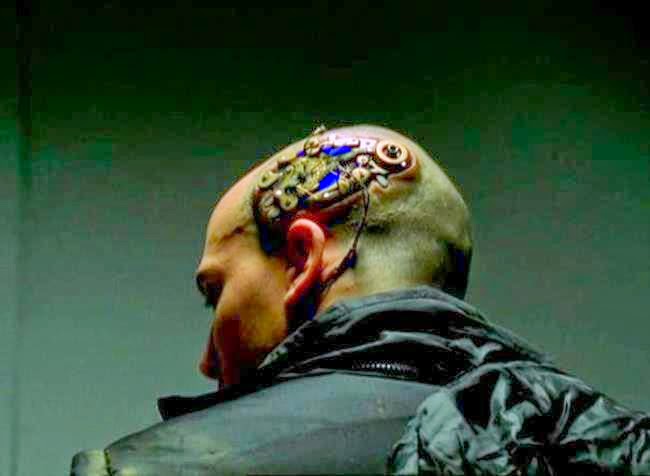
For starters, the digitization of our neurology opens the doors to all the threats and opportunities that befall or benefit existing digital devices, including those connected to the Internet. Collaboration, control, viruses, hacking, surveillance, exponential intellectual progress, personal empowerment, and even human-drones are all in the cards.
And while a climatic and apocalyptic “war with the machines” lingers menacingly in the back of our collective minds, what if devices like that which DARPA is developing led to man merging with machines instead? There would be no war with machines, we would be the machines.
In this context, we face two possible futures: one like that portrayed in science fiction films like Terminator or the Matrix where humans hide amid the ruins of their once proud civilization fighting a desperate resistance against far superior machines that turned on them, or a future like that portrayed in the Japanese anime films and series, Ghost in the Shell. In the latter, the lines are blurred between man and machine and a tenuous balance of power is maintained throughout human civilization, between extremes of both organic and cybernetic natures.
With advances like that announced by DARPA, the latter scenario is the most likely one. A merge between man and machine is the most likely scenario – whomever controls cybernetic technology however, will determine how utopian or dystopian our future will be. Currently, DARPA and other corporate-financier monopolies control this research and technology, while they monopolize other realms of scientific progress including molecular biology, genetic engineering, and information technology. This power in such few hands is surely a recipe for disaster – at least for those without access or say in how the technology is used – or in other words – for the vast majority of us.
A consumerist paradigm that has neurological implants tied to our information technology infrastructure would lead to abuses that would make the NSA’s current overreaching authority look placid in comparison. It could also transform our military’s abilities into the most effective and most horrifying of both human and drone combat.
Instead, this technology must be democratized, ofpened up, and disseminated across society. People to be fully free and in charge of their destiny must not focus on “democracy” and “civil literacy,” but rather on technological literacy, as it is technology that forms the foundation upon which modern society is built and controlled. If we want a say in this modern, technological society, we must understand how it works – currently such an understanding lies in so few hands.
We will not “un-invent” neurological implants that expand the landscapes in which our minds may occupy. We can either choose to boldly embrace and take control of such technology, or cower and complain as others leverage this technology against us to cement an ever expanding disparity between their domination of humanity, and our subservient futility under their dominion.
Robot Olympics Planned For 2020 Powered By Japans’ ‘Robot Revolution’ — video included
by Lucas Cort
Canadian Awareness Network
Aug 3, 2014

ROBOT OLYMPICS PLANNED FOR 2020 POWERED BY JAPAN’S ‘ROBOT REVOLUTION’
Written By: Jason Dorrier – Posted: 08/2/14 8:00 AM
Japan likes robots. And while some Americans raised on a confusing sci-fi diet of Star Wars, Terminator, and iRobot are perhaps a little wary of advanced AI and robotics—Japan simply can’t wait for the “robot revolution.”
In a recent tour of Japanese robotics firms, Japanese prime minister Shinzo Abe declared his intention to create a government task force to study and propose strategies for tripling the size of Japan’s robotics industry to $24 billion.
And one more thing, Abe said, “In 2020, I would like to gather all of the world’s robots and aim to hold an Olympics where they compete in technical skills.”
While mere mortals compete in the 2020 summer Olympics in Tokyo—in a stadium somewhere nearby, the world’s most advanced robots may go head to head in events showcasing their considerable prowess (hopefully by then, right?).
Holding an all-robot competition is by no means a new idea. A number of competitions exist. These range from fun (RoboCup and RoboGames) to serious (the DARPA Robotics Challenge). And recently, a Swiss group announced they’ll host a 2016 Olympics of robotically enhanced humans called Cybathlon.
Incentivized competitions can lead to advancements. The Ansari X PRIZE or DARPA Grand Challenge in autonomous cars, for example, whipped up excitement, real improvements, and the teams competing went on to form more permanent projects.

Now, we have Virgin Galactic and Google’s self-driving cars.
Currently, the highest profile competition in robotics is the DARPA Robotics Challenge. The contest, whose first round took place in December, incentivizes teams to engineer useful, autonomous bots to be used in disaster zones. Tasks include climbing ladders, driving cars, using tools, and navigating uneven terrain.
But the current landscape in robotics is a mixed bag. To the untrained eye, the DRC’s bots may appear slow, clumsy, and at odds with viral videos of robots like Boston Dynamics’ bipedal Petman (in fatigues, Petman looks like Terminator in beta).
Don’t get me wrong, these robots are amazing. But beyond performing simple tasks (for humans) like balancing and walking, robots aren’t very autonomous or skilled outside the lab. And power is a perennial challenge.That said, while we’re still dreaming about owning C-3PO, it isn’t accurate to say that robotics hasn’t already had a significant impact. Industrial robots have been invading manufacturing plants for years, and as they’re becoming more and more intelligent and aware of their environments, they’re also becoming more ubiquitous.
Foxconn, China’s controversial maker of the iPhone (and many other industrial products), makes no bones about its plans to replace as many human workers as it can in the coming years. The firm recently said 10,000 of their homegrown Foxbots are set to begin work soon, and in the future, 30,000 more will come online annually.
And even absent Abe’s proclamation, Japan is already a mecca for advanced robotics engineering and robot culture.
Big Japanese tech firms like Toshiba, Hitachi, and Toyota all work on robots. Indeed, the robot that dominated the DRC’s first round, SCHAFT, is the creation of a Japanese firm since acquired by Google. And did I mention Japanese plans to build a 60-foot moving Gundam robot (from the classic anime series Mobile Suit Gundam) by 2019?
The robotics revolution is already underway, and it’s only going to accelerate from here.
While a 2020 Tokyo Robolympics (if it happens) might be a great incentive to innovate further, it might also showcase robots already capable of feats that seem only a distant possibility given today’s level of capability. After all, self-driving cars went from failing to finish the DARPA course in 2004 to logging 140,000 miles on public roads by 2010.
Image Credit: Humanrobo/Wikimedia Commons
Read More Here

 PN
PN 
