
PODCAST — Remedy Roundtable 04- with Joe Atwill, Bill Joslin, Ryan Gilmore and Jan Irvin – “Psychopaths: The Morally Insane” – #211 | Gnostic Media
Gnostic Media
Sept 2, 2014

This episode is Remedy Roundtable 04, titled: Psychopaths: The Morally Insane.
Released on Thursday, August 14, 2014, Recorded on Monday, August 18.
In this series we have an international team with the Joe Atwill – the author of Caesear’s Messiah, who’s been on many times before; Bill Joslin from Canada – whom we introduced a few weeks ago with our video Meditation: Deconstructing Nonsense; and also Ryan Gilmore – host of Inside Out Asylum, in the UK. Both Joe and I are in Southern California.
Joe Atwill’s websites:
www.caesarsmessiahdoc.com
http://caesarsmessiah.com/
http://caesarsmessiah.com/blog/
Ryan Gilmore’s website:
http://insideoutasylum.com/
Trivium Education:
www.triviumeducation.com
Notes for this episode:
Past episodes:
Dr. James DeMeo interview – “Saharasia, Pt. 1″ – #007 – members only.
Dr. James DeMeo interview – “Saharasia, Pt. 2″ – #009 – members only.
Saharasia book:
http://astore.amazon.com/gnosmedi-20/detail/0962185558
A Conversation on LSD:
https://www.youtube.com/watch?v=_qaumQvMWBA
How To Become A Cult Leader:
https://www.youtube.com/watch?v=K4oEYQhtsYw
Well-known but misleading movie portrayals:
Psycho (1960) (Norman Bates)
• depicts psychopaths as having multiple personality disorder
slasher movie villains (70s & 80s) (Jason Voorhees, Freddy Kruger, Michael Myers)
• deranged and manic criminally insane killers. Could be classed as psychopaths, but are very rare in the real world.
Silence of the Lambs (1991) (Hannibal Lector) (nb. Manhunter (1986) is more accurate)
• Links psychopathy to cannibalism.
American Psycho (2000) (Patrick Bateman)
• gives the impression that psychopaths are psychotic and hallucinate.
Accurate movie portrayals:
Gaslight (1944) (Gregory Anton)
• A psychopath marries a woman to get at her jewels, and convinces her she is insane.
Clockwork Orange (1971) (Alex)
• The state using aversion therapy to control a psychopath. It doesn’t work.
The Devils (1971) (Urbain Grandier)
• portrayed as a victimised hero in the Ken Russell film and in the source novel (Aldous Huxley’s The Devils of Loudun (1952)) (see chapter 5 of Thomas Sheridan’s Defeated Demons (2012). Sheridan argues that Huxley is a psychopathic author defending the actions of a psychopathic character from history, and that the charming and sexually promiscuous Grandier was the real cause of chaos and strife at Loudun in 1634).
To Die For (1995) (Suzanne Stone)
• Dr. Robert Hare consulted Nicole Kidman on her character
The Talented Mr Ripley (1999) (Tom Ripley)
The Imposter (2012 documentary) (Frédéric Bourdin)
• low-level con man, who constantly changed his identity, spins an amazing web of lies on camera
Accurate symbolic fictional portrayals:
Some fantasy stories evoke the emotional realism of a psychopath using symbolism:
Bram Stoker’s Dracula (1897) (nb. Count Dracula is in part based on real-life actor Sir Henry Irving)
• drains life energy from victims (blood drinking)
• can spread his psychopathy (by biting victims)
• cannot self reflect (no reflection in mirrors)
• can assume different personalities (shapeshifter)
• able to seduce others (usually presented as very attractive to women)
Children’s Fairytales (various wicked stepmothers, imps, and wolves) Example: Rumpelstiltskin (16th century?)
• predatory lender (creates gold out of thin air for the miller’s daughter in exchange for her life and first born child)
• uninterested in riches, really interested in human ownership and control
• Is defeated when protagonist becomes aware of who he really is (when she finds out his real name, a way of bringing something clearly into consciousness, the ‘spell’ on her is broken)
Marshall McLuhan: Classical Trivium
Adrian Raine’s “Anatomy of Violence”
Send Bitcoin donations for this episode to:
12EQTDMzU5mxtEd8ZfyrHrxABZi3jtaCCo
Please make other forms of donations here:
http://www.gnosticmedia.com/donate/
Donations. This episode is brought to you by:
Oscar
Luis
Joseph
Paul
Brandon
Carlos
Adam
BTC:
1HzfM
1HsQz
Podcast: Play in new window | Download (Duration: 2:33:45 — 141.0MB) | Embed
Nanotechnology: Are You Ready To Be Reengineered? w/infographic
by Nicholas West
Activist Post
May 24, 2014
Nanotechnology is probably not the reading material sitting on the coffee tables of most people. Yet, it is already beginning to have an impact on everything from electronics to alternative energy to food, cosmetics and clothing. In fact, several hundred common products contain nanomaterials, which has prompted lawsuits against the FDA for failure to properly regulate them.
For futurists and Transhumanists, the human body is the final frontier.
The nanotech revolution has been heavily invested in by the U.S. government, as outlined in their National Nanotechnology Initiative Strategic Plan, which involves 20 federal agencies and partners. This must-read document lays out a projected future to understand and control matter for the management of every facet of the environment, health and safety.
We are beginning to see the dividends being paid to Big Pharma through edible nano-sized microchips and other “smart” pills aimed to surveil the internal workings of the body, and one day perhaps completely reengineer humanity from the atomic level on up … including the brain.
The infographic below offers a comprehensive overview of how this reengineering will take shape. Now is the time to start paying close attention to these developments, as what has been considered to be science fiction conspiracy theory thus far is now being openly discussed on the world stage as Humans 2.0.
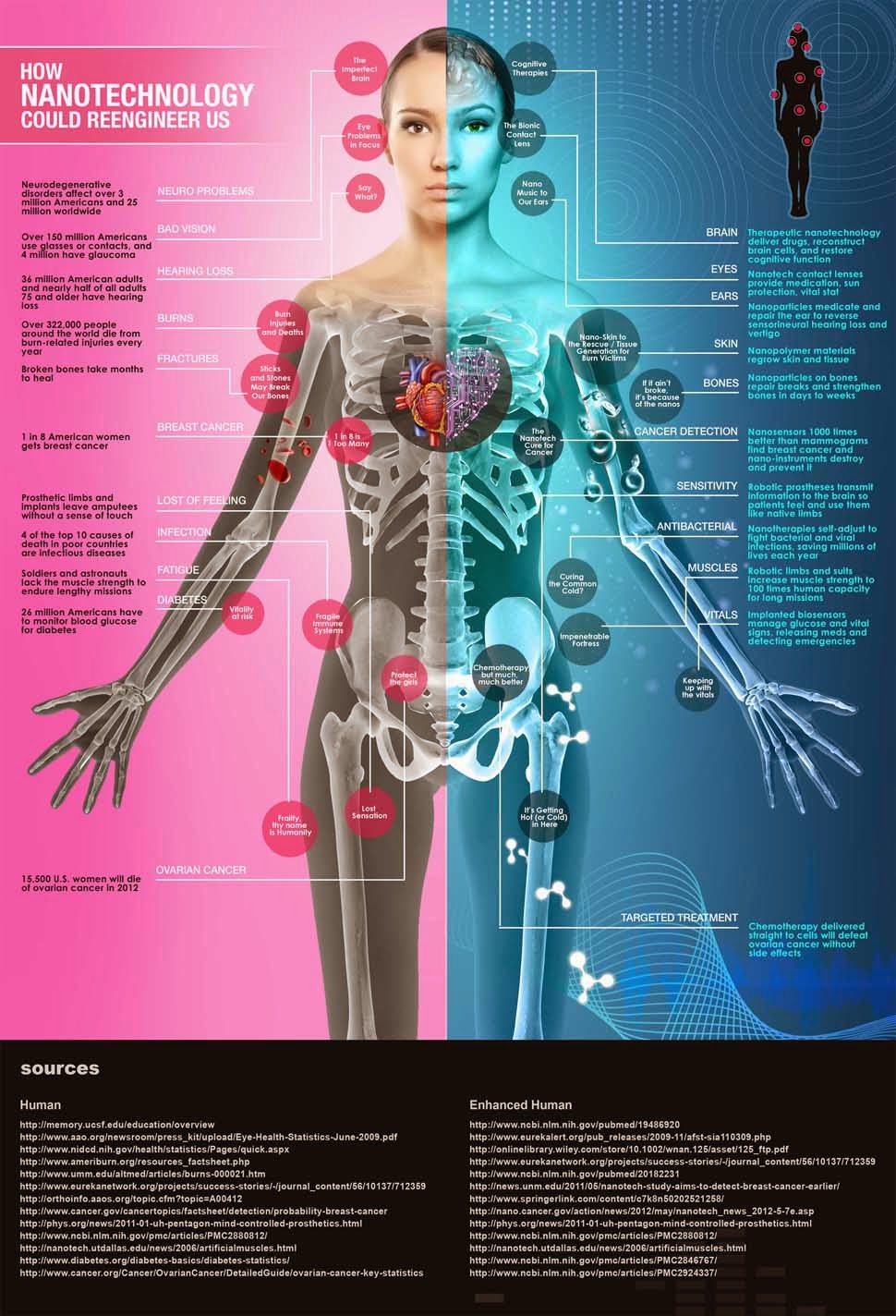
Source, and for larger image:
How Nanotechnology Could Reengineer Us – Keithley Instruments
Hat tip: 33rd Square
Recently by Nicholas West:
Researchers Achieve First Successful Telepathic Transfer
Zen Gardner
Aug 22, 2014

by Nicholas West
There has been much speculation about what could be achieved in the area of human brain-to-brain transfer of information.
A series of studies have intimated at the possibilities:
- Brain-to-Brain Control Established Between Humans and Animals at Harvard
- Remote Controlled Humans Via Internet Now a Reality
- New Mind Reading Research Aims to Synchronize Humans
Now an international team is declaring a successful brain-to-brain data transfer between a person sitting in India to a receiving person in France.
The evolution of civilization points to a progressive increase of the interrelations between human minds, where by “mind” we mean a set of processes carried out by the brain [1]. Until recently, the exchange of communication between minds or brains of different individuals has been supported and constrained by the sensorial and motor arsenals of our body. However, there is now the possibility of a new era in which brains will dialogue in a more direct way [2]. … Pioneering research in the 60′s using non-invasive means already demonstrated the voluntary control of alpha rhythm de-synchronization to send messages based on Morse code [11]. Over the last 15 years, technologies for non-invasive transmission of information from brains to computers have developed considerably, and today brain-computer interfaces embody a well-established, innovative field of study with many potential applications[12]–[16]. Recent work has demonstrated fully non-invasive human to rat B2B communication by combining motor imagery driven EEG in humans on the BCI sidewith ultrasound brain stimulation on the CBI-rat side [17]. … Here we show how to link two human minds directly by integrating two neurotechnologies – BCI and CBI –, fulfilling three important conditions, namely a) being non-invasive, b) cortically based, and c) consciously driven (Fig. 1). In this framework we provide the first demonstration of non-invasive direct communication between human minds. (emphasis added)
The method used was Transcranial Magnetic Stimulation, which has shown the most promise in directly accessing the brain and “thought.”
The intensity of pulses was adjusted for each subject so that a) one particular orientation of the TMS-induced electric field produced phosphenes [19](representing the “active direction” and coding the bit value “1”), and b) the orthogonal direction did not produce phosphenes (representing the “silent direction” and coding the bit value “0”). Subjects reported verbally whether or not they perceived phosphenes on stimulation.
This resulted in online data transfer from mind to mind to mind – telepathic e-mail, essentially:
On March 28th, 2014, 140 bits were encoded by the BCI emitter in Thiruvananthapuram and automatically sent via email to Strasbourg, where the CBI receiver (subject 3) was located. There, a program parsed incoming emails to navigate the robot and deliver TMS pulses precisely over the selected site and with the appropriate coil orientation. A similar transmission with receiver subject 2 took place on April 7th, 2014. In both cases, the transmitted pseudo-random sequences carried encrypted messages encoding a word – “hola” (“hello” in Catalan or Spanish) in the first transmission, “ciao” (“hello” or “goodbye” in Italian) in the second. Words were encoded using a 5-bit Bacon cipher [31] (employing 20 bits) and replicated for redundancy 7 times (for a total of 140 bits). The resulting bit streams were then randomized using random cyphers selected to produce balanced pseudo-random sequences of 0′s and 1′s (for subject blinding and proper statistical analysis purposes in addition to providing word-coding). On reception, de-cyphering and majority voting from the copies of the word were used to decode the message.
All of this is a technical way of saying that, for the first time, not only has there been a signal transfer representing data, the potential has opened up for the transmitting of emotions – a mind-to-mind transfer, not merely brain-to-brain.
Learning a Second Language Staves off Cognitive Decline
 by Elizabeth Renter
Natural Society
Aug 23, 2014
Do you speak more than one language? If so, you could be less likely to suffer from age-related cognitive decline, as reported by recent research. If you don’t speak another language, don’t worry; it’s never too late to learn!
According to a new study published in the Annals of Neurology, knowing more than one language can help protect your brain from decreased performance later in life. And the evidence says you can even reap the benefits if you don’t learn the language until later in adulthood.
“Our study is the first to examine whether learning a second language impacts cognitive performance later in life while controlling for childhood intelligence,” said lead researcher Dr. Thomas Bak of the Centre for Cognitive Aging and Cognitive Epidemiology at the University of Edinburgh.
Spiral Of Silence Also Exists On Social Media: Pew Poll
redOrbit
Aug 27, 2014

Image Credit: Thinkstock.com
April Flowers for redOrbit.com – Your Universe Online
In our social circles – especially among family, friends and co-workers – we have a tendency to hold in our views on public policy issues. This is especially true when we think our own opinion isn’t widely shared in those groups, according to pre-internet human behavior studies. Scientists call this phenomenon the “spiral of silence.”
The hope for social media sites such as Facebook and Twitter was that they would provide such a wide variety of discussion forums that people holding minority views would feel free to express their opinions. Such freedom would broaden public discourse and add new perspectives to the discussions.
The Pew Internet Research Project studied the effect of social media on the spiral of science by conducting a survey of 1,801 adults in 2013. The survey was restricted to one public policy issue: Edward Snowden’s 2013 revelations of widespread government surveillance of Americans’ phone and email records. Other Pew Research polls showed the division Americans were feeling over this issue, making it a timely question for the survey. These studies found that Americans were conflicted over both whether the information leaks were justified and whether the NSA policy itself was appropriate or not. One survey, for example, found that 44 percent say that the classified information leak harms the public interest, while 49 percent said it serves the public interest.
The current survey asked questions about people’s opinions about the Snowden leaks, how willing they were to discuss the revelations in various in-person and online situations, and their perceptions of their peers’ views both online and in-person.
The results showed the following key findings:
• More people were willing to discuss the Snowden-NSA story in person than on social media — 86 percent were willing to discuss it in person, while only 42 percent of Facebook or Twitter users were willing to post about the issue.
• For those not willing to discuss the issue in person, social media did not provide an alternative platform. Only 0.3 percent of the 14 percent who were unwilling to discuss the issue face to face would post about it on social media.
• In both forums, people are more willing to share their views if they believe their audience agrees. People who believe their co-workers share their opinion were three times more likely to join a workplace conversation.
• Previous findings on the spiral of silence apply to social media platforms. Facebook users were twice as likely to join a conversation about the Snowden-NSA issue if they believed their followers agreed with them.
• Social media users were less likely to share their views in face to face settings, especially if they thought their social media followers disagreed with them. The average Facebook user is half as likely to share their opinion as other people.
PODCAST — Remedy Roundtable 02- with Joe Atwill, Bill Joslin, Ryan Gilmore and Jan Irvin – “Common Ground” – #207 | Gnostic Media
Gnostic Media
Aug 14, 2014
This episode is our second edition of Remedy Roundtable 02, titled: Common Ground.
Released on Thursday, August 14, 2014, and was recorded on Tuesday, August 12, 2014.
In this series we have an international team with the Joe Atwill – the author of Caesear’s Messiah, who’s been on many times before; Bill Joslin from Canada – whom we introduced a few weeks ago with our video Meditation: Deconstructing Nonsense; and also Ryan Gilmore – host of Inside Out Asylum, in the UK. Both Joe and I are in Southern California.
Joe Atwill’s websites:
www.caesarsmessiahdoc.com
http://caesarsmessiah.com/
http://caesarsmessiah.com/blog/
Ryan Gilmore’s website:
http://insideoutasylum.com/
Trivium Education:
www.triviumeducation.com
Notes for this episode:
Christine Lagarde speech:
https://www.youtube.com/watch?v=QYmViPTndxw
From Socioecohistory.wordpress.com:
“7” references:
1:22 – “Now I’m going to test your numerology skills by asking you to think about the magic seven”
1:34 – “Most of you will know that seven is quite a number
2:24 – “2014, you drop the zero, fourteen, two times, seven”
4:08 – “It will mark the 70th anniversary, 70th anniversary, drop the zero, seven, of the Bretton Woods Conference that actually gave birth to the IMF” (7 + 0 = 7)
4:22 – “And it will be the 25th anniversary of the fall of the berlin wall, 25th..” (2 + 5 = 7)
4:38 – “It will also mark the 7th anniversary of the financial market jietters”
5:08 – “After those seven miserable years, weak and fragile”
5:14 – “We have seven strong years”
5:43 – “Now I don’t know if the G7 will have anything to do with it” (G is also the 7th letter of the alphabet)
–
“2014” references:
1:18 – “The global economy and what we should expect for 2014″
2:19 – “So if we think about 2014″
2:24 – “2014, you drop the zero, fourteen, two times, seven”
3:54 – “So 2014 will be a milestone and hopefully a magic year in may respects”
5:05 – “So my hope and my wish for 2014″
Maserati Commercial:
http://www.tinfoilhattime.com/public_html/tinfoilhattime/2014/05/14/is-this-strange-maserati-commercial-an-illuminati-message/
Scientist Working on Gov’t Ebola Drug Joked About Culling Population with GMO Virus
http://youtu.be/awuwG9corF8?t=10m25s
Entire:
https://www.youtube.com/watch?v=Nb0p9BDZN2U
https://www.youtube.com/watch?v=awuwG9corF8
Terence McKenna audio clip:
http://youtu.be/_IO7pHD3X9M?t=1h11m5s
“The Mushroom said. […] But since you brought it up. […] I would be very interested in seeing a set of social policies, tax incentives, medical policies, insurance policies, put in place to limit male birth. […] This is the way to feminize the human race. […] I’m a feminist. […] AS A HUMANIST I advocate a reduction in male birth.”
~ Terence McKenna
Cryptography
http://www.gnosticmedia.com/kristov-atlas-anonymous-bitcoin-cryptography-safety-203/
http://www.gnosticmedia.com/kristov-atlas-interview-pt-2-anonymous-bitcoin-cryptography-online-safety-204/
G. Edward Griffin / Yuri Besmenov video
https://www.youtube.com/watch?v=Srw3YSda1XY
Alan Watts: Double Bind
https://www.youtube.com/watch?v=BsI04FhF418
https://www.youtube.com/watch?v=QXX8XaZ8vV4
Gregory Bateson: Double Bind
http://en.wikipedia.org/wiki/Double_bind
“This, then, is where Eastern spirituality entered Bateson’s approach to psychiatry, as a means of expanding the discursive field beyond the modern self. And here it is interesting to bring in tow more English exiles to California, Alan Watts and Aldous Huxley. Watts was a very influential commentator on and popularizer of Zen Buddhism in the United States in the 1950s, and he was also a consultant on Bateson’s schizophrenia project.”
Jiddu Krishnamurti
https://www.youtube.com/watch?v=vONKWdfj_hg
“Knowledge seems so utterly nonsense to me”
~ Jiddu Krishnamurti
Aldous Huxley Letter to Alan Watts:
To Alan Watts:
In regard to research, I think we should make it quite clear that there is no intention of undertaking any micro-physiological investigations of the nerves, electric potentials etc, and that what we are interested in is the ‘molar’ phenomena of the human organism as a whole.
17 October, 1952
A Molar Approach to Social Knowing
Abstract
Exemplary research in social cognition and perception is examined. It is suggested that a singular focus on internal, intraindividual cognitive and perceptual processes is not sufficiently broad to account adequately for the spectrum of social knowing phenomena. A more molar approach to social knowing than can be found in contemporary work in social cognition and perception is advocated. More specifically, it is suggested that work on molecular cognitive and perceptual processes will help elucidate basic social knowing phenomena only when such processes are meaningfully tied to the social contexts in which they, occur and to ongoing social behavior.
http://psp.sagepub.com/content/6/4/574.abstract
Studying phenomena at the “molar” level is a term used in behavioral science (e.g. behaviorism). http://en.wikipedia.org/wiki/Behaviorism
Send Bitcoin donations for this episode to:
12EQTDMzU5mxtEd8ZfyrHrxABZi3jtaCCo
Please make other forms of donations here:
http://www.gnosticmedia.com/donate/
Donations. This episode is brought to you by:
Randy
Bill
John
Nicholas
Louis
BTC:
x
Podcast: Play in new window | Download (Duration: 1:57:10 — 107.4MB) | Embed
PODCAST — Remedy Roundtable 01- with Joe Atwill, Bill Joslin, Ryan Gilmore and Jan Irvin – “Navigating the world of Sophistry” – #205 | Gnostic Media
Gnostic Media
Aug 6, 2014
 This episode is our first edition of Remedy Roundtable, titled: Navigating the world of Sophistry.
Released on Wednesday, August 06, 2014, and was recorded on Monday, August 04, 2014.
In this series we’ll be have an international team with the Joe Atwill – the author of Caesear’s Messiah, who’s been on many times before; Bill Joslin from Canada – whom we introduced a few weeks ago with our video Meditation: Deconstructing Nonsense; and also Ryan Gilmore – host of Inside Out Asylum, in the UK. Both Joe and I are in Southern California.
Joe Atwill’s websites:
www.caesarsmessiahdoc.com
http://caesarsmessiah.com/
http://caesarsmessiah.com/blog/
Ryan Gilmore’s website:
http://insideoutasylum.com/
Trivium Education:
www.triviumeducation.com
Send Bitcoin donations for this episode to:
12EQTDMzU5mxtEd8ZfyrHrxABZi3jtaCCo
Please make other forms of donations here:
http://www.gnosticmedia.com/donate/
Donations. This episode is brought to you by:
Fouzi
Dylan
William
M&A
BTC:
1GmTf7
Podcast: Play in new window | Download (Duration: 1:41:27 — 92.9MB) | Embed

 PN
PN 